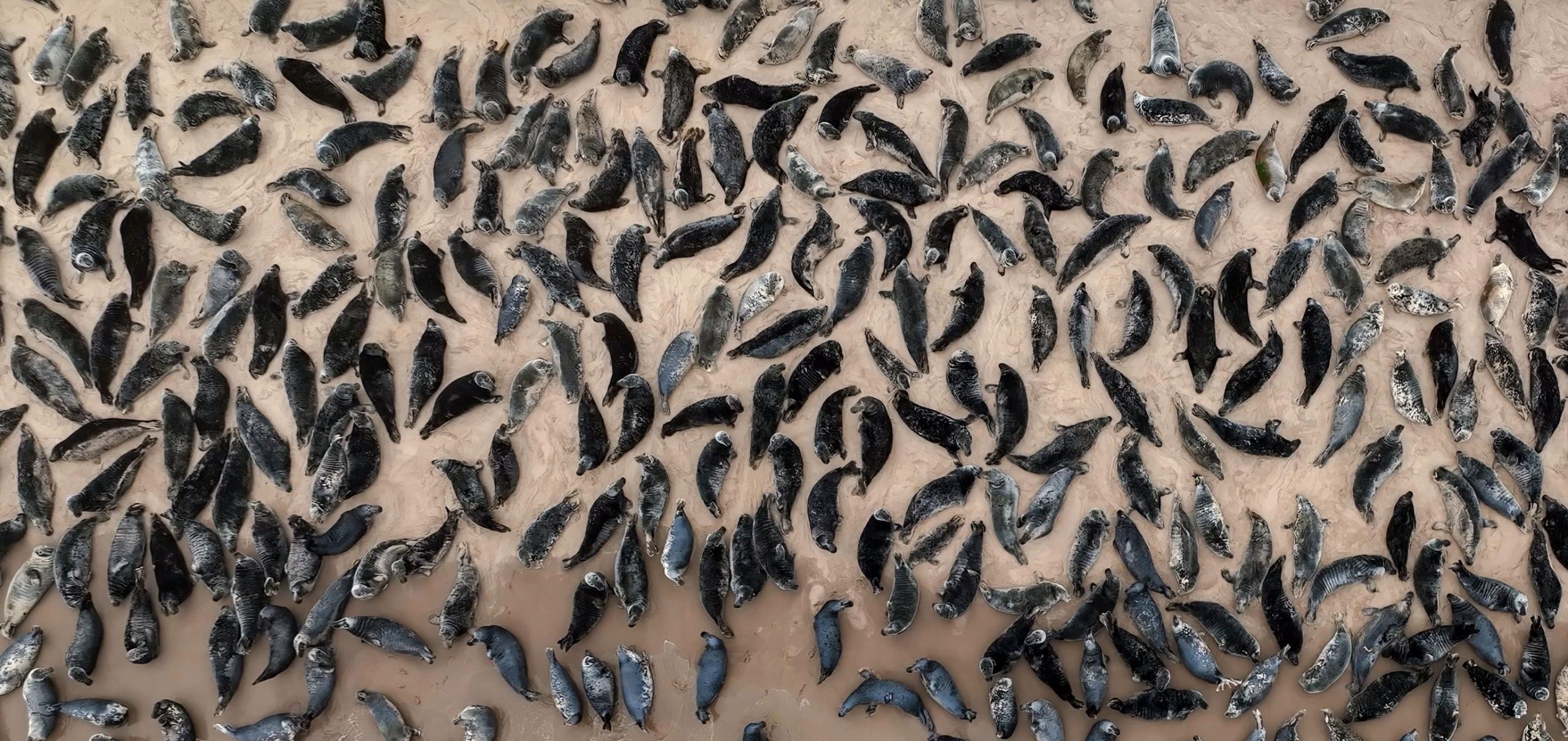
Grey seals at Brion Island
Photo © ORS | Jeffrey Hay Gallant
All Rights Reserved
MEDIA
FOR IMMEDIATE RELEASE

Grey seals at Brion Island
Photo © ORS | Jeffrey Hay Gallant
All Rights Reserved
PRESS RELEASE
AUGUST 11, 2025 | FOR IMMEDIATE RELEASE
Public advisory for divers and other marine users
Increased presence of white sharks in the Gulf of St. Lawrence
Editorial Note: This advisory is not intended to sound the alarm, but rather to raise public awareness of the presence of white sharks through a precautionary message grounded in scientific observation, rather than exaggeration, fear, or sensationalism. Acting solely out of concern for safety and public awareness, we are issuing this advisory in response to numerous media and public enquiries, and in the absence of any official communication on the rise in sightings and confirmed increase in this species’ presence in the St. Lawrence. Any media coverage of this advisory, particularly headlines, should accurately reflect its preventive nature, avoiding any wording likely to generate unwarranted fear or misunderstanding. This advisory also serves as a science-based counterbalance to social media distortions, AI-generated hoaxes, influencer oversimplifications, and misinformation in general.
 MEDIA CONTACT: No interviews will be granted regarding this release. The media may reproduce in full the content of this text as well as the personal commentary of the Scientific Director of the St. Lawrence Shark Observatory.
Gulf of St. Lawrence, August 11, 2025
Over the past week, a reported close encounter between a diver and a white shark (Carcharodon carcharias) in the Magdalen Islands, along with sightings by divers, both underwater and from boats, of severely mutilated seals in Baie des Chaleurs and off the Gaspé Peninsula, have prompted the St. Lawrence Shark Observatory (ORS) to issue this voluntary and non-binding advisory for divers, swimmers, paddlers, and other marine users in the Gulf of St. Lawrence.
ORS has been studying St. Lawrence sharks for over 25 years, including four years of dedicated field research on the white shark in the Magdalen Islands. While concerning, these recent events are part of a broader trend observed throughout the Northwest Atlantic and come as no surprise. In fact, they reflect a wider shift in the distribution and abundance of white sharks over the past decade, as confirmed by recent scientific publications [1, 2], and align with the history of the Indigenous peoples of the Maritime Peninsula, which attests to the presence of the white shark in these waters long before European contact [3].
Although the statistical risk of a shark-related incident in Canada, including in the St. Lawrence, remains low, the likelihood of such encounters is increasing as white sharks repopulate the St. Lawrence and human activity intensifies in their key habitats during peak season.
White shark behaviour and risk factor
Contrary to mindless killing machine portrayed in films such as Jaws, the white shark is a highly evolved hunter equipped with sophisticated sensory systems, specially attuned to identifying its natural prey. The more recent, well-intentioned trend of portraying the white shark as indifferent to humans, and therefore harmless, is equally misleading and oversimplifies the true complexity of its behaviour. In reality, the truth lies somewhere between these two extremes and depends on many variables.
Furthermore, a recent publication [4] also confirms that the white shark does not blindly attack everything it encounters, and that the mistaken identity theory alone cannot account for all bite incidents. The level of risk posed by a white shark in any given situation therefore depends on a range of environmental and behavioural factors, including underwater visibility, the density of natural prey (such as seals), the presence of conspecifics or competitors, or whether the shark is a juvenile learning to hunt marine mammals. Most incidents likely result from an exceptional combination of such circumstances, where the victim unknowingly ends up in the wrong place at the wrong time.
Timing and locations of concern
Until 2021, no unprovoked interaction between a diver and a white shark had ever been substantiated in Canada. Since then, nearly ten encounters have been reported in Nova Scotia, and the one reported on August 2 in the Magdalen Islands (47.838230, -61.145708) would be the first such interaction in the waters of Québec and the Gulf of St. Lawrence. Compounding the risk in the Gulf, is that that certain dive sites, particularly in Québec, are home to some of the largest concentrations of seals in Atlantic Canada. Among these, although less frequently visited, the uninhabited trio of Brion Island, Corps-Mort (Deadman’s) Island, and Rocher aux Oiseaux (Bird Rock), where the encounter reportedly took place, now present a significant risk.
Commentary
“Personally, I would avoid diving in places notoriously rich in seals, such as Rocher aux Oiseaux (Bird Rock), Corps-Mort (Deadman’s) Island, and Brion Island, during the seasonal migration of white sharks in the Gulf, from June to November. These sites have clearly become zones of active predation, comparable to the Farallon Islands off San Francisco, where no diver with any sense of self-preservation would set fin. In such a context, constant mental vigilance and underlying fear would make any dive unenjoyable for most people. As for other Magdalens sites, as elsewhere in the Gulf, in the absence of large gatherings of seals, I would not hesitate to dive, always with a buddy, but I would nonetheless remain vigilant, which is essential during any dive.
It is critical to remember that diver safety depends not only on wildlife behaviour, but also on the diver’s own state of mind. The sudden and unexpected appearance of a shark can trigger panic, especially among less experienced divers. Even if no confrontation occurs, a frightened diver may ascend too quickly, risking serious medical emergencies such as an air embolism or other decompression accidents. Mental preparedness and environmental awareness should therefore be considered just as essential as equipment checks and buddy protocols.”
— Jeffrey Hay Gallant, Scientific Director of ORS
Fortunately, these remote islands of the archipelago, located in the centre of the Gulf, remain beyond the reach of most divers, save for a few adventurers. However, if the white shark population continues to grow, it will only be a matter of time before one is encountered at a popular dive site elsewhere in the Gulf. As such, we believe that proactive adaptation and the dissemination of basic knowledge on shark presence and behaviour, is key to continue diving under safe and enjoyable conditions. Avoiding large gatherings of seals, especially when they remain pressed close to shore (which may indicate the presence of a predator), avoiding murky water, diving with local operators who are familiar with the conditions, and staying informed about sighting reports can help reduce risks considerably. Likewise, swimmers and paddlers should remain alert to the presence of seals and avoid areas where they are concentrated.
Awareness and public safety
The St. Lawrence Shark Observatory (ORS) is neither a public agency nor a government body, and it is therefore not within our official mandate to issue advisories or ensure public safety. However, in the absence of official communication from government agencies regarding the increase in sightings of white sharks and reports of mauled seals in the St. Lawrence, aquatic recreation enthusiasts and the media naturally turn to us for information and reassurance.
Given the sensitive nature of this subject, which can influence public perception, inadvertently spark fear, or affect the decisions of users and coastal communities, we have deemed it necessary to publish this advisory, which ORS issues only with the utmost caution: this is only our second public advisory in over twenty years, the first, in 2005, addressing recreational diving and the Greenland shark (Somniosus microcephalus) in the Baie-Comeau area.
This new advisory, which applies not only to divers and swimmers but to all marine users, is based on field observations and ongoing research conducted by ORS, as well as scientific studies on the white shark, both in Canada and abroad, in similar contexts. In parallel with ongoing efforts across Atlantic Canada, ORS and its partners are initiating the development of a regional campaign focused on shark awareness, conservation, and public safety. In the medium term, this initiative would notably include the installation of informational and warning signs in strategic public and coastal areas, as well as collaboration with various stakeholders to establish a science-based, regionally coordinated awareness and monitoring program. Recognising that this issue concerns all Atlantic Canada, we also aim to contribute to broader initiatives alongside Canadian researchers, fishers, First Nations communities, and public authorities to promote sustainable coexistence between humans and sharks.
Legal protection and responsible conduct
While the renewed presence of the white shark is already prompting some divers and marine users to exercise caution in certain areas, it may also encourage thrill-seekers to pursue this formidable predator, driven by curiosity, the quest for dramatic images, or media attention. It is therefore important to remember that the white shark is a protected species under Canada’s Species at Risk Act (SARA) [3]. As such, it is strictly prohibited to harass a white shark, including by intentionally approaching it at the surface, which could disrupt a predation event or cause injury, flying a drone over it, luring it with bait, or attempting to cage dive without a permit from Fisheries and Oceans Canada (DFO).
We also advise boaters, particularly those in light or inflatable craft, to maintain a minimum distance of 10 metres from any surface activity involving a white shark, especially when it is feeding on a seal or another carcass, as was the case in Gaspé on July 31. A white shark engaged in predation can display energetic and unpredictable behaviour and, in rare cases, may strike a vessel or accidentally bite a pontoon or motor out of curiosity or mistake. This could lead to serious consequences, such as loss of balance or a deflated boat.
Conclusion
It may be reassuring for some to bury their heads in the sand when faced with a situation that, just five years ago, seemed unthinkable. Yet the ocean is undergoing profound change, and we must approach this new reality with calm, realism, and optimism. The marked return of the white shark is a rare sign of hope for the health of the St. Lawrence, even though it poses certain challenges for human activities. By adapting to this evolving situation, understanding the risks, and accepting a few reasonable compromises, we can continue to enjoy the sea while integrating this renewed presence into our activities and cultures, just as Indigenous peoples have done for millennia [6]. In doing so, Canada joins the wider community of “shark nations,” such as Australia and South Africa, where the presence of these powerful predators brings occasional conflict, but also a deeper connection to the living ocean and the wild rhythms that still govern it.
For more information, additional context, or to consult recommendations for divers, swimmers, and other marine users, please visit the ORS Canadian Shark Attack Registry.
No interviews on this topic
Please note that the ORS will not be granting interviews regarding this topic.
As previously stated in earlier advisories and releases, the organisation no longer participates in live media interviews concerning white sharks due to the repeated misinterpretation, sensationalism, and distortion that frequently accompany shark-related coverage. Instead, the ORS will continue to communicate through written statements, scientific publications, background documents, and official press releases intended to ensure clarity, precision, and factual accuracy.
Given the sensitive nature of public safety issues involving large marine predators, verbal interviews and improvised commentary also create significant risks of statements being oversimplified, quoted out of context, or interpreted in ways that do not accurately reflect the position of ORS. Beyond contributing to misinformation and unnecessary sensationalism, such distortions may also carry potential legal and ethical implications in matters relating to public safety. Written communications therefore remain the only format through which ORS is prepared to address this subject publicly.
ORS will continue monitoring developments and will share additional factual updates if warranted.
Jeffrey Hay Gallant, M. Sc.
Founder and Scientific Director
St. Lawrence Shark Observatory
About the Observatory
The St. Lawrence Shark Observatory (ORS), officially founded in 2003 under the name Greenland Shark and Elasmobranch Education and Research Group (GEERG), is Canada’s first independent research organisation and registered charity dedicated to sharks. Entirely volunteer-run, ORS is devoted to the study, awareness, and conservation of sharks inhabiting the Gulf and Estuary of the St. Lawrence. In 2025, the organisation proudly commemorated 25 years since its first field expedition, marking a quarter century of commitment to shark research and conservation in the St. Lawrence and Atlantic Canada. Over the course of its history, ORS has achieved several shark-related firsts in Canada, and even internationally, particularly through its pioneering work on the Greenland shark. In 2022, ORS also founded the Canadian Shark Attack Registry, the first initiative of its kind in Canada dedicated to documenting interactions between sharks and humans in Canadian waters.
Through innovative, non-invasive research integrating field science and historical archives, ORS seeks to build a broader understanding of sharks, both past and present, while promoting rigorous, science-based information free from sensationalism and misinformation. In addition to its research and conservation work, the organisation is actively involved in public education and outreach, particularly among young people, whom it considers the future custodians of sharks and the oceans.
For more information about the history, mission, research, and team of the the St. Lawrence Shark Observatory (ORS), please visit the organisation’s About page.
REFERENCES
(1) Allegue, H., Bordeleau, X., Winton, M. V., Skomal, G. B., Joyce, W., Barajas, V. L., Trudel, M., & Bowlby, H. D. (2025). Systematic assessment of the increasing presence of white sharks in Atlantic Canadian waters. Marine Ecology Progress Series, 761, 145–161. https://doi.org/10.3354/meps14855
(2) Bastien, G., Barkley, A., Chappus, J., Heath, V., Popov, S., Smith, R., Tran, T., Currier, S., Fernandez, D. C., Okpara, P., Owen, V., Franks, B., Hueter, R., Madi19gan, D. J., Fischer, C., McBride, B., & Hussey, N. E. (2020). Inconspicuous, recovering, or northward shift: Status and management of the white shark (Carcharodon carcharias) in Atlantic Canada. Canadian Journal of Fisheries and Aquatic Sciences, 77(10), 1666–1677. https://doi.org/10.1139/cjfas-2020-0055
(3) Gallant, J. (2023. 19 octobre). Registre canadien des attaques de requins (2023:1). Observatoire des requins du Saint-Laurent. https://geerg.ca/fr/attaques-requins
(4) Ryan, L. A., Slip, D. J., Chapuis, L., Collin, S. P., Gennari, E., Hemmi, J. M., How, M. J., Huveneers, C., Peddemors, V. M., Tosetto, L., & Hart, N. S. (2021). A shark’s eye view: testing the ‘mistaken identity theory’ behind shark bites on humans. Journal of the Royal Society, Interface, 18(183), 20210533. https://doi.org/10.1098/rsif.2021.0533
(5) https://publications.gc.ca/collections/collection_2022/eccc/CW69-14-507-2021-eng.pdf
(6) Betts, M. W., Blair, S. E., & Black, D. W. (2012). Perspectivism, Mortuary Symbolism, and Human-Shark Relationships on the Maritime Peninsula. American Antiquity, 77(4), 621–645. https://doi.org/10.7183/0002-7316.77.4.621
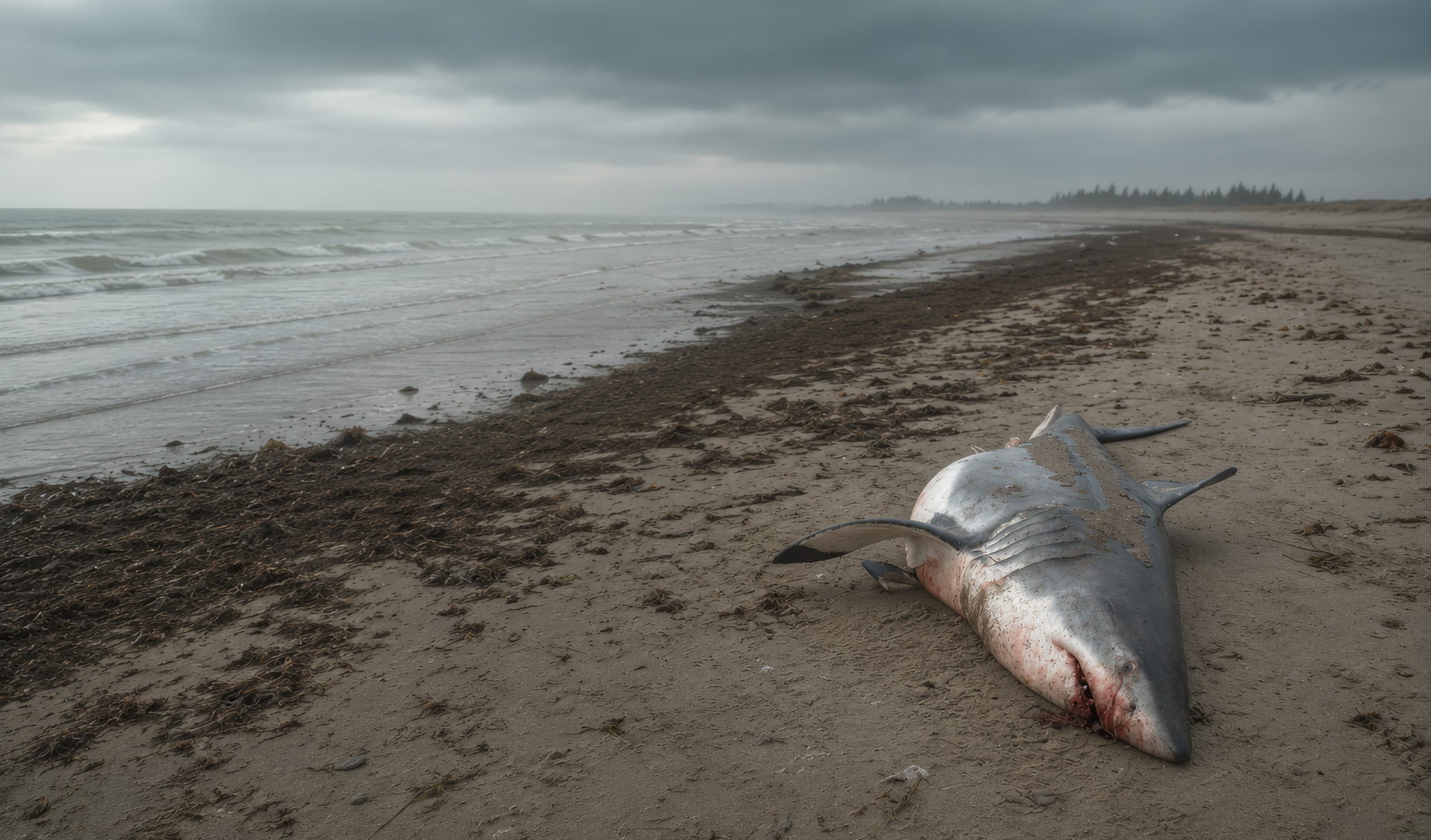
Stranded white shark near Kouchibouguac National Park, New Brunswick
AI-assisted © ORS |. All Rights Reserved
“Fear and apathy bite deeper
than any shark.”
Help protect the sharks
of the St. Lawrence.
— Jeffrey Hay Gallant, ORS
The St. Lawrence Shark Observatory is a registered charity:
Canada Revenue Agency #834462913RR0001
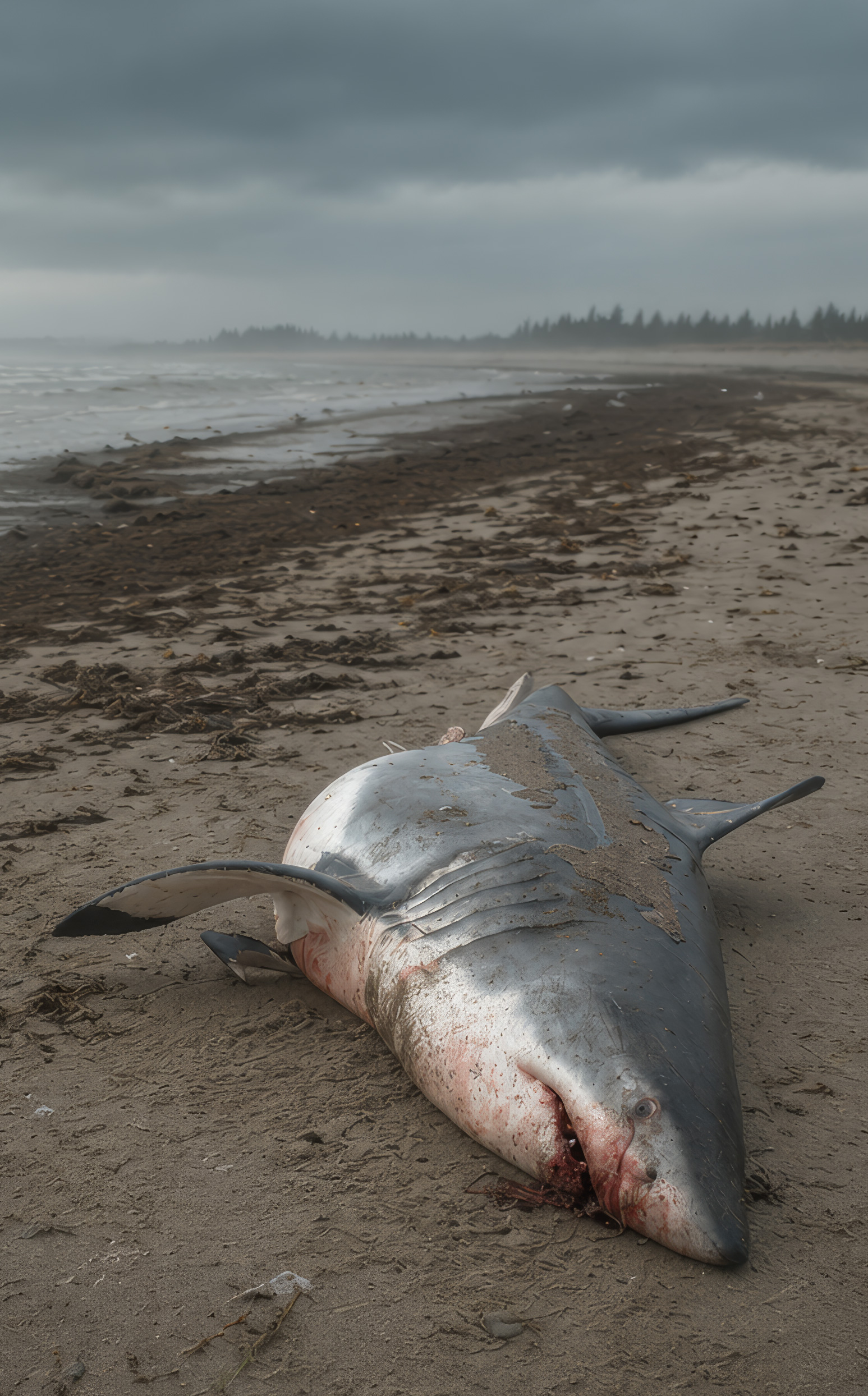
Stranded white shark near Kouchibouguac National Park, New Brunswick
AI-assisted © ORS |. All Rights Reserved
“Fear and apathy
bite deeper
than any shark.”
Help protect the sharks
of the St. Lawrence.
— Jeffrey Hay Gallant, ORS
The St. Lawrence Shark Observatory is a registered charity:
Canada Revenue Agency #834462913RR0001


CSAR
OSF
PUBLICATIONS

© 2026 St. Lawrence Shark Observatory. All Rights Reserved.
CSAR
OSF
PUBLICATIONS
© 2026 St. Lawrence Shark Observatory
All Rights Reserved