

CSAR: 0017
The Fourchu Rammer incident of 1953 revisited.
AI-assisted © ORS | All Rights Reserved
THE FOURCHU RAMMER
1953 | CAPE BRETON
CASE NUMBER: 0017
CANADIAN SHARK ATTACK REGISTRY
The Fourchu Rammer incident of 1953 revisited.
AI-assisted © ORS | All Rights Reserved
The Fourchu Rammer
1953 — CAPE BRETON, NOVA SCOTIA
The Canadian Shark Attack Registry (CSAR) is the first comprehensive database of shark-related incidents in Canada. Compiled and maintained by the St. Lawrence Shark Observatory (ORS) since 2022, it brings together confirmed, plausible, unconfirmed, and discredited reports from historical records, Indigenous oral histories, scientific literature, newspapers, eyewitness accounts, and other relevant sources.
Every incident is individually reviewed and accompanied by a scientific assessment that distinguishes documented facts from interpretation, evaluates the available evidence, identifies the most likely shark species where possible, and explains the rationale behind its classification.
ABOUT THIS REGISTRY
Shark attacks remain exceptionally rare in Canada and worldwide. The purpose of the Canadian Shark Attack Registry is not to sensationalise these events, but to document and critically assess them using the best available historical and scientific evidence, improve public understanding, and support both human safety and shark conservation.
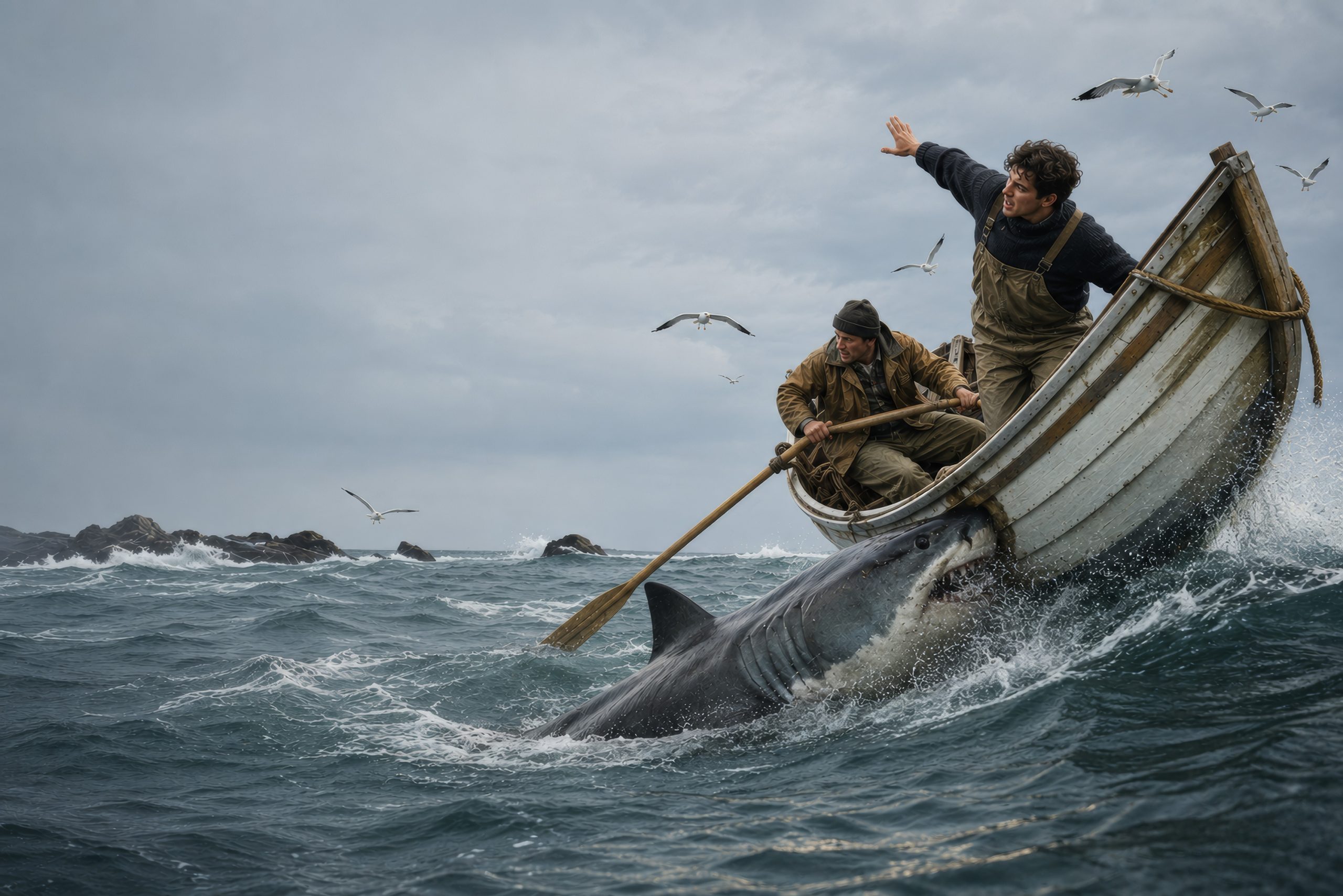
The banner illustration depicts the 1953 Fourchu, Nova Scotia, boat-ramming incident (CSAR-0017), one of the most historically significant and best-documented cases in the registry. It was selected because of its importance in Canadian shark history and because it inspired the visual identity of the Canadian Shark Attack Registry, not because it is representative of the overall risk posed by sharks in Canadian waters. In fact, the vast majority of incidents documented in the registry did not result in death or serious injury, and many involved no physical contact with humans whatsoever.

The Canadian Shark Attack Registry
LAST UPDATED
20.06.2026
Publication information
Author: Jeffrey Hay Gallant, M.Sc., Doctoral Researcher (UQAM)
Affiliation: St. Lawrence Shark Observatory (ORS)
First published: 2022
Current edition: June 2026
Last updated: 23 June 2026
For background on the Canadian Shark Attack Registry, definitions of key terms (including attack, incident, and stalking encounter), explanations of incident codes and classifications, historical context, assessment methodology, and practical recommendations for reducing risk, consult Understanding Shark Interactions in Canada, which provides scientific context and interpretation for the Canadian Shark Attack Registry.
Table of contents
Preface
The Canadian Shark Attack Registry (CSAR) is the first national database dedicated to documenting and critically evaluating reported shark-related incidents in Canadian waters. Established in 2022 by the St. Lawrence Shark Observatory (ORS), the Registry brings together historical records, eyewitness accounts, scientific observations, archival research, and contemporary incident reports spanning more than three centuries.
Shark-related incidents in Canada are exceptionally rare. Yet a number of historical accounts have been repeated for decades without critical scrutiny, while others have been largely forgotten. The purpose of the Registry is therefore not only to document incidents, but also to assess their reliability, identify the species involved whenever possible, and distinguish evidence-based history from folklore, speculation, and misidentification.
The Registry should be regarded as a living scientific resource. As new evidence becomes available, incident assessments, classifications, and species identifications may be revised accordingly.
For definitions, methodology, terminology, historical context, and explanations of the assessment process used throughout this publication, readers are encouraged to consult Understanding Shark Interactions in Canada, which provides scientific context and interpretation for the Canadian Shark Attack Registry.
Citation and use of this resource
The Canadian Shark Attack Registry is the product of ongoing historical research and scientific review conducted by the St. Lawrence Shark Observatory (ORS). Compiling and assessing these records often requires locating and interpreting rare or obscure sources, including historical newspapers, government documents, scientific publications, archival material, and eyewitness accounts spanning more than three centuries. Many original documents exist only in French or English, while some of the earliest sources are written in archaic forms of the language that require careful interpretation and contextual analysis.
Researchers, educators, journalists, students, and other users are encouraged to cite this publication when referencing information, data, analyses, or original interpretations contained within it. Proper attribution acknowledges the work involved in assembling and critically evaluating these records, enables readers to consult the original source, and supports the continued development and maintenance of this openly accessible scientific resource.
Suggested citation:
Gallant, J. H. (2026a). Canadian shark attack registry [Database]. St. Lawrence Shark Observatory. https://www.sharkscience.ca/csar
In-text citation:
(Gallant, 2026a)
When referring to a specific case:
(Gallant, 2026a; CSAR-0017)
When referring to a specific incident, users are encouraged to include the corresponding Canadian Shark Attack Registry (CSAR) identifier (e.g., CSAR-0015) in addition to the recommended citation. These permanent identifiers provide a stable means of referencing individual records and remain valid as the registry is updated and expanded.
Notice to journalists and content creators
As per its media communication policy, the St. Lawrence Shark Observatory (ORS) does not participate in live interviews concerning shark incidents or the Canadian Shark Attack Registry.
Journalists, documentary producers, educators, and other content creators are encouraged to consult the Canadian Shark Attack Registry and Understanding Shark Interactions in Canada, which together provide the official scientific background, terminology, historical context, assessment methodology, incident classifications, and practical safety recommendations developed by ORS.
This written approach helps ensure that information is communicated accurately and consistently while reducing the risk of statements being quoted out of context, oversimplified, or sensationalised. Inquiries requiring clarification may be addressed through written correspondence or future updates published through ORS’s official communication channels.
Living scientific resource
The Canadian Shark Attack Registry and its companion publications are living scientific resources. Historical interpretations, incident classifications, behavioural assessments, species identifications, and other conclusions may be revised as new evidence becomes available. Consequently, the assessments and interpretations presented herein represent the best available understanding of the evidence at the time of publication rather than immutable historical fact.
To ensure that readers have access to the most current information, corrections, and case assessments, these resources are maintained in digital form and are not presently available in print.
Scope of the Registry
The Canadian Shark Attack Registry is not intended to serve as a catalogue of every shark sighting or encounter reported in Canadian waters. Instead, it documents incidents that are historically significant, scientifically informative, involve physical contact, result in injury or damage, or otherwise contribute meaningfully to understanding shark behaviour and risk in Canada.
As shark observations have become increasingly common in recent years, particularly in Atlantic Canada, many encounters now occur that do not meet these criteria. Consequently, the Registry focuses on notable incidents rather than routine sightings and should not be interpreted as a comprehensive database of all shark observations reported in Canada.
Additional information regarding inclusion criteria and case selection can be found in Understanding Shark Interactions in Canada, which provides scientific context and interpretation for the Canadian Shark Attack Registry.
Methodological note
Historical records often lack sufficient detail to permit definitive identification of the shark species involved or the circumstances surrounding an incident. Where direct evidence is unavailable, assessments are based on the best available information and may include scientifically supported inferences derived from the known biology, distribution, ecology, and behaviour of shark species occurring in Canadian waters. Documented facts are distinguished from interpretation, and all hypotheses are presented with an appropriate degree of confidence.
Incident classification codes
The Canadian Shark Attack Registry classifies incidents according to the primary nature of the interaction.
PRE: Predatory or food-related interaction involving a person or vessel, including incidents associated with bait, captured prey, blood in the water, or other feeding stimuli.
HR (Hit or Ram): A shark strikes, rams, slashes, or bites a person, vessel, paddleboard, or other object where the available evidence is insufficient to conclude that the interaction was predatory, defensive, or primarily food-related.
DF: Defensive interaction by a shark responding to capture, harassment, injury, or another perceived threat.
ST: Stalking or investigatory encounter involving a person without physical contact.
SC: Scavenging event involving human remains or body parts.
Case status categories
Every record is individually evaluated using the best available historical, biological, and scientific evidence.
Confirmed: The incident is supported by reliable evidence and is considered to have occurred as described.
Plausible: The available evidence suggests the incident may have occurred, but important uncertainties remain.
Unconfirmed: The available evidence is insufficient to verify the incident or determine the species involved with confidence.
Discredited: The available evidence indicates that the reported incident is unsupported, highly improbable, or more likely explained by folklore, misidentification, exaggeration, duplication of another account, or another non-shark-related explanation.
For definitions of terms such as attack, incident, and stalking encounter, see Understanding Shark Interactions in Canada, which provides scientific context and interpretation for the Canadian Shark Attack Registry.
Why include discredited incidents?
The Canadian Shark Attack Registry is intended to document all known reports of alleged shark-related incidents in Canada, not only those that can be confirmed. Historical anecdotes, local legends, newspaper stories, and long-circulating rumours are therefore included whenever they have become part of the historical record or are frequently cited in the literature or popular media.
Including these accounts does not imply that they are authentic. On the contrary, documenting them allows each case to be critically examined using the best available historical, biological, and scientific evidence. Where the available information indicates that an event is unsupported, inconsistent with known shark biology, or likely represents folklore, misidentification, exaggeration, or duplication of another account, this conclusion is stated explicitly in the assessment and reflected in the case status.
Excluding such reports altogether could create the false impression that they were overlooked or unknown to the CSAR. By retaining and evaluating them transparently, the registry provides a complete and evidence-based record while clearly distinguishing documented events from unsubstantiated claims.
Canadian Shark Attack Registry by the numbers
As of Version 2.0 (22.06.2026), the Canadian Shark Attack Registry (CSAR) contains 31 entries, including 30 individual incidents and one collective historical record based on Indigenous oral traditions predating European settlement. Together, these records span more than 330 years of Canadian shark history and represent the most comprehensive review of shark-related incidents currently available for Canadian waters.
Registry Composition
- 31 records currently documented
- 1 collective historical record based on Indigenous oral traditions
- 30 individual incidents spanning more than 330 years
Incident Status
- 15 confirmed incidents
- 4 plausible incidents
- 1 unconfirmed incident
- 4 discredited reports
- 1 historical report lacking supporting evidence and probably originating elsewhere
- 1 confirmed incident with uncertain species identification and behavioural interpretation
- 1 collective historical record supported by multiple independent oral and historical sources
Human Outcomes
- 1 confirmed fatal shark-related death in Canada
- 4 additional historical fatalities classified as plausible
- 1 confirmed case of scavenging on human remains
- 1 non-fatal injury requiring medical intervention
- 24 incidents resulting in no human injury
Other Documented Interactions
- 1 confirmed fatal attack on a domestic dog
- 2 confirmed attacks on scientific research gliders
- Multiple confirmed interactions involving boats, canoes, fishing gear, paddleboards, divers, and surfers without serious injury
- Numerous incidents involving investigatory behaviour directed toward vessels and other inanimate objects
Species Represented
- White shark (Carcharodon carcharias)
- Greenland shark (Somniosus microcephalus)
- Porbeagle shark (Lamna nasus)
- Bluntnose sixgill shark (Hexanchus griseus)
- Unknown or undetermined species
Time Span
- Earliest record: Pre-contact Indigenous oral traditions
- Earliest individual incident: 1691
- Most recent incident: 2025
Incident database
Cases are presented in chronological order. Select a year below to view the corresponding incident report, including its description, scientific assessment, and references.
CSAR ID: CSAR-0030
Date: 2025-08-12
Location: Cherry Hill Beach, Nova Scotia
Incident type: Shark interaction with paddleboard — Code: HR
Species (Confirmed): White shark (Carcharodon carcharias)
Possible cause(s): Undetermined (investigatory behaviour or mistaken identity possible)
Result: No injury
Status: Confirmed

Description
On 12 August 2025, stand-up paddleboarder Kent Walsh encountered a large shark while paddling off Cherry Hill Beach, Nova Scotia. According to Walsh, the shark suddenly seized his paddleboard, knocking him into the water. Looking up from the surface, he observed the shark struggling to free its jaws from the buoyant board while much of its dorsal fin and upper body remained visible above the water. Walsh repeatedly struck the shark on the head with his paddle until it released the board, allowing him to return safely to shore without injury. The paddleboard sustained substantial damage.¹
The incident prompted the temporary closure of Cherry Hill Beach while local authorities and fisheries officials investigated the event. Photographs and video footage of the damaged paddleboard were subsequently reviewed by shark specialists. Based on the bite marks and the available evidence, shark expert Dr. Chris Harvey-Clark concluded that the animal was a juvenile white shark (Carcharodon carcharias) measuring approximately three metres in length.¹
No evidence indicates that the shark made physical contact with the paddleboarder. The encounter concluded without injury.
The event received extensive national and international media attention and represents one of the best-documented shark-related incidents in Canadian history owing to the availability of contemporaneous photographs, video evidence, eyewitness testimony, and expert evaluation.
ORS Assessment
The identification of the shark as a white shark (Carcharodon carcharias) is supported by multiple independent lines of evidence, including documented damage to the paddleboard, eyewitness observations, and expert examination of the bite marks. Together, these provide a high degree of confidence in the species identification.
The behavioural motivation underlying the interaction cannot be determined with certainty. One plausible explanation is that the shark was investigating an unfamiliar object at the surface. White sharks are known to exhibit exploratory or investigatory biting behaviour toward novel stimuli, although the frequency and ecological significance of such behaviour remain poorly understood. Another possible explanation is mistaken identity, whereby the silhouette of the paddleboard may have resembled that of a seal or other natural prey item when viewed from below. Alternative interpretations, including accidental contact or another behavioural context, cannot be excluded based on the available evidence.
Importantly, there is no evidence that the shark directed a sustained predatory attack towards the paddleboarder. The available observations indicate that the shark’s physical contact was limited to the paddleboard itself, and its occupant escaped without injury.
Based on the available evidence, the Canadian Shark Attack Registry considers this case a confirmed white shark interaction with a stand-up paddleboard resulting in substantial damage to the board but no injury to its occupant. Although the precise behavioural motivation cannot be established, investigatory behaviour directed towards the paddleboard is considered the most parsimonious interpretation.
Sidenote
The Cherry Hill incident attracted considerable public attention because it occurred in a region where shark-related injuries are exceptionally rare. Despite extensive media coverage, the event does not alter the broader statistical reality that encounters resulting in injury remain exceedingly uncommon in Canadian waters.
Reference
¹ LeBel, J. (2025, August 15). Great white fright: N.S. man escapes unscathed after using paddle to repel shark. Global News.
CSAR ID: CSAR-0029
Date: 2024-09-22
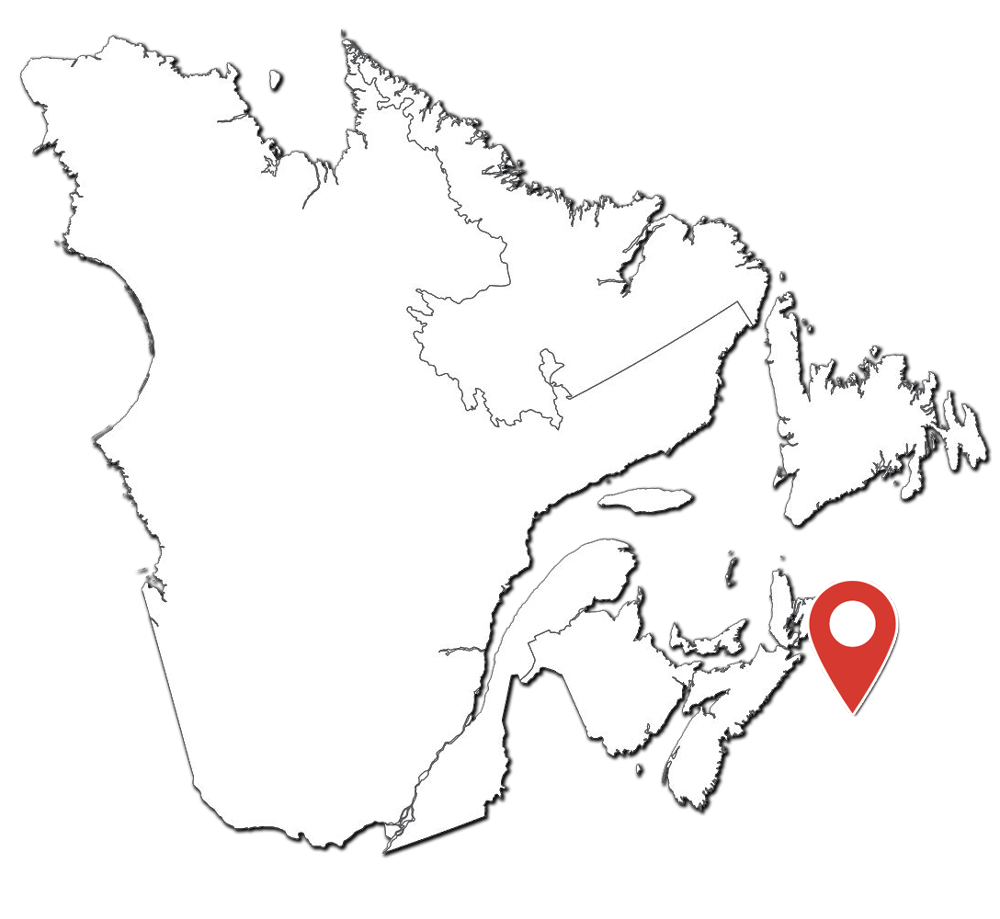
Location: Offshore Nova Scotia (approximately 300 km southeast of Halifax)
Incident type: Attack on inanimate object — Code: PRE
Species (Suspected): White shark (Carcharodon carcharias)
Possible cause(s): Investigatory behaviour toward an autonomous underwater vehicle (Provoked)
Result: Research glider disabled and damaged
Status: Confirmed
Description
On 22 September 2024, an autonomous ocean glider operated by Fisheries and Oceans Canada (DFO) sustained severe damage while conducting oceanographic research approximately 300 kilometres offshore of Nova Scotia. The vehicle, a SeaExplorer glider, was part of a scientific monitoring program collecting environmental data from the Northwest Atlantic.¹ ²
According to DFO researchers, the glider was operating at a depth of approximately 300 metres when it suddenly experienced a malfunction and initiated an emergency ascent. Telemetry data indicated that the vehicle had sustained a significant impact. Following recovery, investigators discovered extensive structural damage concentrated near the forward section of the glider, including puncture marks, gouges, deformation of external components, and damage to internal systems.¹ ²
Examination of the recovered vehicle suggested that the damage had been caused by a large shark. Researchers reported that the bite marks displayed characteristics consistent with serrated teeth and noted that a solid aluminium structural component had been bent significantly during the interaction.¹
Analysis of the telemetry data further suggested that the shark may have interacted with the glider more than once. Investigators hypothesised that an initial bite occurred while the vehicle was operating at depth and that a second interaction may have taken place as the glider ascended toward the surface following the malfunction.¹
The incident was subsequently documented through media coverage and a detailed technical video examination of the recovered glider presented by veterinarian and shark researcher Dr. Chris Harvey-Clark in collaboration with Fisheries and Oceans Canada personnel. The footage provided close-up views of the damage and the engineering assessment of the vehicle following recovery.³
No injuries to people occurred.
ORS Assessment
The occurrence of this incident is exceptionally well documented through telemetry records, recovery of the damaged glider, direct examination of the vehicle, media reporting, and technical video documentation showing the nature and extent of the damage. The available evidence confirms that the autonomous ocean glider sustained severe damage following a forceful interaction with a large shark.
The species responsible cannot be established with absolute certainty because no teeth, tissue samples, or genetic material attributable to the shark have been reported. Nevertheless, the available evidence strongly supports identification as a white shark (Carcharodon carcharias).
According to Fisheries and Oceans Canada researchers, the morphology of the bite marks, particularly the presence of serrated impressions, is consistent with the dentition of a white shark. The recovered vehicle therefore provides direct physical evidence of a shark interaction. The location of the incident is also significant. White sharks are regularly documented in offshore waters of Atlantic Canada during late summer and autumn and are known to undertake extensive vertical movements, including dives to several hundred metres.¹ ²
The damage observed on the recovered vehicle is inconsistent with ordinary mechanical failure or incidental contact with floating debris. Video documentation of the glider reveals puncture marks, gouging, deformation of external components, and damage requiring substantial force. Researchers further reported that a solid aluminium structural component had been bent significantly during the interaction. Collectively, these observations support the conclusion that the glider was physically bitten by a large shark.
Telemetry data further suggest that the shark may have interacted with the glider more than once. Investigators reported that the vehicle likely sustained an initial impact at depth before beginning an emergency ascent, after which a second interaction may have occurred as the glider rose through the water column. Although this interpretation cannot be confirmed conclusively, it is consistent with the observed damage pattern and the sequence of events recorded by the vehicle.¹
The behavioural motivation behind the interaction remains uncertain. Autonomous ocean gliders produce visual, hydrodynamic, acoustic, and possibly weak electrical cues that may attract the attention of large predatory sharks. Their size, colour, movement, and oscillating dive profile may also resemble unfamiliar biological or environmental stimuli. White sharks are known to investigate novel objects through physical contact or exploratory biting, and such behaviour provides the most parsimonious explanation for the interaction.
This incident closely resembles the 2021 Ocean Tracking Network glider event documented near Sable Island (CSAR-0027), in which a Slocum glider sustained severe damage attributed to a probable white shark. The similarities between the two incidents provide additional evidence that autonomous underwater vehicles may occasionally elicit investigatory biting behaviour from large sharks in Atlantic Canadian waters.
Based on the available evidence, the Canadian Shark Attack Registry considers this a confirmed shark interaction resulting in substantial damage to an autonomous research glider. The serrated bite marks, damage pattern, telemetry data, expert examination, regional occurrence of white sharks, and comparison with the similar 2021 glider incident collectively provide strong support for a white shark (Carcharodon carcharias) as the species responsible. However, because no diagnostic dental or genetic material has been recovered or reported publicly, the species identification should be regarded as strongly supported but not conclusively confirmed.
Recommendation
Researchers deploying autonomous underwater vehicles in regions where large sharks occur should recognise that such equipment may occasionally attract investigatory behaviour. Although these interactions remain exceptionally rare, damage to scientific instruments can result in equipment loss, interruption of research activities, and degradation of long-term monitoring programs. Recovery and examination of damaged vehicles should include detailed photographic documentation and, whenever possible, collection of biological or genetic material from bite sites.
Sidenote
This incident represents one of the most thoroughly documented shark interactions involving a scientific research platform in Canadian waters. Together with the 2021 Ocean Tracking Network glider incident (CSAR-0027), it provides compelling evidence that autonomous oceanographic gliders may occasionally attract investigatory biting behaviour from large sharks. These cases are particularly valuable because they combine physical damage, telemetry records, and expert examination, providing a level of documentation rarely available in shark-related incidents.
References
- Shark likely to blame for taking chomp out of DFO ocean glider off N.S. coast. CBC News. 8 October 2024.
- Ocean research device victim of great white shark attack off Nova Scotia shore. Global News / The Canadian Press. 8 October 2024.
- Harvey-Clark, C. (2024). Technical video examination of the damaged Fisheries and Oceans Canada SeaExplorer glider following a suspected white shark interaction.
CSAR ID: CSAR-0028
Date: 2023-10-18
Location: Toby Island, Nova Scotia
Incident type: Attack on domestic dog — Code: PRE
Species (Suspected): White shark (Carcharodon carcharias)
Possible cause(s): Undetermined (attraction to wounded waterfowl and associated surface activity during duck hunting possible)
Result: Dog killed
Status: Confirmed
Description
On 18 October 2023, a Chesapeake Bay Retriever named Pepper was fatally attacked by a shark while retrieving a sea duck off Toby Island near Port Medway, Nova Scotia. According to the dog’s owner, an experienced sea-duck hunter who requested anonymity, Pepper had already completed one successful retrieve that morning and was entering the water to recover the second duck of the day when the incident occurred.¹
The owner reported that the dog had swum only a short distance from the boat when a large shark suddenly attacked from below, lifting Pepper partially out of the water before dragging her beneath the surface. Moments later, the dog resurfaced and struggled back towards the vessel, where she was pulled aboard. Despite being recovered quickly, Pepper sustained catastrophic injuries and died shortly thereafter.¹
The hunter estimated that the shark measured approximately 2.4 metres in length but stated that the attack occurred so rapidly that he could not identify the species with certainty. The vessel was operating close to shore in approximately six metres (20 feet) of water, and Pepper had reportedly been swimming for only a matter of minutes before the attack occurred.¹
The incident received widespread media attention across Canada and prompted renewed discussion regarding the seasonal presence of large sharks along the coast of Nova Scotia.
ORS Assessment
The occurrence of a fatal shark attack on the dog is supported by firsthand testimony from the owner and is not in doubt. However, because no photographs or video of the shark, recovered teeth, biological samples, or forensic examination of the bite wounds have been made publicly available, the identity of the species responsible cannot be established with certainty.
Several independent lines of evidence nevertheless support the white shark hypothesis. The incident occurred during October, when white sharks are regularly documented in Nova Scotian waters, including in nearshore environments. The reported shark length of approximately 2.4 metres is consistent with that of a juvenile white shark, and the location lies within an area frequented by grey seals and other marine mammals that constitute important prey for the species.
The circumstances of the incident may also have increased the likelihood of attracting a shark. Retrieval of freshly shot waterfowl can release blood and other biological material into the water, while repeated splashing by a swimming retriever may generate visual, acoustic, and hydrodynamic cues resembling those produced by struggling prey. Together, these stimuli may have attracted a nearby shark already foraging in the area.
Alternative species cannot be excluded entirely. However, the season, geographic location, estimated size of the animal, and behavioural context are all consistent with a juvenile white shark.
Based on the available evidence, the Canadian Shark Attack Registry considers this case a confirmed fatal shark attack on a domestic dog that occurred during the retrieval of a hunted waterfowl off Toby Island, Nova Scotia, on 18 October 2023. The balance of evidence strongly favours a juvenile white shark (Carcharodon carcharias) as the species involved. However, because no direct physical evidence confirming the identification has been made publicly available, the species remains suspected rather than confirmed.
Safety Considerations
Waterfowl hunters, dog handlers, and other recreational users should be aware that white sharks may remain in Atlantic Canadian waters well into late autumn. Activities involving wounded game, blood in the water, or repeated surface splashing may increase the likelihood of attracting sharks in areas where they are seasonally present. Whenever practical, retrieval of downed birds should be undertaken with an awareness of local shark activity and prevailing environmental conditions.
Sidenote
To the best of our knowledge, this represents the first documented fatal shark attack on a domestic dog in Canadian waters. Although tragic, the incident occurred under highly unusual circumstances involving an actively retrieving hunting dog in an area and season where white sharks are known to occur.
Reference
¹ Owner left shocked after watching his dog get attacked by shark in N.S. waters. (2023, October 19). Global News.
CSAR ID: CSAR-0027
Date: 2021-09-12
Location: Offshore of Sable Island, Nova Scotia
Incident type: Attack on inanimate object — Code: PRE
Species (Suspected): White shark (Carcharodon carcharias)
Possible cause(s): Investigatory behaviour toward an autonomous underwater vehicle (Provoked)
Result: Research glider disabled
Status: Confirmed
Description
On 12 September 2021, an autonomous underwater glider operated by the Ocean Tracking Network (OTN) and deployed in collaboration with Environment and Climate Change Canada was attacked and disabled approximately 200 km east of Halifax, near Sable Island, Nova Scotia. The Slocum glider was conducting oceanographic research and monitoring acoustically tagged Atlantic halibut when it sustained severe damage to its aluminium rudder module.¹
The damaged vehicle lost normal navigational capability and drifted at sea for approximately 72 hours before being successfully recovered. Despite the mechanical failure, the glider continued transmitting its position, enabling recovery and subsequent examination.¹
Inspection of the damage revealed deep puncture marks consistent with the bite of a large shark.
Commenting on the incident, Dr. Fred Whoriskey, Executive Director of the Ocean Tracking Network, stated:
“It must have been a pretty big and powerful shark because it managed to penetrate three millimetres or more with teeth marks into the aluminum base of what’s solid aluminum.”¹
Following recovery, the bite marks were examined and the glider was swabbed for environmental DNA in an attempt to identify the species responsible. No publicly available results from the eDNA analysis have subsequently been reported.
ORS Assessment
The damage to the glider and the resulting loss of navigational capability are well documented through recovery of the vehicle and direct examination by Ocean Tracking Network personnel. The incident is therefore considered confirmed.
The identity of the shark responsible, however, cannot be established with certainty. No teeth were recovered and no publicly available genetic evidence has been released from the environmental DNA samples collected following recovery.
Nevertheless, several independent lines of evidence strongly support the white shark hypothesis. White sharks are seasonally abundant in waters surrounding Sable Island during late summer and autumn, where they exploit the region’s large grey seal population. The dimensions and force of the bite, which penetrated several millimetres into solid aluminium, are consistent with the powerful jaws of a large lamnid shark, and Dr. Fred Whoriskey publicly identified a white shark as the most probable candidate.
The behavioural motivation behind the interaction remains speculative. The glider’s size, shape, movement, colour, acoustic emissions, or low-frequency vibrations may have attracted the shark’s attention. White sharks are known to investigate unfamiliar objects through physical contact or exploratory biting, a behaviour documented elsewhere involving boats, surfboards, scientific equipment, and other floating objects.
Interpretation of this incident is further strengthened by a subsequent event documented off Nova Scotia in 2024, when a Fisheries and Oceans Canada autonomous ocean glider sustained severe structural damage attributed to repeated bites by a probable white shark. Detailed examination of the recovered vehicle, together with telemetry data and technical analysis presented by Dr. Chris Harvey-Clark and Fisheries and Oceans Canada personnel, demonstrated striking similarities to the 2021 case and provided additional evidence that autonomous underwater vehicles may occasionally elicit investigatory biting behaviour from large white sharks.
Based on the available evidence, the Canadian Shark Attack Registry considers this a confirmed shark interaction resulting in the disabling of an autonomous research glider. Although no direct physical evidence conclusively identifies the species responsible, the location, season, nature of the damage, expert assessment, and the existence of a nearly identical documented incident in 2024 strongly favour a white shark (Carcharodon carcharias) as the animal responsible. The species identification should therefore be regarded as suspected rather than confirmed.
Sidenote
This incident represents one of the earliest documented cases in Atlantic Canada involving severe damage inflicted on an autonomous oceanographic glider by a large shark. A comparable event occurred in 2024, when a Fisheries and Oceans Canada glider operating off Nova Scotia sustained extensive bite damage attributed to a probable white shark (see CSAR-0029). Together, the two cases suggest that interactions between large sharks and autonomous underwater vehicles, although rare, are not isolated events and most likely reflect investigatory behaviour toward unfamiliar moving objects in the marine environment.
References
- ‘Big and powerful’ shark attack left ocean glider adrift off Nova Scotia for days. CBC News. 17 September 2021.
- Dal’s university veterinarian was on a routine dive near Halifax. Then a great white shark spotted him. Dal News. 15 November 2021.
CSAR ID: CSAR-0026
Date: 2021-11-09
Location: Chebucto Head, Nova Scotia
Incident type: Stalking encounter with no physical contact — Code: ST
Species (Confirmed): White shark (Carcharodon carcharias)
Possible cause(s): Undetermined (investigatory behaviour in close proximity to a feeding area possible)
Result: No injury
Status: Confirmed

Description
On 9 November 2021, two scuba divers, including veterinarian and shark researcher Dr. Chris Harvey-Clark, encountered a juvenile white shark while exploring the wreck of the Letitia off Chebucto Head near the approaches to Halifax Harbour.
The shark was first observed at a depth of approximately 33 metres and an estimated distance of eight metres from the divers. Harvey-Clark immediately identified the animal as a white shark measuring roughly three metres in length, corresponding to the size at which late-stage juveniles are believed to transition from a primarily piscivorous diet to one increasingly incorporating marine mammals.
Following the initial sighting, the shark made two additional close passes. During the second approach, it reportedly came within approximately six metres of the divers. Concerned by the repeated encounters, Harvey-Clark signalled his dive partner to terminate the dive and proceed directly to the ascent line.
The shark made a third pass before the divers reached the mooring line leading back to their vessel. Visibility deteriorated markedly above approximately 10 metres, preventing the divers from seeing more than the tips of their fins and increasing their perception of vulnerability during the ascent. As a precaution, they elected to omit the customary safety stop and return directly to the surface.
Reflecting on the encounter, Harvey-Clark later stated:
“It’s one thing to have a shark do a drive-by and check you out once, but if the shark comes back repeatedly that’s a predatory investigation going on and you don’t want to be at the bitter end of that. That is the feeling of being hunted and it’s not a good feeling.”¹
He also remarked:
“The visibility was so bad you couldn’t see the end of your fins, you’re in murky water, we were right around the corner from where there are seals with a foraging shark nearby and no ability to fend it off so that is about the worst it gets.”¹
ORS Assessment
The occurrence of this encounter is well documented through firsthand testimony from a shark expert and veterinarian with extensive expertise in shark encounters. The identification of the shark as a white shark (Carcharodon carcharias) is therefore considered reliable.
The repeated close approaches understandably caused concern for the divers. However, the shark made no physical contact and displayed no unequivocal evidence of an imminent predatory attack. Similar repeated investigative passes have been documented elsewhere in white sharks and may represent exploratory behaviour directed towards unfamiliar objects encountered within their environment.
The encounter occurred adjacent to habitat frequented by grey seals and other marine mammals, which constitute an important prey resource for juvenile and subadult white sharks. The proximity of a likely feeding area, combined with extremely poor underwater visibility, may have contributed to the shark’s interest in the divers.
The divers’ decision to terminate the dive immediately and return to the surface via the ascent line was prudent. Remaining underwater until lower air reserves or conducting a prolonged safety stop would have unnecessarily increased risk from reduced air supply, deteriorating visibility, and the continued presence of the shark. Furthermore, because both divers were concentrating on the seafloor while searching for benthic torpedo rays, it is entirely possible that the shark had approached them before it was first detected.
Although the behavioural motivation of the shark cannot be determined with certainty, the available evidence supports the interpretation that the animal was investigating the divers rather than actively attempting to attack them.
Based on the available evidence, the Canadian Shark Attack Registry considers this case a confirmed stalking encounter involving a white shark (Carcharodon carcharias) repeatedly approaching two scuba divers without making physical contact. Although the precise behavioural motivation cannot be established, investigatory behaviour is considered the most parsimonious interpretation.
Safety Considerations
Divers should not rely on the Gregorian calendar to estimate when white sharks have departed Atlantic Canadian waters for the season. Verified observations demonstrate that white sharks may remain in the Gulf of St. Lawrence and the Maritime provinces well into November. Whether this reflects a long-term shift in seasonal residency associated with changing environmental conditions remains an active area of scientific research.
Sidenote
Dr. Chris Harvey-Clark was interviewed directly by the St. Lawrence Shark Observatory (ORS) regarding this encounter. He was also one of the two divers involved in the documented Greenland shark stalking incident near Baie-Comeau, Québec (CSAR-0020), in 2004.
ORS is also aware of a similar but unsubstantiated report of a diver encounter with a suspected white shark at Chebucto Head in 1991. Owing to the absence of corroborating evidence, that event is not currently included in the registry.
References
¹ Dal’s university veterinarian was on a routine dive near Halifax. Then a great white shark spotted him. Dal News. 15 November 2021.
² Le golfe du Saint-Laurent a eu chaud en 2021. La Presse. 19 January 2022.
Further reading: How a great white shark altered an N.S. underwater researcher’s diving plans for 2022. Toronto Star. 24 December 2021.
CSAR ID: CSAR-0025
Date: 2021-08-13
Location: Margaree Island, Nova Scotia
Incident type: Biting/slashing attack on swimmer — Code: HR
Species (Suspected): White shark (Carcharodon carcharias)
Possible cause(s): Undetermined (investigatory behaviour or mistaken identity in a feeding area possible)
Result: Injury requiring medical intervention
Status: Plausible

Description
On 13 August 2021, 22-year-old Taylor Boudreau-Deveaux was swimming from a recreational boat approximately 0.8 km west of Margaree Island (also known as Sea Wolf Island), Nova Scotia, when she sustained a serious bite injury to her thigh. Witnesses reported observing a dark dorsal fin breaking the surface of the water both immediately before¹ and after² the incident.
The victim was airlifted to hospital in Halifax, where she underwent surgery and received numerous stitches. According to a public statement made by her grandfather, Wayne Boudreau, she recovered successfully despite the severity of the injury.
No photographs or video of the shark, biological samples, recovered teeth, DNA evidence, or formal forensic analysis of the wound have been made publicly available. Likewise, no individual directly involved in the incident has publicly presented evidence permitting definitive identification of the species responsible.
ORS Assessment
The available evidence strongly supports the conclusion that the injury was caused by a shark. However, the identity of the species cannot be confirmed with certainty.
Margaree Island lies immediately adjacent to the Sea Wolf Island National Wildlife Area, which supports a substantial grey seal (Halichoerus grypus) colony. Such locations constitute recognised feeding areas for white sharks and represent environments where interactions between sharks and humans, although exceptionally rare, are more likely to occur.
Several hypotheses could explain the shark’s behaviour if the attacker was indeed a white shark. The animal may have mistaken the swimmer for a pinniped and delivered an exploratory bite, or it may have been investigating a potential prey item before disengaging. Alternatively, it may have perceived the swimmer as a competitor in the vicinity of a feeding opportunity. Experimental studies have suggested that juvenile white sharks may occasionally misidentify objects viewed from below under certain environmental conditions owing to limitations in visual discrimination.³
Unfortunately, no detailed forensic examination of the wound or associated tissue damage has been published. Such information could have provided valuable insight into the mechanics of the bite and the identity of the shark responsible.
Nevertheless, several independent lines of circumstantial evidence support the white shark hypothesis. These include eyewitness reports of a dorsal fin at the scene, the location and season of the incident, the documented occurrence of tagged white sharks in nearby waters, the close proximity of a major grey seal colony, and the overall characteristics of the reported injury.
Based on the available evidence, the Canadian Shark Attack Registry considers this case a plausible shark bite involving a swimmer, with the balance of evidence strongly favouring a white shark (Carcharodon carcharias) as the species responsible. However, because no direct physical evidence confirming the species has been made publicly available, the identification remains suspected rather than confirmed, and the case is therefore classified as Plausible.
Sidenote
As of the most recent review, no publicly available photographs, biological evidence, or forensic analyses have been released by individuals directly involved in the incident that would permit definitive confirmation of the shark species responsible.
References
¹ Woman badly injured in apparent N.S. shark attack. National Post. 14 August 2021.
² Shark expert believes recent incident may have involved white shark. The Port Hawkesbury Reporter. 23 August 2021.
³ Ryan, L. A., et al. (2021). A shark’s eye view: testing the “mistaken identity theory” behind shark bites on humans. Journal of the Royal Society Interface, 18, 20210533. https://doi.org/10.1098/rsif.2021.0533
CSAR ID: CSAR-0024
Date: 2019-07-31
Location: White Point, Nova Scotia
Incident type: Reported stalking encounter with no physical contact — Code: ST
Species (Suspected): White shark (Carcharodon carcharias)
Possible cause(s): Undetermined (seals present in the area; behavioural motivation unknown)
Result: No injury
Status: Confirmed (species and behavioural interpretation uncertain)
Description
On 31 July 2019, a group of surfers reported observing a large dorsal fin while surfing off White Point, Nova Scotia. According to media reports, the fin was estimated to stand approximately one metre above the surface and at one point appeared to lie between the surfers and the shoreline, prompting the group to leave the water and make their way back to shore farther down the beach.¹
The witnesses interpreted the animal’s movements as suggesting that it may have been following or monitoring them. However, no photographs or video recordings of the animal were obtained, and no direct interaction or physical contact occurred.
The incident received considerable media attention and renewed public discussion regarding the presence of large sharks along Nova Scotia’s South Shore.
ORS Assessment
The sighting itself is well documented through multiple independent witness accounts and contemporaneous media coverage and is therefore considered confirmed. However, the identity of the animal and its behaviour cannot be established with certainty.
Although white sharks were known to occur in southwestern Nova Scotia during the summer of 2019, the reported dimensions of the dorsal fin are also compatible with those of a basking shark (Cetorhinus maximus), a harmless planktivorous species that frequently swims at the surface and is regularly observed in Atlantic Canadian waters. The reported fin height would also effectively exclude species such as the ocean sunfish (Mola mola), which is often mistaken for a shark but possesses a substantially different dorsal profile.
Likewise, there is insufficient evidence to conclude that the animal, if it was indeed a shark, was actively stalking the surfers. The apparent positioning of the fin between the group and the shoreline may simply have resulted from the independent movements of the surfers and the animal rather than any deliberate behavioural response. In the absence of additional observations or supporting evidence, attributing intentional stalking would be speculative.
White Point lies approximately nine kilometres from Kejimkujik National Park Seaside, an area known to support substantial populations of both grey and harbour seals. ORS researcher Jeffrey Hay Gallant also observed grey and harbour seals swimming among surfers at White Point on two consecutive days in July 2022, demonstrating that pinnipeds regularly frequent the area and may attract white sharks seasonally.
Based on the available evidence, the Canadian Shark Attack Registry considers this case a confirmed sighting of a large finned marine animal in close proximity to surfers. However, the available information is insufficient to determine the species involved or to conclude that the animal was intentionally stalking the surfers. While a white shark remains a plausible candidate given the location and season, a basking shark or another large marine animal cannot be excluded. Accordingly, the species identification remains suspected, and the behavioural interpretation remains uncertain.
Safety Considerations
When a large unidentified marine animal displaying a prominent dorsal fin is observed in close proximity to swimmers or surfers, leaving the water in a calm and orderly manner is a prudent precaution regardless of the species involved. Confirming the animal’s identity should not be attempted from the water.
Reference
¹ Diver story of shark encounter along Nova Scotia’s South Shore sparks concern among surfers. Global News. 31 July 2019.
CSAR ID: CSAR-0023
Date: 2012-07-19
Location: Tofino, British Columbia
Incident type: Reported bite or slash injury to surfer — Code: HR
Species: Unknown
Possible cause(s): Undetermined
Result: Injury to one finger
Status: Unconfirmed

Description
On 19 July 2012, a surfer at Tofino, British Columbia, reported sustaining an injury to one of her fingers while surfing. According to media accounts, she initially believed that her surfboard leash had caught or injured her hand. It was only after seeking medical attention that a physician reportedly suggested the wound might instead have been caused by a shark bite.¹
No shark was observed by the surfer or other witnesses at the time of the incident. No photographs of the wound, forensic analysis, biological samples, recovered teeth, or other physical evidence linking the injury to a shark have been made publicly available.
The report nevertheless attracted considerable media attention because confirmed shark bites on humans in British Columbia are exceedingly rare.
ORS Assessment
The available evidence is insufficient to determine whether the injury was caused by a shark.
No eyewitness reported seeing a shark, and no physical or forensic evidence has been presented to substantiate the shark hypothesis. The description of the wound as reported publicly is also not characteristic of a bite by a white shark (Carcharodon carcharias), the species most commonly associated with serious shark bites in temperate waters.
Other potential candidates appear equally problematic. The salmon shark (Lamna ditropis) is an uncommon visitor to the area, is primarily piscivorous, and has not been implicated in any verified attack on a human. Bluntnose sixgill sharks (Hexanchus griseus) inhabit deeper water and are not known to frequent the surf zone where the incident occurred. Spiny dogfish (Squalus acanthias), although common along the British Columbia coast, are too small to represent a plausible explanation and have never been associated with an attack on a human.
Non-shark explanations, including injury from surf equipment or another unidentified object in the water, cannot be excluded and may be more consistent with the available information.
Based on the available evidence, the Canadian Shark Attack Registry considers this case unconfirmed. No shark was observed, no diagnostic evidence has been made publicly available, and no candidate species provides a compelling explanation based on its known biology or behaviour. Consequently, there is insufficient evidence to conclude that a shark was responsible for the reported injury, and the species involved, if any, remains unknown.
Sidenote
This case is included in the Canadian Shark Attack Registry to acknowledge that the report exists and has received public attention. Its inclusion should not be interpreted as validation of the claim that a shark was involved.
Reference
¹ Injured surfer’s shark-bite diagnosis met with skepticism. The Globe and Mail. 24 July 2012.
CSAR ID: CSAR-0022
Date: 2010-10-23
Location: Eastport, Maine (approximately 2 km from the Canadian border)
Incident type: Diver bumped by shark — Code: HR
Species (Confirmed): Porbeagle shark (Lamna nasus)
Possible cause(s): Undetermined (attraction to nearby fish pens and/or investigatory behaviour towards the diver possible)
Result: No injury
Status: Confirmed

Description
On 23 October 2010, commercial diver Scott MacNichol of New Brunswick, Canada, experienced a close encounter with a porbeagle shark while diving beneath an empty salmon pen near Eastport, Maine, approximately two kilometres south of the Canadian border.
During the dive, the shark repeatedly circled MacNichol before making physical contact by forcefully bumping him. The diver later described the impact as substantial and interpreted the encounter as an apparent attack or attempted slash. Remarkably, the entire interaction was captured on underwater video and subsequently broadcast by several media outlets.
Despite the force of the collision, MacNichol was not bitten and escaped without injury.
ORS Assessment
The encounter is exceptionally well documented through contemporaneous video footage and firsthand testimony from the diver. The shark is clearly identifiable as a porbeagle (Lamna nasus), making both the occurrence of the incident and the species identification confirmed.
The precise motivation for the shark’s behaviour cannot be determined with certainty. Porbeagle sharks are primarily piscivorous and are not known to prey upon marine mammals or humans. Consequently, the available evidence does not support interpreting the encounter as a predatory attack.
Several alternative explanations are plausible. Although the diver was working beneath an empty salmon pen, neighbouring pens contained live fish that may have attracted sharks to the area and heightened feeding activity. The shark may also have perceived the diver as a competitor or unfamiliar object within its immediate environment and responded with investigatory or displacement behaviour. Another possibility is that the electronic equipment carried by the diver, including his underwater camera system, generated weak electrical fields that attracted or stimulated the shark’s electrosensory system.
Because the shark circled the diver repeatedly before making contact, the event is consistent with behaviour often described as a bump-and-investigate interaction, in which a shark physically contacts an unfamiliar object without subsequently attempting to bite.
Based on the available evidence, the Canadian Shark Attack Registry considers this case a confirmed encounter in which a porbeagle shark (Lamna nasus) repeatedly approached and physically bumped a diver without biting or causing injury. Although the precise behavioural motivation remains uncertain, the circumstances are most consistent with investigatory behaviour or attraction to nearby aquaculture operations rather than an attempt at predation.
Safety Considerations
Divers operating near aquaculture facilities or other areas where fish are concentrated should remain aware that sharks may be attracted to these locations. Although porbeagle sharks are not known to target humans as prey, close encounters involving investigatory behaviour can occur. When a shark exhibits repeated circling or close approaches, a calm and controlled exit from the water is advisable whenever conditions permit.
Sidenote
The underwater footage of this encounter represents one of the few documented videos worldwide showing a porbeagle shark making physical contact with a diver and provides valuable insight into the species’ investigatory behaviour around humans.
Video: Watch video
Reference
¹ Diver films shark attacking him in Bay of Fundy. CTV News. 1 November 2010.
CSAR ID: CSAR-0021
Date: Spring 2007
Location: Ingalik, Nunavut
Incident type: Stalking encounter with no physical contact — Code: ST
Species (Confirmed): Greenland shark (Somniosus microcephalus)
Possible cause(s): Undetermined (attraction to blood and remains from recently butchered seals possible)
Result: No injury
Status: Confirmed

Description
In the spring of 2007, Joeelee Papatsie witnessed a Greenland shark closely approach his young grandson while the child was playing in shallow water with a wooden toy near the shoreline at Ingalik, Nunavut. Earlier that day, seals had been butchered at the same location, leaving blood and organic remains in the water.¹
According to Papatsie, the shark remained close to shore and appeared to investigate or follow the child’s movements without making physical contact. The encounter ended without injury but highlighted the species’ willingness to enter extremely shallow coastal waters when responding to food-related stimuli.
ORS Assessment
The occurrence of this encounter is consistent with well-documented behaviour of Greenland sharks at Arctic marine mammal butchering sites, where individuals are routinely attracted to shore by blood, discarded carcasses, and other organic waste associated with traditional subsistence activities.¹
Comparable observations have also been made in the Gulf and Estuary of the St. Lawrence, where Greenland sharks have been documented investigating boats, divers, and other potential food sources under appropriate environmental conditions.² These investigations are believed to rely heavily on the species’ highly developed olfactory system, although acoustic and hydrodynamic cues may also contribute to prey detection.
In this case, the shark was most likely attracted by chemical cues originating from the recently butchered seals. The child’s movements through the shallow water may have generated additional sounds and vibrations that further focused the shark’s attention. There is no evidence, however, that the animal displayed overtly aggressive behaviour or attempted to bite the child.
Nevertheless, Greenland sharks responding to marine mammal remains have been observed entering water so shallow that they occasionally strand themselves as the tide recedes. Under conditions of poor underwater visibility caused by blood, suspended sediment, or ice, an investigatory bite directed at an unfamiliar object cannot be entirely excluded. Children may be particularly vulnerable in such circumstances because of their smaller body size and limited ability to react quickly.
Based on the available evidence, the Canadian Shark Attack Registry considers this case a confirmed stalking encounter involving a Greenland shark (Somniosus microcephalus) that closely approached a child at a shoreline seal-butchering site without making physical contact. The behaviour is most parsimoniously explained by attraction to blood and other food-related stimuli associated with recently processed seals rather than aggression directed towards the child.
Safety Considerations
People participating in marine mammal harvesting or butchering activities should avoid entering the water where blood, carcasses, or offal are present or have recently been discarded. Particular care should be taken to supervise children and pets near active butchering sites, as Greenland sharks may approach very shallow water while investigating food sources.
Sidenote
A comparable response to strong food-related stimuli was documented in 2013, when a juvenile Greenland shark stranded itself after approaching moose remains discarded near the shoreline at Norris Arm North, Newfoundland. The incident illustrates the species’ willingness to enter extremely shallow water when following powerful olfactory cues.
References
¹ Idrobo, C. J. (2008). The Pangnirtung Inuit and the Greenland Shark. M.Sc. thesis, University of Manitoba, Winnipeg, Manitoba, Canada.
² Gallant, J. J., Rodríguez, M. A., Stokesbury, M. J. W., & Harvey-Clark, C. (2016). Influence of environmental variables on the diel movements of the Greenland shark (Somniosus microcephalus) in the St. Lawrence Estuary. Canadian Field-Naturalist, 130(1), 1–14.
CSAR ID: CSAR-0020
Date: 2004-06-20
Location: Baie-Comeau, Québec
Incident type: Stalking encounter with no physical contact — Code: ST
Species (Confirmed): Greenland shark (Somniosus microcephalus)
Possible cause(s): Undetermined (attraction to sounds and vibrations produced at the surface possible)
Result: No injury
Status: Confirmed

Description
On 20 June 2004, GEERG (ORS) researchers Chris Harvey-Clark and Jeffrey Hay Gallant encountered a Greenland shark (Somniosus microcephalus) while diving near Baie-Comeau, Québec, one year after the initial discovery of a congregation site for the species in the St. Lawrence Estuary.
The research team had spent nearly a week unsuccessfully searching for sharks before commencing what was intended to be the expedition’s final dive. The support boat was anchored close to shore in just over seven metres of water, where the likelihood of encountering a shark immediately upon entering the water was considered extremely low.
Only seconds after the divers descended, an approximately four-metre female Greenland shark appeared at a depth of about four metres. Underwater visibility in the upper water column was less than one metre because of suspended sediment. While checking his camera housing for leaks, Gallant initially mistook the vague silhouette of the approaching shark for his dive partner. Moments later, Harvey-Clark narrowly avoided a head-on collision with the animal, passing within only a few centimetres.
Apparently startled by the near collision, the shark turned away and swam in front of the divers as Harvey-Clark gave chase through the highly turbid surface layer. Visibility improved markedly below approximately 10 metres, allowing Harvey-Clark to observe the shark in its entirety. The animal continued swimming ahead of the diver until reaching a depth of roughly 30 metres before breaking away.
Because both researchers were still preparing their camera systems when the shark first appeared, the initial approach was not recorded. Underwater video footage was obtained only after the encounter had already begun.
ORS Assessment
The encounter is unequivocally documented through direct observation by both researchers and contemporaneous underwater video footage. The identity of the animal as a Greenland shark (Somniosus microcephalus) is therefore beyond doubt.
Environmental conditions at the site were characterised by exceptionally poor visibility in the upper ten metres of the water column. High tide and persistent southerly winds had transported a dense plume of suspended sediment from the nearby grain-loading terminal into the head of Baie des Anglais, reducing underwater visibility to less than one metre and severely limiting visual detection by both divers and shark.
Under such conditions, it is unlikely that the shark relied primarily on vision to locate the divers. A more parsimonious explanation is that it was attracted by sounds and vibrations generated while the researchers prepared equipment aboard the anchored boat and subsequently entered the water. Greenland sharks possess highly developed non-visual sensory systems capable of detecting chemical cues, low-frequency vibrations, and water movement, enabling them to locate objects of interest even under conditions of near-zero visibility.
The incident also demonstrates that Greenland sharks may voluntarily leave the seabed to investigate novel stimuli in the water column. Subsequent GEERG (ORS) observations and published research documented multiple instances in which normally benthic Greenland sharks ascended from the bottom to investigate divers entering the water from boats and floating docks, supporting this interpretation.¹
Although the shark approached the divers at extremely close range, it made no physical contact and exhibited no unequivocal evidence of aggressive behaviour. Whether its motivation was exploratory, opportunistic, or related to potential foraging cannot be determined from the available observations.
Based on the available evidence, the Canadian Shark Attack Registry considers this case a confirmed stalking encounter involving a Greenland shark (Somniosus microcephalus) that closely approached and investigated two scuba divers under exceptionally poor visibility conditions without making physical contact. The behaviour is most parsimoniously explained by investigatory responses to non-visual sensory cues rather than aggression.
Safety Considerations
Diving in visibility of less than six metres where Greenland sharks, or any other large, mobile shark species, may be present is not recommended. Poor visibility substantially reduces reaction time for both divers and sharks and increases the likelihood of surprise encounters or accidental collisions. Regardless of the shark’s intentions, a startled diver may make an uncontrolled ascent or become disoriented while attempting to locate the ascent line. If the line cannot be located, or if shore is closer than the support vessel, dive teams should remain together and proceed slowly towards shore while maintaining vigilance for nearby sharks.
Sidenote
This encounter was one of the first underwater observations demonstrating that Greenland sharks may actively investigate divers in extremely shallow water under conditions of near-zero visibility. Subsequent observations by GEERG (ORS) documented similar behaviour on multiple occasions, providing valuable insight into the species’ sensory ecology and investigatory behaviour.
Reference
¹ Gallant, J. J., Rodríguez, M. A., Stokesbury, M. J. W., & Harvey-Clark, C. (2016). Influence of environmental variables on the diel movements of the Greenland shark (Somniosus microcephalus) in the St. Lawrence Estuary. Canadian Field-Naturalist, 130(1), 1–14.
CSAR ID: CSAR-0019
Date: 2000-12-05
Location: Digby, Nova Scotia
Incident type: Diver bumped and dragged by shark — Code: PRE
Species (Suspected): Porbeagle shark (Lamna nasus)
Possible cause(s): Undetermined (attraction to nearby bait and/or the diver’s catch bag containing sea urchins possible)
Result: No injury
Status: Confirmed

Description
On 5 December 2000, commercial sea urchin diver Daniel MacDonald was harvesting green sea urchins (Strongylocentrotus droebachiensis) at a depth of approximately 16 metres near Digby, Nova Scotia, when he experienced an unexpected encounter with a large shark.
MacDonald first felt a powerful impact against his side. Turning to investigate, he observed a shark estimated to measure approximately three metres in length that had seized his catch bag containing harvested sea urchins. As the shark swam away while still gripping the bag, MacDonald was dragged through the water because his fingers remained entangled in the bag’s handle.
Describing the incident, he later recalled:
“When he took off, it locked my fingers in the bag and I was bouncing off the side of the shark. When he stopped, I laid on my back and swam to shore backwards and he kept hovering around me, darting back and forth at me. I was just thinking get to shore.”¹
The shark eventually released the catch bag but reportedly remained in the vicinity, circling the diver and making repeated close approaches. During an approximately 15-minute swim covering about 60 metres back to shore, MacDonald struck the shark several times with the catch bag in an effort to discourage its advances.
The diver escaped without injury.
ORS Assessment
The occurrence of the encounter is well supported by firsthand testimony from the diver and contemporaneous media reports and is therefore considered confirmed. However, no photographs, video recordings, biological samples, recovered teeth, or independent observations are available to establish the identity of the shark with certainty.
Based on the reported size, location, season, and behaviour, the porbeagle shark (Lamna nasus) represents the most plausible candidate. Porbeagles are regularly encountered in Atlantic Canadian waters during the colder months and are among the few large lamnid sharks expected in the Bay of Fundy during December. The reported length of approximately three metres also approaches the maximum documented size for the species.³
The shark’s behaviour appears most consistent with a food-motivated investigation. The presence of bait associated with nearby lobster fisheries may have attracted the animal to the area, while the diver’s catch bag containing freshly harvested sea urchins likely provided an additional source of visual, mechanical, or chemical stimulation. Although porbeagles are regarded primarily as fish-eating sharks, sea urchin remains have occasionally been reported among their stomach contents, although these may have been ingested incidentally while feeding on benthic prey.²
The shark’s repeated close approaches after releasing the bag cannot be interpreted with certainty. They may have represented continued investigation of the catch bag itself, curiosity towards the diver, or an attempt to relocate the original food stimulus. Importantly, the shark never attempted to bite the diver despite ample opportunity to do so.
Based on the available evidence, the Canadian Shark Attack Registry considers this case a confirmed encounter in which a large shark seized a diver’s catch bag, dragged the diver through the water, and subsequently made repeated close approaches without inflicting injury. The balance of evidence strongly favours a porbeagle shark (Lamna nasus) as the species involved. However, because no direct physical evidence confirming the identification is available, the species remains suspected rather than confirmed.
Safety Considerations
Divers harvesting marine resources or working near baited fishing operations should recognise that sharks may be attracted by food-related stimuli and associated underwater activity. Carrying freshly harvested catch or bait may increase the likelihood of investigatory encounters, particularly in areas where large pelagic sharks are seasonally present.
Sidenote
Although this encounter involved prolonged close interaction and physical contact through the diver’s catch bag, there is no evidence that the shark intentionally targeted or attempted to bite the diver. The case remains one of the best-documented examples in Atlantic Canada of a shark focusing its attention on harvested catch rather than on the person carrying it.
References
¹ Telegraph Journal. 8 December 2000.
² Martin, R. A. Biology of the Porbeagle. ReefQuest Centre for Shark Research.
³ FAO. Species Catalogue for Fishery Purposes. Food and Agriculture Organization of the United Nations, Rome.
CSAR ID: CSAR-0018
Date: 1961-08-17
Location: Esperanza Inlet, British Columbia
Incident type: Attack on inanimate object — Code: PRE
Species (Confirmed): White shark (Carcharodon carcharias)
Possible cause(s): Undetermined (attraction to fish and blood associated with active fishing operations possible)
Result: Fishing gear damaged
Status: Confirmed

Description
On 17 August 1961, commercial fisherman Greg Trenholme observed a large shark estimated to measure between four and six metres in length swimming at the surface astern of his vessel while salmon fishing in Esperanza Inlet, British Columbia. According to the published account, the shark repeatedly bit one of the canvas fish bags being towed behind the boat before eventually releasing it and disappearing beneath the surface.¹
Following the incident, a tooth and several tooth fragments recovered from the damaged bag were examined and identified as belonging to a white shark (Carcharodon carcharias), providing direct physical evidence of the species responsible.
No injuries to the occupants of the vessel were reported.
ORS Assessment
This incident is supported by unequivocal physical evidence in the form of diagnostic dental material recovered from the damaged fishing gear. The identification of the recovered tooth and fragments as originating from a white shark confirms both the occurrence of the incident and the species involved.
The reported behaviour is entirely consistent with that of a predatory shark responding to stimuli associated with active fishing operations. Fish retained in a canvas bag, together with blood, scent, and distress cues generated during salmon fishing, would likely attract large sharks and may elicit investigatory or feeding behaviour directed towards fishing equipment rather than the vessel or its occupants.
Comparable interactions have been documented worldwide, with white sharks and other large predatory species attacking hooked fish, catches suspended alongside boats, fishing nets, and other gear containing or associated with prey. In such cases, the equipment itself is not the target; rather, the shark is responding to biological cues indicating the presence of food.
Based on the available evidence, the Canadian Shark Attack Registry considers this case a confirmed interaction in which a white shark (Carcharodon carcharias) repeatedly bit and damaged fishing gear while apparently attempting to access captured fish associated with ongoing fishing activity. The available evidence indicates that the shark’s attention was directed towards the fish bag rather than the vessel or its occupants.
Safety Considerations
Fishers should recognise that sharks may be attracted to blood, struggling fish, and retained catches during fishing operations. Whenever practical, catches should be brought aboard promptly and unnecessary discharge of blood or offal into the water should be minimised in areas where large predatory sharks are known or suspected to occur.
Sidenote
At the time of publication, this represents one of the few Canadian incidents in which physical evidence recovered directly from damaged equipment allowed definitive identification of the shark species involved.
Reference
¹ Collier, R. S., Marks, M. A., & Warner, R. W. (1996). White shark attacks on inanimate objects along the Pacific coast of North America. In A. P. Klimley & D. G. Ainley (Eds.), Great White Sharks: The Biology of Carcharodon carcharias (pp. 217–222). Academic Press.
CSAR ID: CSAR-0017
Date: 1953-07-09
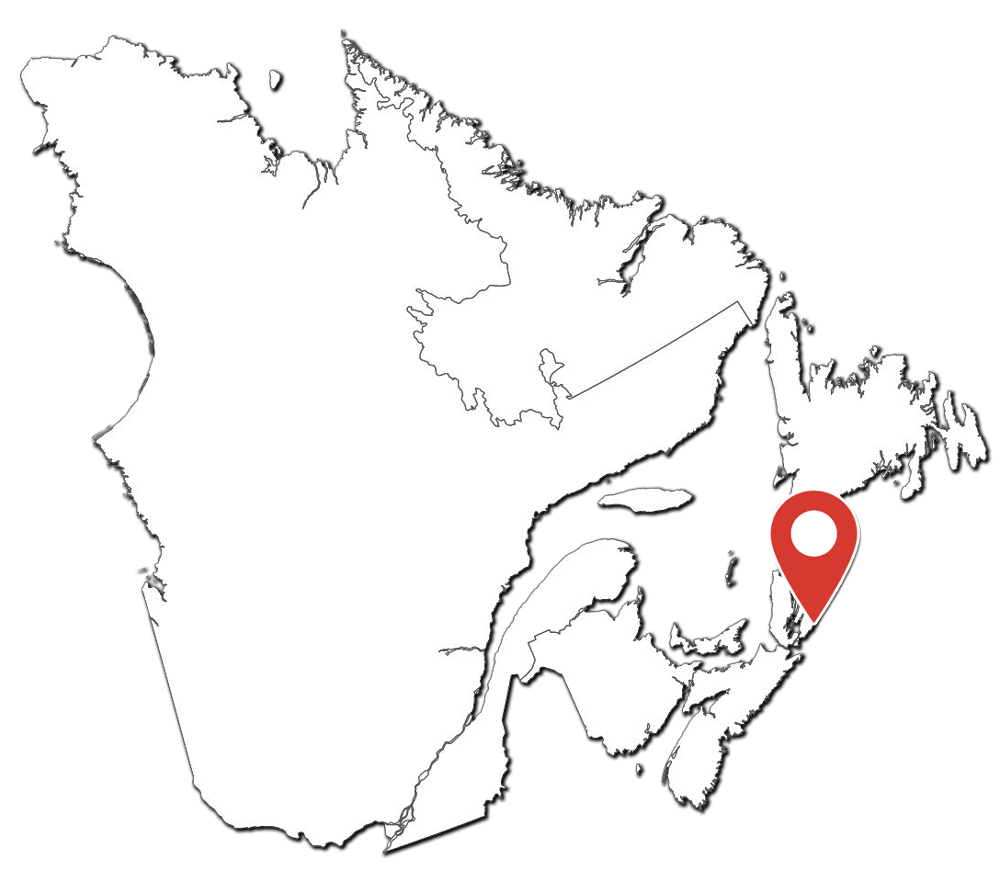
Location: Fourchu, Nova Scotia
Incident type: Attack on boat causing fatality — Code: PRE
Species (Confirmed): White shark (Carcharodon carcharias)
Possible cause(s): Undetermined (attraction to bait associated with lobster fishing possible)
Result: Fatality (drowning)
Status: Confirmed
Description
During the summer of 1953, newspapers across Atlantic Canada reported repeated sightings of a large marine animal that became popularly known as the “Fourchu Rammer.” Contemporary accounts described an enormous shark-like creature that allegedly pursued and rammed fishing boats along the Cape Breton coast, particularly in the vicinity of Louisbourg, Main-à-Dieu, Little Lorraine, Glace Bay, and Fourchu.¹ ² Many of these reports were anecdotal and cannot now be independently verified.
The only incident supported by physical evidence occurred on 9 July 1953, approximately 100 metres offshore from Fourchu. According to contemporary accounts, a large shark struck a wooden lobster boat with sufficient force to punch a hole nearly one metre wide in its hull, causing the vessel to capsize. The two occupants were thrown into the water. Forty-year-old John Burns drowned, while John MacLeod, aged 21, was rescued by a nearby vessel after attempting to swim ashore. Burns’ body was later recovered without any apparent bite wounds or other obvious traumatic injuries.
The event triggered an extensive local search involving members of the Royal Canadian Mounted Police, commercial fishers, and even an aircraft dispatched to locate the shark. Contemporary reports also indicate that many lobster fishers temporarily remained in port because of concerns about further encounters.
Accounts differ regarding the physical evidence recovered from the damaged boat. Depending on the source consulted, investigators recovered either a single tooth fragment¹ or three intact teeth² embedded in the wooden hull. The material was examined by Dr. A. W. L. Needler of the Atlantic Fisheries Biological Station in Fredericton, who tentatively identified it as belonging to a white shark (Carcharodon carcharias). The specimen was subsequently forwarded to William C. Schroeder of Harvard University’s Museum of Comparative Zoology, one of the foremost shark authorities of the period, for independent confirmation.
Several days after the fatal incident, swordfish fisherman Lester Fleet reportedly harpooned a 272-kg shark in Louisbourg Harbour following additional reports of boats being chased ashore near Petit-de-Grat. Many local residents believed this animal to be the legendary Fourchu Rammer. However, the available descriptions are contradictory. One newspaper account² describes Fleet’s specimen as measuring approximately 3.4 metres in length, possessing five gill slits, a blunt snout, a dorsal fin approximately 36 centimetres high, green spotting on both the dorsal and ventral surfaces, and no visible teeth, a combination of characteristics inconsistent with a white shark.
ORS Assessment
The Fourchu incident occupies a unique place in Canadian shark history because it is supported by contemporaneous physical evidence rather than eyewitness testimony alone. Dental material recovered directly from the damaged vessel was independently examined by Dr. A. W. L. Needler and William C. Schroeder, both recognised authorities on shark taxonomy, who identified it as originating from a white shark (Carcharodon carcharias). This evidence provides compelling support for the species identification.
By contrast, the broader Fourchu Rammer narrative is considerably less robust. Reports from neighbouring communities describe an exceptionally large animal whose estimated size, appearance, and behaviour vary substantially among sources and often differ from what is known of white shark biology. Consequently, there is insufficient evidence to conclude that these reports involved the same individual or even the same species.
One parsimonious explanation is that many of the additional sightings involved basking sharks (Cetorhinus maximus). Basking sharks attain very large sizes, possess prominent dorsal fins, and frequently approach vessels while feeding on plankton near the surface before changing course at close range. Their teeth are minute and often unnoticed by casual observers. Similar encounters continue to be reported throughout Atlantic Canada and the Gulf of St. Lawrence and are occasionally misinterpreted as aggressive behaviour.
Although this interpretation is plausible, it remains speculative. The available historical record is insufficient to determine whether the numerous reports referred to a single white shark, multiple unrelated animals, basking sharks, or a combination of genuine observations subsequently amplified through repeated retelling and media coverage.
Based on the available evidence, the Canadian Shark Attack Registry considers this case a confirmed white shark (Carcharodon carcharias) attack on a lobster boat resulting in the vessel’s capsizing and the subsequent drowning of one occupant. The recovery and expert identification of diagnostic dental material embedded in the hull provide one of the strongest lines of evidence available for any historical shark incident in Canada. While many additional reports associated with the legendary “Fourchu Rammer” remain unverified and may involve other species, the Fourchu boat attack itself is unequivocally confirmed.
Sidenote
The Fourchu incident was featured in the February 1968 issue of National Geographic magazine and illustrated by renowned artist Paul Calle. The same illustration later appears briefly in the film Jaws and served as the inspiration for the banner image used by the Canadian Shark Attack Registry, reflecting one of the most historically significant shark incidents ever documented in Canadian waters.
References
¹ Day, L. R., & Fisher, H. D. (1954). Notes on the Great White Shark, Carcharodon carcharias, in Canadian Atlantic Waters. Copeia, 1954(4), 295–296.
² Poisson-mystère en Nouvelle-Écosse. Le Soleil (Québec). 21 July 1953.
Additional contemporary newspaper coverage: The Guardian (14 July 1953); The Winnipeg Free Press (11 July 1953).
CSAR ID: CSAR-0016
Date: 1940-04-04
Location: Île aux Basques, Québec
Incident type: Boat approached and bumped by shark — Code: ST
Species (Confirmed): Greenland shark (Somniosus microcephalus)
Possible cause(s): Undetermined (attraction to blood trailing from an animal carcass possible)
Result: No injury
Status: Confirmed

Description
On 4 April 1940, Charles Morency, warden of Île aux Basques for the Société Provencher d’Histoire Naturelle du Canada, reportedly experienced a close encounter with a large shark while travelling from Trois-Pistoles to Île aux Basques in the Lower St. Lawrence Estuary.¹
According to Morency’s account, he was transporting the carcass of a small animal intended as food for the island’s foxes. Blood escaping from the carcass reportedly formed a visible trail behind the vessel, after which a large marine animal estimated to measure approximately four metres in length appeared several hundred feet astern.
Initially believing the animal to be a porpoise, Morency watched as it rapidly approached before diving beneath the surface and reappearing immediately behind the boat. The resulting disturbance allegedly came close to capsizing the craft. The shark then dived again, surfaced alongside the vessel, and finally passed beneath it, reportedly lifting the hull before continuing ahead of the bow and disappearing from sight.
Morency identified the animal as a blue shark (Prionace glauca), describing it as grey-blue in colour and possessing a mouth characteristic of the species. An experienced fisherman who had previously captured sharks in the Gulf of St. Lawrence, he nevertheless admitted that the encounter had taken him completely by surprise.
A substantially similar account was republished the following year in Le Progrès du Golfe.²
ORS Assessment
The occurrence of a close encounter between Charles Morency and a large shark appears credible and is supported by contemporaneous newspaper accounts together with the testimony of an experienced fisherman familiar with sharks. The presence of blood trailing behind the vessel provides a straightforward and biologically plausible explanation for why a large scavenging shark may have approached and followed the boat.
The reported species identification, however, is difficult to reconcile with current knowledge of shark distribution in the St. Lawrence Estuary. There are no verified records of blue sharks (Prionace glauca) west of Grande-Vallée, approximately 343 kilometres (185 nautical miles) downstream from Trois-Pistoles, and their occurrence in the ice-laden estuary during early April would be highly improbable.
By contrast, the Greenland shark (Somniosus microcephalus) is a year-round resident of the Estuary and is regularly encountered during winter and spring. Given the location, season, water temperature, and ecological context, it represents by far the most parsimonious identification despite Morency’s original conclusion.
Several aspects of the reported behaviour nevertheless warrant caution. Published telemetry data indicate that Greenland sharks generally cruise at relatively modest speeds, averaging approximately 0.3 m/s.³ Consequently, the claim that the shark rapidly closed a distance of several hundred feet or generated a wave capable of nearly capsizing the vessel is difficult to reconcile with current understanding of the species’ swimming performance. Likewise, while accidental contact with the underside of a small craft is conceivable, there is no evidence that Greenland sharks intentionally attempt to overturn boats.
The type of vessel involved also remains uncertain. Contemporary accounts refer to a canoe, although it is possible that Morency was instead using the larger motorised service launch normally employed for travel between Trois-Pistoles and Île aux Basques.
Based on the available evidence, the Canadian Shark Attack Registry considers this case a confirmed close encounter involving a Greenland shark (Somniosus microcephalus) that approached and apparently bumped or passed beneath a small vessel after being attracted to blood trailing from an animal carcass. While several dramatic elements of the account, including the shark’s reported speed and its alleged attempts to overturn the boat, are difficult to substantiate and may reflect observational error or embellishment, the encounter itself is credible and consistent with the known scavenging ecology of the species.
Sidenote
This historical account illustrates the remarkable olfactory capabilities of the Greenland shark and its willingness to investigate potential food sources in extremely shallow water. Similar behaviour has since been documented repeatedly in both Arctic communities and the St. Lawrence system, where sharks are known to approach boats and shorelines in response to blood and animal remains.
References
¹ Poursuivi par un requin. Le Soleil (Québec). 11 April 1940.
² Une histoire de requins. Le Progrès du Golfe. 6 June 1941.
³ Gallant, J. J., Rodríguez, M. A., Stokesbury, M. J. W., & Harvey-Clark, C. (2016). Influence of environmental variables on the diel movements of the Greenland shark (Somniosus microcephalus) in the St. Lawrence Estuary. Canadian Field-Naturalist, 130(1), 1–14.
CSAR ID: CSAR-0015
Date: 1936-08-11
Location: Georges Bank, Nova Scotia*
Incident type: Shark leaps onto fishing dory — Code: DF
Species (Suspected): White shark (Carcharodon carcharias)
Possible cause(s): Undetermined (shark hooked while feeding on a captured cod possible)
Result: No injury
Status: Confirmed

Description
On 11 August 1936, three fishermen from the schooner Raymonde, Albion Muise, Peter Dousette, and Jack Shannon, reportedly experienced a remarkable encounter with a large shark while cod fishing on Georges Bank. According to a contemporary account published in The New York Times, the men had hooked a cod that was subsequently swallowed by a large shark, causing the animal itself to become caught on the fishing line.¹
During the ensuing struggle, the shark reportedly leapt completely out of the water and landed across the small dory occupied by the three fishermen. The animal was estimated to measure approximately six metres (20 feet) in length.
The shark was eventually removed from, or freed itself from, the boat and returned to the water. According to the newspaper account, it remained in the immediate vicinity for approximately 15 minutes, during which time it continued to alarm the occupants of the dory. No injuries were reported.
The available description does not indicate whether the shark subsequently rammed, bit, or otherwise physically attacked the vessel after returning to the water.
ORS Assessment
The occurrence of a dangerous encounter between the fishermen and a large hooked shark is supported by contemporaneous reporting and is consistent with the circumstances described. The case is therefore considered confirmed.
The species identification, however, is less certain. The original newspaper report referred to the animal as a “shovelnose shark,” a common name that has historically been applied inconsistently to several unrelated fishes and does not correspond to any recognised shark species occurring in Atlantic Canadian waters. Consequently, the reported name cannot be relied upon for taxonomic identification.
Based on the estimated size of the animal, the location on Georges Bank, the season of occurrence, and the behaviour exhibited after becoming hooked, the white shark (Carcharodon carcharias) represents the most plausible candidate species. White sharks are well documented from Georges Bank during the summer months and are capable of violent defensive reactions when restrained or hooked during feeding events.
Alternative identifications cannot be excluded because no photographs, specimens, teeth, or detailed morphological descriptions are available. Likewise, there is no evidence that the shark intentionally attacked the dory after returning to the water. Its continued proximity may simply have reflected the confusion and stress associated with being hooked and entangled.
Based on the available evidence, the Canadian Shark Attack Registry considers this case a confirmed encounter in which a large shark became hooked while attempting to consume a captured cod and subsequently leapt onto a fishing dory. The balance of evidence favours a white shark (Carcharodon carcharias) as the species involved. However, because no direct physical evidence confirming the identification exists, the species remains suspected rather than confirmed.
Sidenote
Although often described as an “attack,” the available evidence suggests that the shark’s behaviour was most likely a defensive reaction after becoming accidentally hooked while feeding. Incidents in which large sharks leap into boats under similar circumstances have been documented elsewhere in the world but remain exceedingly rare.
* Some historical databases incorrectly list this incident as having occurred in Newfoundland. Georges Bank lies offshore of Nova Scotia.
Reference
¹ 20-Foot Shark Attacks Dory. The New York Times. 13 August 1936.
CSAR ID: CSAR-0014
Date: 1932-07-02
Location: Bay of Fundy (off Digby Gut), Nova Scotia
Incident type: Attack on boat — Code: PRE
Species (Confirmed): White shark (Carcharodon carcharias)
Possible cause(s): Undetermined (attraction to fish caught on fishing gear possible)
Result: Damage to hull and propeller
Status: Confirmed
Description
In the early morning of approximately 2 July 1932, fisherman Wilson Munroe and his young son were tending fishing trawls from their 25-foot (7.6-metre) motorboat in about 40 fathoms (73 metres) of water approximately 10 miles (16 kilometres) northwest of Digby Gut, Nova Scotia. The incident was subsequently documented in detail by Harry Piers based on interviews with the witnesses and examination of the physical evidence.¹
According to Piers, fishermen aboard another vessel located approximately one-quarter mile (400 metres) away first noticed a large shark circling Munroe’s boat while it remained stationary over the fishing gear. They believed the animal had been attracted by fish caught on the trawls.
Without warning, the shark reportedly surged towards the vessel, striking it with sufficient force to heel the boat sharply onto its starboard side and allow water to wash over the port quarter. The animal then passed beneath the hull, bumping or scraping along its underside before disappearing.
After returning to shore, Munroe examined the damage and discovered that the blades of the boat’s three-bladed propeller had been bent. Several shark teeth were also found embedded in the keel or one of the bottom strakes, indicating that the animal had bitten the vessel during the encounter. One of the recovered teeth was later deposited in the Provincial Museum for examination.
Munroe estimated the shark to have measured approximately 30 feet (9.1 metres) in length, although he acknowledged that he never obtained a clear view of the entire animal.
ORS Assessment
This incident is supported by both eyewitness testimony and contemporaneous physical evidence. Most importantly, shark teeth recovered directly from the damaged vessel were examined by Harry Piers and identified as belonging to a white shark (Carcharodon carcharias), providing compelling evidence for the species involved.
The behaviour described is consistent with a white shark responding to stimuli associated with active fishing operations. Fish restrained on trawl gear, together with blood and struggling prey, can attract large predatory sharks and elicit investigatory or feeding behaviour directed towards the catch rather than the vessel itself. The resulting collision and bite damage are therefore plausibly explained as the consequence of a shark attempting to seize fish associated with the gear.
The estimate that the shark measured approximately 30 feet (9.1 metres) should, however, be treated with caution. No scientifically verified white shark has approached that length, and substantial overestimation of body size is common during unexpected encounters with large marine animals, particularly under stressful conditions.
Alternative identification as a basking shark (Cetorhinus maximus) is not supported by the available evidence. The recovery of diagnostic serrated teeth embedded in the hull, together with the reported biting behaviour and damage inflicted on the vessel, is incompatible with the feeding ecology and dentition of basking sharks.
Based on the available evidence, the Canadian Shark Attack Registry considers this case a confirmed white shark (Carcharodon carcharias) interaction with a fishing vessel actively tending fish-laden trawls. The recovery and identification of shark teeth embedded in the damaged hull provide direct physical evidence supporting both the occurrence of the incident and the species involved. The interaction is most parsimoniously interpreted as a food-motivated response to fishing activity rather than an attack directed at the boat itself.
Sidenote
This incident represents one of the earliest documented Canadian cases in which shark teeth recovered directly from a damaged vessel provided definitive evidence for species identification. It also illustrates how fishing activity and associated prey can inadvertently attract large predatory sharks.
Reference
¹ Piers, H. (1934). Accidental occurrence of the man-eater or great white shark, Carcharodon carcharias (Linnaeus), in Nova Scotian waters. Proceedings of the Nova Scotian Institute of Science, 18(3), 192–203.
CSAR ID: CSAR-0013
Date: 1925-01-07
Location: Burrard Inlet (Second Narrows), Vancouver, British Columbia
Incident type: Attack on diver — Code: DF
Species: Unknown
Possible cause(s): Undetermined (diver perceived as a disturbance or intruder during underwater construction work possible)
Result: No injury
Status: Confirmed

Description
On 7 January 1925, commercial hardhat diver John (Jack) Bruce reportedly experienced a prolonged underwater confrontation with a shark while working on the construction of water mains associated with the Second Narrows crossing in Burrard Inlet, British Columbia. The incident was reported the following day in The Vancouver Sun.¹
According to the newspaper account, Bruce had descended to a depth of approximately 95 feet (29 metres) when he noticed a large fish approaching him on the bottom. Initially uncertain of its identity, he soon realised that it was a shark after it repeatedly rushed towards his legs.
Equipped with an iron bar used in his underwater work, Bruce reportedly defended himself by striking and jabbing at the shark whenever it approached. Fearing that ascending immediately might expose him to greater danger, he chose not to signal the surface crew to haul him up, believing the shark might seize him during the ascent.
The confrontation allegedly lasted approximately 30 minutes before Bruce succeeded in killing the shark with repeated blows from the iron bar. The carcass was then attached to a line and raised to the surface along with the diver. According to the newspaper, Bruce returned to work the following day after recovering from exhaustion.
The shark was reported to measure approximately 6 feet 2 inches (1.9 metres) in length and was subsequently displayed publicly before being destroyed.
ORS Assessment
The existence of an unusual encounter between John Bruce and a shark is supported by contemporaneous newspaper coverage and is therefore regarded as credible. However, no photographs of the shark, preserved specimen, museum record, or detailed scientific description are known to exist, preventing definitive identification of the species or independent verification of every aspect of the narrative.
The account itself should be interpreted cautiously. Newspaper reporting from the early twentieth century frequently emphasised dramatic details, and certain elements, particularly the reported duration of the struggle and the successful killing of the shark by repeated blows while wearing a cumbersome standard diving dress, may have been embellished through retelling or editorial sensationalism.
Based on the reported size and location, several candidate species merit consideration. White sharks (Carcharodon carcharias) are unlikely because winter records from Burrard Inlet are lacking and the species is not known to frequent the area under such conditions. Salmon sharks (Lamna ditropis) are powerful, fast-swimming predators and would be improbable candidates for the behaviour described. Pacific spiny dogfish (Squalus suckleyi) are excluded by their substantially smaller size.
The two most plausible candidates are the bluntnose sixgill shark (Hexanchus griseus) and the Pacific sleeper shark (Somniosus pacificus), both of which occur in the region, frequent deep water, and are capable of approaching divers or underwater structures. Unfortunately, the limited description provided in contemporary sources is insufficient to distinguish between these species.
Based on the available evidence, the Canadian Shark Attack Registry considers this case a confirmed close encounter in which a commercial diver repeatedly defended himself against an approaching shark while working underwater in Burrard Inlet. However, the absence of diagnostic physical evidence or a detailed morphological description prevents reliable identification of the species involved. Based on the location, season, reported size, and known regional fauna, the shark was most likely either a bluntnose sixgill shark (Hexanchus griseus) or a Pacific sleeper shark (Somniosus pacificus). Accordingly, the species remains unknown.
Sidenote
Interestingly, later that same year, The Vancouver Sun reported the capture and public exhibition of another large shark described as a “mud shark” in Burrard Inlet.² Although identified by that common name, its reported size and behaviour appear more consistent with a Pacific sleeper shark than with the much smaller Pacific spiny dogfish traditionally referred to as a mud shark in British Columbia.
References
¹ Diver Wins Fierce Battle With Shark. The Vancouver Sun. 8 January 1925.
² Big Mud Shark Caught in Harbor. The Vancouver Sun. 10 December 1925.
CSAR ID: CSAR-0012
Date: Before 1924
Location: Grand Banks, Newfoundland and Labrador
Incident type: Reported shark bite while tending fishing gear — Code: HR
Species: Unknown
Possible cause(s): Attraction to baited fishing gear (Provoked)
Result: Injury to the hand
Status: Unconfirmed
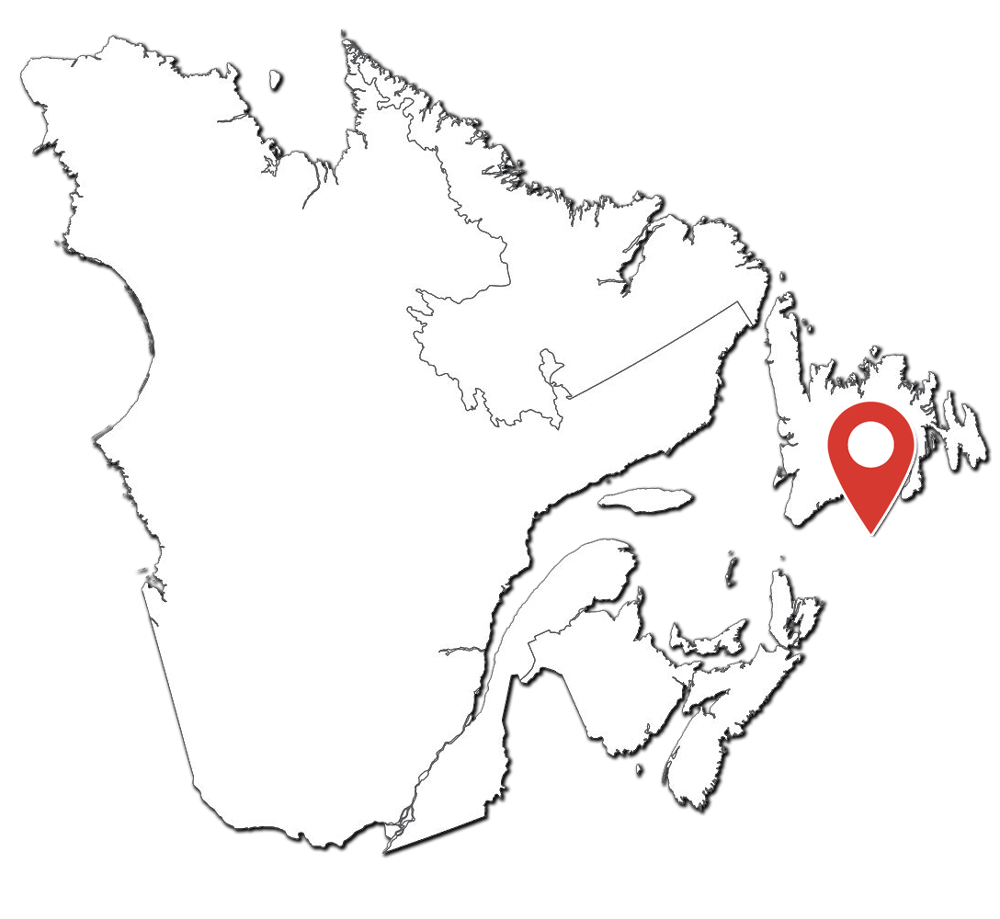
Description
According to a historical account published by Charles Edward Russell in From Sandy Hook to 62°, fisherman Joe Folsom reportedly sustained an injury to his hand after being bitten by a shark while tending fishing lines aboard the schooner Cape Ann near the western edge of the Grand Banks of Newfoundland.¹
Beyond this brief statement, few details are available. The source provides no description of the shark, the circumstances immediately preceding the alleged bite, the severity of the injury, or the subsequent outcome for the fisherman. No contemporaneous newspaper reports, medical records, official investigations, photographs, or physical evidence corroborating the incident have been located.
Assessment
The available evidence is insufficient to establish that Joe Folsom was bitten by a shark. The account derives from a secondary historical publication written several years after the alleged event and is unsupported by independent documentation or descriptive details that would permit critical evaluation.
If the incident occurred as reported, the presence of baited fishing lines and captured fish would have created circumstances capable of attracting sharks to the vessel. Under such conditions, an accidental bite sustained while handling fishing gear is biologically plausible and has been documented elsewhere. However, the available information does not allow this interpretation to be confirmed.
Similarly, there is no basis upon which to infer the species responsible. The Grand Banks support several shark species capable of interacting with fishing operations, but the historical record provides no diagnostic information from which a reliable identification can be made.
Taken together, the available evidence is insufficient to verify that a shark was responsible for Joe Folsom’s reported hand injury or to identify the species allegedly involved. The case is therefore classified as Unconfirmed and is retained in the Canadian Shark Attack Registry as a historical report pending the discovery of additional documentary evidence.
Significance
This case illustrates the challenges associated with evaluating historical shark incidents. Although the available evidence is insufficient to verify the event, documenting such reports helps ensure transparency and allows future researchers to reassess them should additional information become available. The inclusion of unconfirmed cases reflects the Registry’s commitment to recording and evaluating historical claims rather than excluding them solely because corroborating evidence has not survived.
References
- Russell, C. E. (1929). From Sandy Hook to 62°. Sandy Hook Pilots Association, pp. 310–311.
CSAR ID: CSAR-0011
Date: 27 June 1920
Location: Hubbards, Nova Scotia
Incident type: Attack on boat — Code: DF
Species (Confirmed): White shark (Carcharodon carcharias)
Possible cause(s): Defensive response after being harpooned (Provoked)
Result: No injury
Status: Confirmed

Description
On 27 June 1920, fishermen Jeremiah Harnish and John Chandler encountered a large shark while fishing near Slaunwhite’s Ledge, approximately 0.5 miles (0.8 km) south-southeast of the bell buoy marking the entrance to Hubbard Cove, Nova Scotia. The incident was later documented in detail by Harry Piers based on interviews with the participants and examination of the available evidence.¹
Believing the animal to be an Atlantic bluefin tuna (Thunnus thynnus), the fishermen harpooned it from their motorboat before transferring to a small rowboat being towed astern, intending to tire the fish in the customary manner.
Rather than making the prolonged dives typical of a hooked tuna, the animal remained near the surface. Approximately ten minutes after being struck, it surfaced about 15 feet (4.5 metres) from the rowboat before suddenly charging the stern.
The impact was forceful enough to throw John Chandler into the water. The shark then bit the side of the boat, gouging the wooden planking and leaving behind a large triangular tooth embedded in the hull. Chandler, an experienced swimmer, quickly returned to the boat and was pulled aboard while the shark did not pursue him further.
Recognising that they were dealing with a shark rather than a tuna, the fishermen cut the harpoon line and abandoned the capture, allowing the animal to swim away with the embedded harpoon and attached rope.
Although the original tooth was subsequently lost, Harry Piers obtained a detailed sketch and description from Harnish’s son. The tooth reportedly measured approximately 1.75 inches (4.4 cm) in height and 1.5 inches (3.8 cm) across the base and possessed the broad triangular shape and serrated cutting edges characteristic of a white shark.
Assessment
This incident is supported by eyewitness testimony and physical evidence in the form of a shark tooth recovered directly from the damaged vessel. Although the specimen was later lost, the measurements and detailed sketch preserved by Harry Piers provide valuable diagnostic information.
The described tooth morphology, a broad triangular crown with coarse serrations along both cutting edges, is characteristic of the white shark (Carcharodon carcharias) and inconsistent with other shark species regularly encountered in Atlantic Canadian waters. The estimated size of the shark and the nature of the damage inflicted on the rowboat likewise support this identification.
The shark’s behaviour is also readily explained by the circumstances of the encounter. Having been harpooned and restrained by a line, the animal was almost certainly responding defensively to injury rather than attempting to prey upon the occupants of the vessel. Notably, although John Chandler was thrown into the water by the collision, the shark made no attempt to pursue or bite him after he entered the sea.
Subsequent observations have demonstrated that white sharks continue to occur regularly in the waters surrounding Hubbards, including several well-documented encounters involving divers and tagged individuals in recent years. While these modern records do not constitute evidence for the 1920 incident, they are consistent with the long-term presence of the species along this section of the Nova Scotian coast.
Taken together, the available evidence confirms that the shark involved in this incident was a white shark (Carcharodon carcharias) acting defensively after being harpooned. The recovered tooth, eyewitness testimony, and documented damage to the vessel provide strong support for both the occurrence of the event and the species identification. The case is therefore classified as Confirmed.
Significance
This incident represents one of the strongest historical records of a white shark interacting aggressively with a vessel in Canadian waters. The recovery of a diagnostic tooth from the damaged boat provides unusually robust evidence for species identification, while the circumstances of the encounter clearly illustrate the distinction between defensive and predatory behaviour. Although the shark forcefully struck and bit the boat, its actions occurred only after it had been harpooned, and it did not attack the fisherman who entered the water following the collision.
References
- Piers, H. (1933). Accidental Occurrence of the Man-Eater or Great White Shark, Carcharodon carcharias (Linn.) in Nova Scotian Waters. Proceedings of the Nova Scotian Institute of Science, 18(3), 192–203.
CSAR ID: CSAR-0010
Date: 1905-07-05
Location: False Creek (Vancouver), British Columbia
Incident type: Child stalked by shark — Code: ST
Species (Suspected): Bluntnose sixgill shark (Hexanchus griseus)
Possible cause(s): Attraction to the movements and vibrations produced by a child wading in shallow water (Unprovoked)
Result: No injury
Status: Confirmed
Description
On the evening of 5 July 1905, eight-year-old Harry Menzies was wading in shallow water near the mouth of False Creek, Vancouver, when a large shark was reportedly observed approaching him from deeper water. The incident was described in contemporaneous articles published in the Vancouver Daily World.¹ ²
According to the newspaper account, Ed Dusenberry, who was watching from shore, initially believed he was seeing a swimmer moving beneath the surface before noticing a prominent fin projecting above the water. Realising that the approaching animal was a shark, he shouted a warning and rushed toward the shoreline carrying a pike pole.
The child immediately ran toward shore while the shark continued advancing into progressively shallower water. The animal ultimately stranded itself on the beach, where it was killed by Dusenberry and several other men before it could return to deeper water.
The carcass was subsequently placed on public display beneath a temporary tent, where local residents reportedly paid ten cents for admission. Contemporary newspapers described the specimen as an enormous “man-eating Hawaiian shark,” with one witness speculating that it had followed salmon or perhaps a ship northward into Burrard Inlet.
A follow-up article published the next day included a photograph of the shark, although the image quality is insufficient for definitive identification.²
ORS Assessment
The occurrence of the incident itself is well supported by contemporaneous newspaper accounts and by the existence of a published photograph showing the stranded shark. The evidence therefore confirms that a large shark entered shallow water in close proximity to a child before beaching itself.
The species identification proposed by contemporary observers, however, is not supported by modern knowledge of shark taxonomy or biogeography. No “Hawaiian man-eating shark” matching the description would be expected in coastal British Columbia, and the terminology likely reflects the limited scientific understanding and sensationalised journalism of the period.
Based on the available evidence, the bluntnose sixgill shark (Hexanchus griseus) represents the most plausible candidate. This large deep-water species occurs naturally in the coastal waters of British Columbia, including Burrard Inlet and the Strait of Georgia, and is known to enter relatively shallow water under certain conditions.
Although the published photograph is of limited quality, it appears to depict a shark with a broad, blunt head and relatively small dorsal fin, features more consistent with a bluntnose sixgill shark than with a Pacific sleeper shark (Somniosus pacificus). The apparently diminutive dorsal fin would also effectively exclude the basking shark (Cetorhinus maximus).
The shark’s behavioural motivation cannot be determined with certainty. Its direct approach toward the child may represent investigatory behaviour stimulated by the sounds, vibrations, or movements produced by someone wading through shallow water rather than an attempt at predation. No physical contact occurred before the shark stranded itself.
Based on the available evidence, the Canadian Shark Attack Registry considers this a confirmed shark encounter involving a large shark that closely approached an eight-year-old child before beaching itself on the shoreline. Although the available documentation does not permit definitive species identification, the reported morphology, geographic location, and limited photographic evidence are most consistent with a bluntnose sixgill shark (Hexanchus griseus). Nevertheless, a Pacific sleeper shark (Somniosus pacificus) cannot be excluded, and the species identification therefore remains suspected rather than confirmed.
Sidenote
This remains one of the earliest documented shark encounters involving a child in Canadian history and is unusual in that the shark stranded itself immediately after the approach, allowing it to be examined and photographed. Unfortunately, no preserved specimen or detailed scientific description is known to survive.
References
- A Shark Killed in False Creek. Vancouver Daily World. 6 July 1905.
- False Creek Shark. Vancouver Daily World. 7 July 1905.
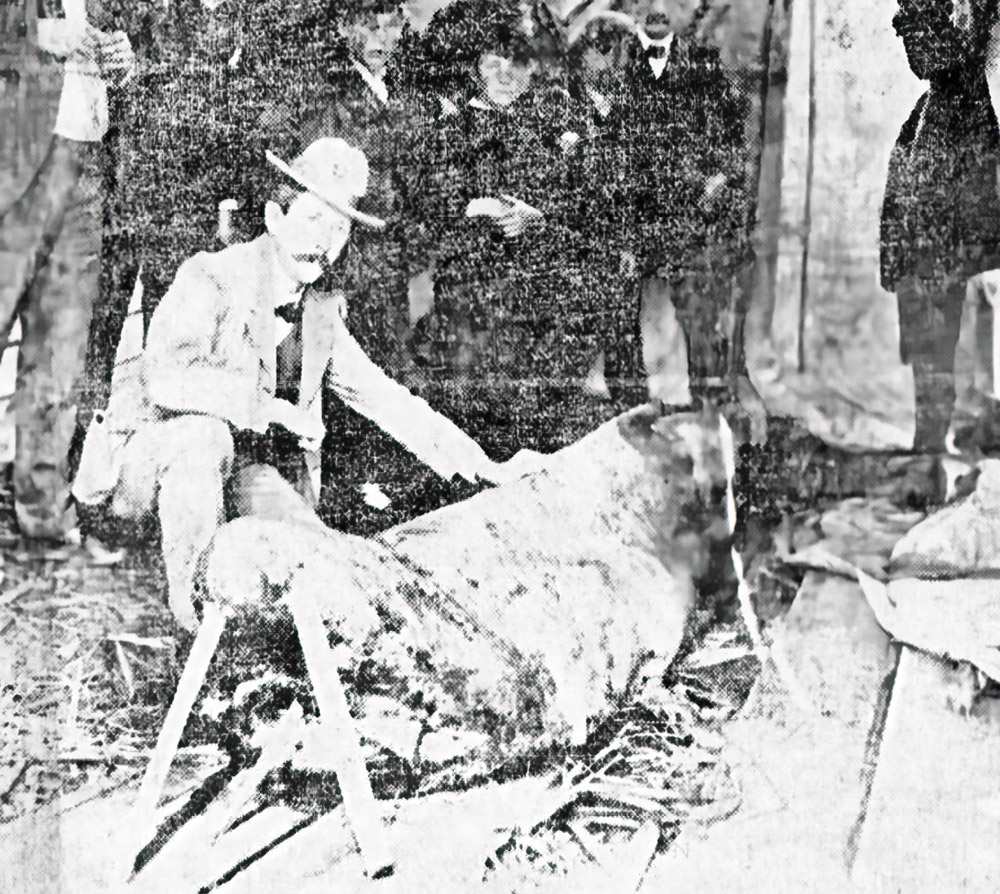
The big shark is still lying in the tent on False Creek near the Granville Street bridge, and yesterday evening until long after dark, crowds flocked to that point to get a look at the marine monster. This morning Mr. Dusenberry was offered $50 for the shark by a local exhibitor, but he has not taken it yet as he wants to allow the Arts Historical Society an opportunity of acquiring it on the same terms first. — False Creek Shark. Vancouver Daily World. 7 January 1925
CSAR ID: CSAR-0009
Date: Reported 1891-08-30
Location: Cabot Strait, Nova Scotia
Incident type: Reported fatal shark attack — Code: PRE
Species: Unknown
Possible cause(s): Undetermined (person overboard during fishing operations)
Result: Fatality
Status: Plausible

Description
According to a historical account published by Charles Edward Russell, 21-year-old fisherman John Roult reportedly fell overboard from the French schooner Société while fishing in the Cabot Strait.¹
Russell states that Roult was immediately attacked by a shark after entering the water and disappeared before he could be rescued. His body was reportedly never recovered.
Beyond these brief details, little information is available. The precise date and location of the incident remain unknown, although the account was reported on 30 August 1891. No description of the shark, eyewitness testimony, official investigation, medical examination, or contemporaneous newspaper coverage has been identified.
ORS Assessment
The available evidence is insufficient to confirm that John Roult was killed by a shark. The account derives from a secondary historical source published decades after the alleged event and is unsupported by contemporaneous documentation or independent corroboration.
Nevertheless, the reported circumstances are biologically plausible. A person unexpectedly entering the water from a fishing vessel could potentially attract the attention of large predatory sharks, particularly in an area where fishing activity, discarded catch, blood, or bait may already be present. The absence of a recovered body is also consistent with a variety of alternative explanations and cannot be regarded as evidence of a shark attack.
The species responsible, if a shark was involved, cannot be determined from the available information. White sharks (Carcharodon carcharias) are known to occur seasonally in the Cabot Strait region and represent one plausible candidate, but no evidence exists to support that identification over any other explanation.
Based on the available evidence, the Canadian Shark Attack Registry considers this case plausible but unconfirmed. The reported circumstances are consistent with a scenario in which a fatal shark attack could have occurred, but the absence of contemporaneous documentation or independent corroboration prevents confirmation. The case is therefore retained in the Registry as a historically reported incident pending the discovery of additional documentary evidence.
Sidenote
Unlike many unconfirmed historical reports, this case is classified as Plausible because the available account describes a scenario that is biologically credible and contains no obvious internal inconsistencies. Its inclusion reflects the Registry’s commitment to documenting historical reports while clearly distinguishing between levels of evidentiary support.
Reference
¹ Russell, C. E. (1929). From Sandy Hook to 62°. Sandy Hook Pilots Association, pp. 310–311.
CSAR ID: CSAR-0008
Date: 1888-08-27
Location: Baie des Ha! Ha!, Saguenay, Québec
Incident type: Reported encounter with stranded shark — Code: DF
Species (Likely): Greenland shark (Somniosus microcephalus)
Possible cause(s): Undetermined (shark stranded by the receding tide possible)
Result: No injury
Status: Discredited
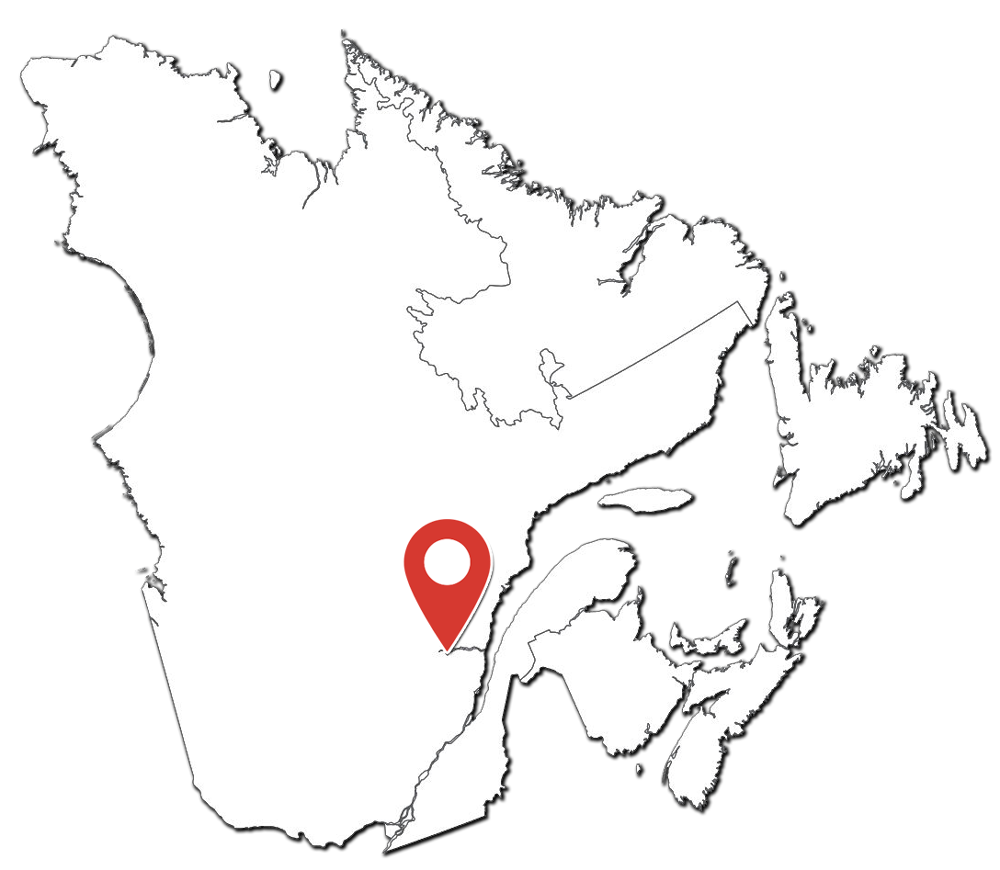
Description
According to an article published in Le Progrès du Saguenay, a woman collecting driftwood along the shore of Baie des Ha! Ha! reportedly encountered a large live shark stranded by the receding tide on 27 August 1888.¹
The newspaper described the animal as measuring approximately four metres in length. Frightened by the unexpected discovery, the woman allegedly attacked it with the gaff she routinely carried while gathering firewood.
The article recounts a dramatic struggle in which the wounded shark supposedly rose upright on its tail, emitted hissing sounds, and repeatedly lunged toward the woman while she continued striking it. As the tide receded further, the animal allegedly became completely stranded, allowing the woman to kill it with a final blow to the throat.
According to the report, local residents subsequently gathered around the carcass, which was cut open and examined, revealing its cartilaginous skeleton and multiple rows of teeth.
More than fifty years later, Le Progrès du Golfe published what appears to be a retelling of the same event, although the narrative had changed substantially. In that version, the shark was said to have nearly attacked a woman washing clothes along the shoreline rather than someone collecting driftwood.³
ORS Assessment
The original newspaper account likely contains a kernel of truth: namely, that a large shark stranded in shallow water near Baie des Ha! Ha! and was subsequently killed by local residents.
However, the behavioural elements that transformed the event into an alleged shark attack are inconsistent with the known biology of any shark species.
Although the newspaper identified the animal as a “man-eating” porbeagle shark, the reported size and location are far more consistent with a Greenland shark (Somniosus microcephalus). Porbeagle sharks (Lamna nasus) rarely exceed 2.6 metres in verified length, whereas Greenland sharks commonly attain four metres or more and are well documented from the Saguenay Fjord and adjacent waters.²
Equally problematic are the reported behaviours. There is no evidence that Greenland sharks can rear upright on their tails while stranded or intentionally confront humans on land. Likewise, sharks possess no specialised vocal organs and are not known to produce hissing sounds. Any noises perceived by witnesses were more likely caused by air or water being forced through the mouth or gill openings as the dying animal struggled.
The substantial differences between the 1888 and 1941 versions of the story further illustrate how historical accounts can become embellished through repeated retelling, with an encounter involving a stranded shark gradually evolving into a dramatic tale of an attempted attack.
Based on the available evidence, the Canadian Shark Attack Registry considers it likely that a large shark, most probably a Greenland shark (Somniosus microcephalus), became stranded in shallow water and was subsequently killed by local residents. However, there is no credible evidence that the animal attacked or attempted to attack the woman described in the newspaper account. The dramatic behavioural elements are inconsistent with the known biology of Greenland sharks and are best interpreted as exaggeration or folklore. The case is therefore classified as Discredited with respect to aggressive shark behaviour toward humans.
Sidenote
This case is retained in the Canadian Shark Attack Registry because it provides an instructive example of how genuine observations can evolve into sensational stories over time. Its inclusion demonstrates that the Registry critically evaluates historical reports rather than accepting them at face value.
References
¹ Le Progrès du Saguenay. 27 September 1888.
² Castro, J. I. (2011). The Sharks of North America. Oxford University Press. 613 pp.
³ Une histoire de requins. Le Progrès du Golfe. 6 June 1941.
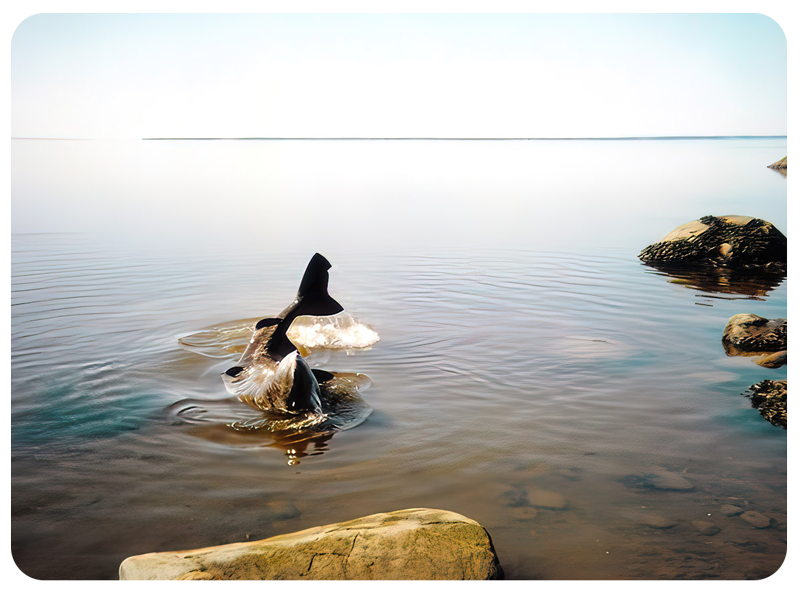
(Above) A stranded Greenland shark cannot stand on its tail. Photo from Baie-Comeau (2005). © ORS.
CSAR ID: CSAR-0007
Date: 1888-08-14
Location: Sable Island, Nova Scotia
Incident type: Reported shark attack following shipwreck — Code: PRE
Species: Unknown
Possible cause(s): Undetermined (shipwreck with numerous people struggling in the water and possible blood from injuries)
Result: Fatality
Status: Plausible
Description
On 14 August 1888, the transatlantic steamship SS Geiser sank after colliding with the Danish liner SS Thingvalla in dense fog near Sable Island, Nova Scotia. The disaster resulted in numerous fatalities as passengers and crew abandoned the vessel and entered the water.
According to a contemporary newspaper account published several days later, one of the survivors reportedly heard a passenger cry out that he had been bitten by a shark while struggling in the water.¹ The individual was subsequently lost and presumed to have perished during the sinking.
No further details concerning the alleged attack were provided. The available account does not describe the shark, the nature of the reported injuries, whether any witnesses observed the animal directly, or whether the victim’s body was ever recovered.
ORS Assessment
The available evidence is insufficient to confirm that a shark was involved in this incident. The report is based on a single historical newspaper account describing a statement allegedly made amid the confusion and panic of a major maritime disaster and is unsupported by physical evidence, independent eyewitness testimony, or a medical examination.
Nevertheless, the circumstances described are biologically plausible. A large shipwreck involving numerous people entering the water simultaneously could create conditions capable of attracting sharks through splashing, struggling survivors, and the presence of blood from traumatic injuries sustained during the collision or evacuation.
The waters surrounding Sable Island also lie within the seasonal range of the white shark (Carcharodon carcharias), making that species a plausible candidate should a shark interaction actually have occurred. However, no evidence exists to support that identification, nor can other explanations be excluded. The victim may simply have drowned or sustained injuries unrelated to any shark before disappearing beneath the surface.
Based on the available evidence, the Canadian Shark Attack Registry considers this case plausible but unconfirmed. While the reported circumstances are biologically credible and contain no obvious internal inconsistencies, the absence of corroborating evidence prevents verification that a shark was involved or identification of the species responsible. The case is therefore retained in the Registry pending the discovery of additional documentary evidence.
Sidenote
This case illustrates the challenges of evaluating nineteenth-century maritime disasters, where confusion, limited documentation, and the absence of recovered victims often make it impossible to distinguish between verified events and unconfirmed reports. Its inclusion reflects the Registry’s commitment to documenting historical accounts while critically assessing the strength of the available evidence.
Reference
¹ Aurora Daily Express. 18 August 1888.
CSAR ID: CSAR-0006
Date: 1874
Location: St. Pierre Bank, Newfoundland and Labrador*
Incident type: Attack on boat — Code: HR
Species (Confirmed): White shark (Carcharodon carcharias)
Possible cause(s): Undetermined (attraction to fish carried aboard the dory possible)
Result: No injury
Status: Confirmed

Description
In 1874, a large shark reportedly attacked a small fishing dory operating on St. Pierre Bank, south of Newfoundland. The incident was first documented by Frederic Ward Putnam and later discussed in detail by Harry Piers.¹ ²
According to the original account, the dory was heavily laden with freshly caught fish when it came under repeated attack from the shark. The animal reportedly rammed and bit the vessel several times with sufficient force to heel it over, causing part of the catch to spill into the water and allowing seawater to enter the hull. The two occupants reportedly kept the boat afloat only by continuously bailing.
Examination of the damaged planking revealed numerous bite marks, and fragments of several shark teeth were recovered from the hull. One nearly complete lower anterior tooth measured approximately 1.8 inches (4.6 cm) from the centre of the root to the tip.
Samuel Garman examined the specimen and concluded that it belonged to Carcharias (Prionodon) lamia or a closely related form, estimating that the shark exceeded 13 feet (4 metres) in length.
Subsequent reviews by Bigelow and Welsh, and later by Harry Piers, re-examined the evidence and concluded that the recovered tooth was more appropriately attributable to the white shark (Carcharodon carcharias).¹
ORS Assessment
This incident represents one of the strongest nineteenth-century records of a white shark interacting with a vessel in Canadian waters because it is supported by direct physical evidence rather than eyewitness testimony alone.
Although Samuel Garman’s original taxonomic assignment reflected the nomenclature and understanding of the period, later authorities independently concluded that the recovered tooth belonged to a white shark. The morphology of the specimen, together with the reported damage inflicted on the vessel, is fully consistent with that interpretation.
The circumstances of the encounter are likewise biologically plausible. A small wooden dory heavily laden with freshly caught fish would have released blood, bodily fluids, and other attractants into the surrounding water. Under such conditions, repeated biting or ramming of the boat is readily interpreted as investigatory or feeding-related behaviour directed toward the catch rather than an attack on the fishermen themselves.
Some uncertainty has existed regarding the precise location of the event. While Bigelow and Welsh later referred to Banquereau Bank, Harry Piers reviewed the original documentation and concluded that Putnam’s account almost certainly referred to St. Pierre Bank, an interpretation that is accepted here.¹
Based on the available evidence, the Canadian Shark Attack Registry considers this case a confirmed white shark (Carcharodon carcharias) interaction with a fish-laden dory operating on St. Pierre Bank. The recovery and subsequent taxonomic evaluation of shark teeth embedded in the hull provide compelling physical evidence supporting both the occurrence of the incident and the species involved. The interaction is most parsimoniously interpreted as a food-motivated response associated with the vessel’s catch rather than aggression directed toward its occupants.
Sidenote
This incident is one of the earliest documented Canadian examples in which diagnostic shark teeth recovered directly from a damaged vessel permitted retrospective confirmation of the species responsible. It also illustrates how historical taxonomic interpretations can evolve as scientific understanding improves.
* Location note: Some secondary sources have incorrectly attributed this incident to Banquereau Bank. Review of the original literature by Harry Piers indicates that the event almost certainly occurred on St. Pierre Bank, south of Newfoundland.
References
¹ Piers, H. (1933). Accidental Occurrence of the Man-Eater or Great White Shark, Carcharodon carcharias (Linn.) in Nova Scotian Waters. Proceedings of the Nova Scotian Institute of Science, 18(3), 192–203.
² Putnam, F. W. (1874). Tooth of a man-eater that attacked a dory near St. Pierre Bank. Bulletin of the Essex Institute, 6(4), 72.
CSAR ID: CSAR-0005
Date: October 1860
Location: Off Cape Canso, Nova Scotia
Incident type: Reported attack on shipwrecked crew — Code: PRE
Species: Unknown
Possible cause(s): Undetermined (shipwreck with survivors struggling in the water and possible blood from injuries)
Result: Fatalities
Status: Plausible
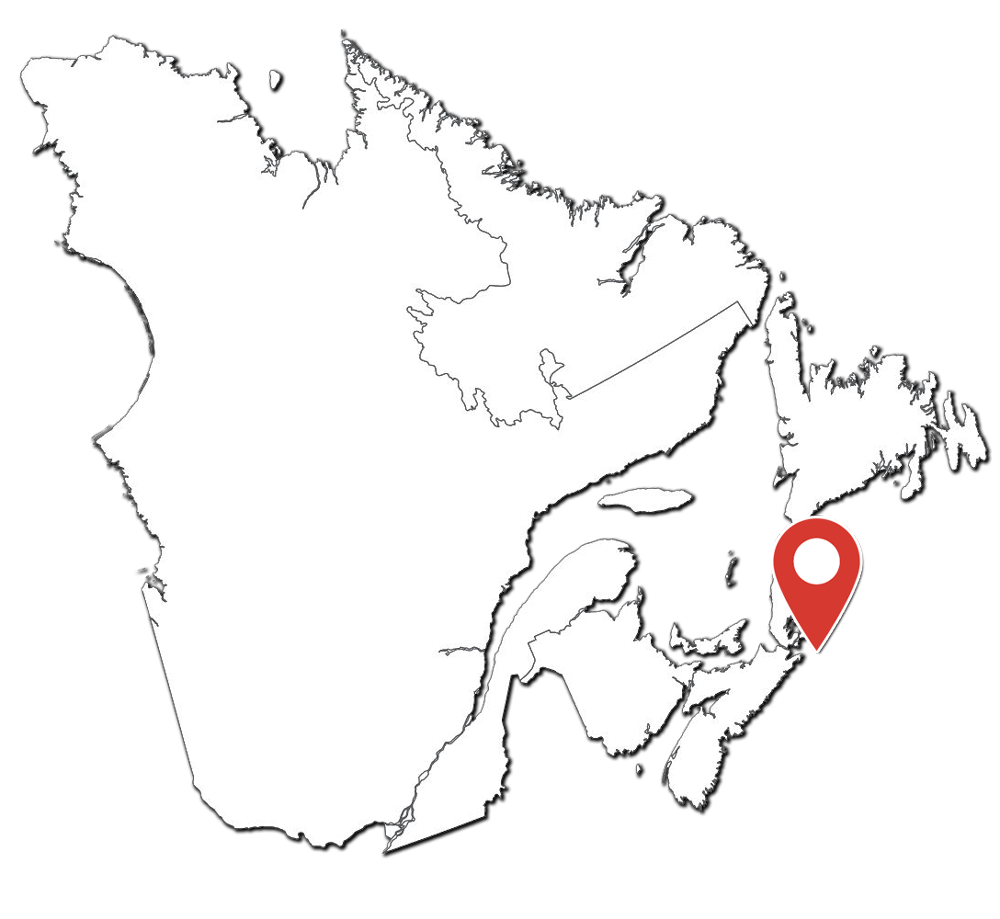
Description
According to a contemporary newspaper report published in The Daily Dispatch, two fishermen were allegedly killed by sharks following the loss of their schooner after it collided with a steamer in dense fog off Cape Canso, Nova Scotia, in October 1860.¹
The account states that members of the crew initially survived by clinging to the partially submerged wreck for approximately two days while awaiting rescue. During that time, seven men were reportedly swept away by heavy seas.
The remaining nine survivors eventually abandoned the wreck in a lifeboat. Shortly after launching, the boat itself capsized, throwing all occupants into the water. According to the newspaper report, two of the men were then attacked and killed by sharks.
The surviving seven crew members succeeded in righting the lifeboat and climbing back aboard. Two later died from exhaustion before the remaining survivors were ultimately rescued by a passing vessel.
No details regarding the species involved, the nature of the alleged injuries, or eyewitness descriptions of the sharks were provided in the published account.
ORS Assessment
The available evidence is insufficient to confirm that sharks were responsible for the deaths of the two crew members. The account relies on a single contemporary newspaper source and is unsupported by physical evidence, official investigations, recovered bodies, or detailed eyewitness descriptions.
Nevertheless, the reported circumstances are biologically plausible. A prolonged shipwreck involving numerous exhausted survivors struggling at the surface could potentially attract large predatory sharks, particularly if blood from injuries, discarded provisions, or other organic material entered the water. Such conditions are known elsewhere to increase the likelihood of opportunistic interactions between sharks and shipwreck victims.
The species involved, if a shark was responsible, cannot be determined from the available information. White sharks (Carcharodon carcharias) occur seasonally in Atlantic Canadian waters and represent one plausible candidate, but no evidence exists to support that identification.
Equally plausible, however, is the possibility that the victims drowned or disappeared beneath the surface for reasons unrelated to sharks and that subsequent accounts attributed their deaths to shark attacks in the confusion surrounding the disaster.
Based on the available evidence, the Canadian Shark Attack Registry considers this case plausible but unconfirmed. While the reported circumstances are biologically credible and contain no obvious internal inconsistencies, the absence of corroborating evidence prevents verification that sharks were involved in the deaths or identification of the species responsible. The case is therefore retained in the Registry pending the discovery of additional documentary evidence.
Sidenote
Historical shipwrecks often generated sensational newspaper coverage at a time when forensic investigations were limited or nonexistent. This case illustrates the importance of distinguishing between reports that are plausible based on the available evidence and those that can be independently confirmed through physical evidence or multiple reliable sources.
Reference
¹ The Daily Dispatch. 1 November 1860.
CSAR ID: CSAR-0004
Date: 1859
Location: Pond Inlet, Nunavut
Incident type: Scavenging of human remains — Code: SC
Species (Suspected): Greenland shark (Somniosus microcephalus)
Possible cause(s): Undetermined (opportunistic scavenging of a deceased individual)
Result: No evidence of injury caused by the shark
Status: Confirmed

Description
According to records maintained by the International Shark Attack File (ISAF), a Greenland shark (Somniosus microcephalus) reportedly captured near Pond Inlet, Nunavut, in 1859 was found to contain a human leg in its stomach.¹
No additional information concerning the identity of the deceased individual, the condition of the recovered remains, or the circumstances under which the body part entered the shark’s digestive tract has been documented. Likewise, no contemporaneous accounts describing a shark attack or a person disappearing under circumstances suggestive of predation have been identified.
The available record simply notes the recovery of human remains from the stomach contents of a captured shark.
ORS Assessment
The presence of human remains in the stomach of a Greenland shark does not constitute evidence of a shark attack. Greenland sharks are opportunistic scavengers that consume a wide variety of carrion, including marine mammals, fishes, seabirds, and terrestrial animals entering the marine environment.
Pond Inlet lies within the core distribution of the species, where Greenland sharks have long been recognised as abundant.² Under such circumstances, scavenging of a body following drowning, accidental immersion, or another fatal event represents the most parsimonious explanation.
No evidence suggests that the individual was alive when consumed or that the shark inflicted injuries contributing to death. In the absence of trauma demonstrating antemortem predation, the available information supports only the conclusion that the shark scavenged human remains.
Based on the available evidence, the Canadian Shark Attack Registry considers this case a confirmed instance of scavenging involving a Greenland shark (Somniosus microcephalus) and human remains. However, there is no evidence that the shark attacked or killed a living person. The most likely explanation is opportunistic scavenging following death from unrelated causes.
Sidenote
Several historical accounts from the Arctic describe Greenland sharks scavenging the carcasses of marine mammals and other animals, including those associated with hunting activities. Although such reports occasionally give rise to speculation about attacks on humans, no confirmed case has demonstrated that a Greenland shark actively killed a living person.
References
¹ International Shark Attack File (ISAF).
² Templeman, W., & Fisheries Research Board of Canada. (1963). Distribution of sharks in the Canadian Atlantic (with special reference to Newfoundland waters).
CSAR ID: CSAR-0003
Date: Before 1846
Location: Mouth of the Moisie River, Québec
Incident type: Reported attack on canoe — Code: PRE
Species (Hypothetical): White shark (Carcharodon carcharias)
Possible cause(s): Undetermined
Result: Reported fatality
Status: Discredited

Description
In Hudson’s Bay; or, Every-Day Life in the Wilds of North America (1848), Robert M. Ballantyne¹ recounts the story of a shark that allegedly stalked and repeatedly attacked an Innu family travelling in a birchbark canoe near the mouth of the Moisie River sometime before 1846. According to the account, the family escaped only after the father threw his infant child overboard to distract the shark while paddling to shore.
Ballantyne introduces the narrative while discussing the presence of sharks in the Gulf of St. Lawrence and states that local Indigenous people and long-time residents had informed him that sharks were occasionally encountered along the coast.
Original text:
Sometimes I shouldered my gun and ranged about the forest in search of game, and occasionally took a swim in the sea. I was ignorant at the time, however, that there were sharks in the Gulf of St. Lawrence, else I should have been more cautious. The Indians afterwards told me that they were often seen, and several gentlemen who had lived long on the coast corroborated their testimony. Several times Indians have left the shores of the gulf in their canoes, to go hunting, and have never been heard of again, although the weather at the time was calm; so that it was generally believed that sharks had upset the canoes and devoured the men. An occurrence that afterwards happened to an Indian renders this supposition highly probable. This man had been travelling along the shores of the gulf with his family—a wife and several children—in a small canoe. Towards evening, as he was crossing a large bay, a shark rose near his canoe, and, after reconnoitring a short time, swam towards it, and endeavoured to upset it. The size of the canoe, however, rendered this impossible; so the ferocious monster actually began to break it to pieces, by rushing forcibly against it. The Indian fired at the shark when he first saw it, but without effect; and, not having time to reload, he seized his paddle and made for the shore. The canoe, however, from the repeated attacks of the fish, soon became leaky, and it was evident that in a few minutes more the whole party would be at the mercy of the infuriated monster. In this extremity the Indian took up his youngest child, an infant of a few months old, and dropped it overboard; and while the shark was devouring it, the rest of the party gained the shore.
— Robert M. Ballantyne, Hudson’s Bay; or, Every-Day Life in the Wilds of North America (1848)
ORS Assessment
No independent historical documentation or physical evidence corroborating this alleged incident has been identified. Instead, several lines of evidence suggest that the account is apocryphal or represents a modified version of another narrative.
Most notably, an almost identical story appears in later literature describing an Inuit family travelling by kayak in Arctic waters while being pursued by a Greenland shark (Somniosus microcephalus).² The two narratives differ principally in the identity of the victims, the type of watercraft involved, the geographic setting, and the shark species implicated. In both versions, the father sacrifices his youngest child in order to save the remaining occupants. Such close correspondence strongly suggests that one account was derived from the other or that both originated from a common literary or folkloric tradition rather than from independent eyewitness observations.
If such an event had actually occurred near the mouth of the Moisie River, the white shark (Carcharodon carcharias) would represent the most plausible biological candidate given its historical presence in the Gulf of St. Lawrence and its ability to inflict substantial damage on a lightweight birchbark canoe. However, biological plausibility does not constitute evidence that the reported event actually occurred.
The internal consistency of the narrative also raises questions. Ballantyne describes the canoe as being sufficiently small that it carried only two adults and several children, yet simultaneously states that it was too large for the shark to overturn while claiming that repeated impacts were enough to destroy it. These details are difficult to reconcile and suggest literary embellishment rather than the faithful reporting of an observed event.
Finally, the portrayal of an Indigenous father sacrificing his infant child without hesitation may reflect nineteenth-century literary conventions, colonial stereotypes, or the adaptation of older folklore rather than an authentic historical account.
Based on the available evidence, the Canadian Shark Attack Registry considers this account apocryphal rather than historical. Although a white shark would represent the most plausible species if such an event had occurred in the Gulf of St. Lawrence, there is no reliable evidence that it did. The complete absence of corroborating documentation, the striking similarity to another published narrative, and the internal inconsistencies of the story all weigh strongly against its authenticity. The case is therefore classified as Discredited and is retained in the Registry solely because of its historical significance and its role in the evolution of Canadian shark folklore.
Sidenote
This account has been widely repeated in discussions of sharks in the Gulf of St. Lawrence and is sometimes cited as evidence of historical attacks in Québec. Its inclusion in the Canadian Shark Attack Registry reflects the Registry’s commitment to critically evaluating such claims and documenting why they are not supported by reliable historical evidence.
References
¹ Ballantyne, R. M. (1848). Hudson’s Bay; or, Every-Day Life in the Wilds of North America. William Blackwood and Sons, Edinburgh and London.
² Van Grevelynghe, G., Diringer, A., & Séret, B. (1999). Tous les requins du monde. Collection Les encyclopédies du naturaliste. Delachaux et Niestlé, Lausanne, Switzerland.
CSAR ID: CSAR-0002
Date: Before 1846
Location: Nunavut (exact locality unknown)
Incident type: Reported attack on kayak — Code: PRE
Species (Hypothetical): Greenland shark (Somniosus microcephalus)
Possible cause(s): Undetermined
Result: Reported fatality
Status: Discredited

Description
Several historical publications¹ recount the story of a shark that allegedly stalked and repeatedly attacked an Inuit family travelling by kayak somewhere in what is now Nunavut. According to the account, the family was ultimately able to escape only after the father threw his infant child overboard to distract the shark.
Original account (translated):
An Inuit family was travelling by kayak when a large Greenland shark began pursuing them. The animal repeatedly attacked the kayak and threatened to overturn it. Seeing no other means of escape, the father threw his youngest child into the water. The shark seized the infant, allowing the remaining members of the family to paddle safely to shore.
A remarkably similar narrative appears in Robert M. Ballantyne’s Hudson’s Bay; or, Every-Day Life in the Wilds of North America (1848).² In Ballantyne’s version, however, the incident allegedly takes place near the mouth of the Moisie River in present-day Québec, the victims are described as an Innu family travelling by birchbark canoe rather than an Inuit family travelling by kayak, and the shark is identified as a white shark (Carcharodon carcharias) instead of a Greenland shark.
No contemporaneous documentation or independent evidence corroborating either account has been identified.
ORS Assessment
The available evidence does not support the historical authenticity of the alleged Nunavut incident. Instead, several independent lines of evidence suggest that the story is apocryphal or represents a modified version of another narrative.
First, the Nunavut and Moisie accounts are nearly identical in structure and detail, differing primarily in the identity of the victims, the type of watercraft involved, and the shark species implicated. In both versions, the father is said to sacrifice his youngest child in order to save the remaining occupants. Such close correspondence strongly suggests that one account was derived from the other or that both originated from a common source rather than from independent eyewitness observations.
Second, although the Greenland shark (Somniosus microcephalus) is the only large shark regularly occurring throughout much of Nunavut, there is no documented evidence that the species actively pursues occupied kayaks or repeatedly attacks small surface craft. The species is best known as a slow-moving scavenger and opportunistic predator that relies heavily on olfactory cues.
Third, the alleged mode of attack is difficult to reconcile with the biology and morphology of the Greenland shark. Traditional Inuit kayaks possess an extremely shallow draft, making repeated impacts by a large benthopelagic shark mechanically improbable except under unusual circumstances.
Finally, the portrayal of an Indigenous father sacrificing his infant child without hesitation may reflect literary conventions, colonial stereotypes, or folkloric motifs common in nineteenth-century European writings rather than a factual historical account.
Based on the available evidence, the Canadian Shark Attack Registry considers this account apocryphal rather than historical. Although the Greenland shark would be the only plausible species if such an event had occurred in Arctic Canada, there is no reliable evidence that it did. The complete absence of corroborating documentation, the extraordinary similarity between the Nunavut and Moisie narratives, and the lack of biological support for the alleged behaviour all weigh strongly against its authenticity. The case is therefore classified as Discredited and is retained in the Registry solely because of its historical significance and its role in the evolution of Canadian shark folklore.
Sidenote
This case illustrates why historical anecdotes are included in the Canadian Shark Attack Registry even when they are unsupported by evidence. By documenting and critically evaluating such stories, the Registry demonstrates that they have been investigated rather than overlooked, helping to distinguish folklore from verifiable historical events.
References
¹ Van Grevelynghe, G., Diringer, A., & Séret, B. (1999). Tous les requins du monde. Collection Les encyclopédies du naturaliste. Delachaux et Niestlé, Lausanne, Switzerland.
² Ballantyne, R. M. (1848). Hudson’s Bay; or, Every-Day Life in the Wilds of North America. William Blackwood and Sons, Edinburgh and London.
CSAR ID: CSAR-0001
Date: 1691 (publication date)
Location: Gaspé Peninsula, Québec (attribution uncertain)
Incident type: Reported attack on swimmer — Code: PRE
Species: Undetermined
Possible cause(s): Undetermined
Result: Fatality
Status: No evidence. Probably occurred elsewhere.

Description
In Nouvelle relation de la Gaspésie (1691), Chrestien Le Clercq¹ recounts the story of a fatal shark attack on a swimmer while describing the fauna of the Gaspé Peninsula, including whales, fishes, and elasmobranchs.
Original text (translated by JHG):
The shark, which some call the requiem, is a very dangerous fish armed with two or three rows of teeth, measuring four to five feet in length and proportionately stout. It is very dangerous to bathe in places where this fish commonly occurs, for it pursues those it sees in the water and cuts off an arm or a thigh, which it devours at once. I remember that a poor passenger, having thrown himself into the sea for amusement during calm, fair weather to bathe, was unfortunate enough to encounter one of these requiem. The shark did him no harm while he remained in the water; but just as those aboard the ship prepared to pull the unfortunate man back on board, the shark rushed upon him and severed his thigh before he reached the vessel. He died approximately two hours later.
— Chrestien Le Clercq, Nouvelle relation de la Gaspésie (1691)
ORS Assessment
Although Le Clercq included this account in his work on the Gaspé Peninsula, the text provides neither the date nor the location of the alleged incident. The identity of the victim, the vessel involved, and the source of the information are likewise omitted, and there is no indication that Le Clercq personally witnessed the event.
Furthermore, closely related versions of the same story appear in the writings of other authors from the same period, suggesting that the account may have originated from a widely circulated anecdote or second-hand report rather than from a documented event in New France. The description of the shark as a requiem, a historical term broadly applied to dangerous sharks, does not permit reliable species identification.
The absence of contextual details also makes it impossible to determine whether the incident occurred in the Gulf of St. Lawrence, elsewhere in North America, or even outside the continent. As a result, the narrative cannot be attributed to the Gaspé Peninsula solely because it appears in a book devoted to that region.
Based on the available evidence, the Canadian Shark Attack Registry considers this account unsupported as a Canadian historical record. Although Le Clercq included the story in a work on the Gaspé Peninsula, the absence of corroborating documentation and the existence of nearly identical contemporary narratives strongly suggest that it represents a borrowed anecdote or literary illustration rather than a documented shark attack in New France. The case is therefore classified as “No evidence. Probably occurred elsewhere.” It is retained in the Registry solely because of its historical significance and its longstanding association with Canadian shark history.
Sidenote
The inclusion of this case illustrates an important principle of the Canadian Shark Attack Registry: historically significant anecdotes are documented and critically assessed rather than ignored. Recording and evaluating such stories helps distinguish evidence-based history from folklore and ensures that longstanding claims are addressed transparently.
Reference
¹ Le Clercq, C. (1691). Nouvelle relation de la Gaspésie.
CSAR ID: CSAR-0000 (Collective historical record)
Date: Pre-contact period (prior to European settlement)
Location: Gulf of St. Lawrence and Maritime provinces
Incident type: Repeated reported attacks on canoes resulting in fatalities — Code: PRE
Species (Hypothesised): White shark (Carcharodon carcharias)
Possible cause(s): Encounters during open-water travel in traditional bark canoes
Result: Multiple reported fatalities
Status: Oral history supported by multiple independent historical sources
Description
Unlike the other entries in the Canadian Shark Attack Registry, which document individual incidents, this record summarises a body of Indigenous oral tradition and early historical testimony suggesting that fatal encounters between humans and large sharks occurred repeatedly in Atlantic Canada for centuries before the arrival of Europeans.
The most detailed account comes from Mi’kmaw oral history recorded by Father Pierre-Antoine-Simon Maillard around 1746. In describing the dangers faced by Mi’kmaw seafarers, a shaman named Lkimu (also known as Arguimaut) explained that large “bad fish” regularly attacked bark canoes during crossings of open water, sometimes sinking them and killing their occupants. According to the account (translated by JHG):
“They often travel at great risk, making considerable journeys with their bark canoes, like four, five, six, and sometimes seven leagues to go from one shore to another […] These are considerable journeys for us. Even if we make them in calm or good weather, the bad fish that often infest these seas do not allow us to travel without worry or fear. It happens all too often that this malicious spawn comes and attacks our canoes so suddenly from behind that it suddenly causes them to sink with those who are in them. Some who swim well escape the peril, but there are always some who fall prey to these carnivorous and extremely voracious fish. When we have time to see them bearing down on us, we immediately stop paddling so that we may take a wooden pole tipped with a very hard and pointy bone and stab, if we can, the animal, which, as soon as it feels injured, ceases to pursue for a little while. We take advantage of the brief respite to paddle with all our might, and if the animal returns, we repeat the same manoeuvre until we have reached shore. There is little we can do when two attack a canoe. When we happen to be without our spears and while shaking with fright, we throw from time to time pieces of meat or fish, if we have any, to distract the animal that pursues us, while the one who is in front of the canoe paddles slowly without stopping. When we have no more food to throw, we remove our furs; we often throw even our animal skin hats to our pursuers. We then wait for the animal so we can stab it, which is not as easy as with the spear since the paddle is never long enough. However, we have often been able to make good use of this makeshift weapon. Finally, when we embark on a new journey, which is rare due to these formidable animals, we furnish the stern of our canoe with several leafy branches, which protrude approximately two feet above the rim. We know by experience that when these fish see and smell the foliage, they withdraw and do not approach, apparently believing this is a piece of land where they could become stranded.”
A second independent account appears in an 1824 memoir by Father Jacques Merle (Vincent de Paul), who described Mi’kmaw guides becoming alarmed after observing three enormous fish known as maraches during a canoe voyage from Tracadie to the Strait of Canso. According to the memoir (translated by JHG):
“Their teeth are like gardeners’ knives for cutting and sawing; they are like slightly curved razors. They are extremely voracious and often pursue boats and attack them with violence. Bark canoes cannot resist them; they split them wide open with a single bite, and they sink to the bottom.”
Fortunately, the animals did not pursue the canoe and the party arrived safely at its destination.
These accounts are complemented by archaeological and linguistic evidence suggesting a long-standing relationship between Indigenous peoples and large sharks in Atlantic Canada. The Mi’kmaq possessed multiple words referring to sharks, including wabinmek ’wa, the traditional name for the white shark, while no historical Mi’kmaw name has yet been identified for the orca despite suggestions by some historians that the feared “bad fish” may have referred to orcas (Orcinus orca).
ORS Assessment
Unlike most entries in the Canadian Shark Attack Registry, this record does not describe a single identifiable event. Rather, it summarises a recurring body of oral tradition independently recorded by multiple missionaries over approximately one century.
Several aspects of the narratives warrant careful consideration. The repeated references to canoes being attacked from behind, occupants being lost after entering the water, specially designed defensive weapons carried expressly for protection, and detailed descriptions of the attackers’ dentition all suggest knowledge derived from repeated direct encounters rather than from a single isolated anecdote.
The description of the teeth as resembling “gardeners’ knives” or “slightly curved razors” is particularly noteworthy. Such language is broadly consistent with the large, triangular, serrated teeth of the white shark (Carcharodon carcharias) and is more difficult to reconcile with the conical dentition of the orca (Orcinus orca), which some authors have proposed as the identity of the “bad fish”. Likewise, the reported ability to split bark canoes with a single bite is more readily explained by the powerful jaws and cutting dentition of a white shark than by the known feeding behaviour of orcas.
Modern scientific understanding also provides little support for the hypothesis that orcas historically represented a persistent danger to Indigenous seafarers. Wild orcas are generally regarded as indifferent or curious towards humans, and there are no verified records of fatal attacks by free-ranging orcas in Canadian waters. By contrast, white sharks are capable of delivering powerful investigatory bites to unfamiliar floating objects and are known to interact with boats and other watercraft.
At the same time, these traditions should not be interpreted uncritically. Oral histories often combine factual observations with symbolic or cultural elements and may preserve collective memories rather than literal descriptions of individual events. The precise frequency of attacks, the number of fatalities, and the behavioural details recorded by European missionaries cannot now be independently verified.
Based on the available evidence, the Canadian Shark Attack Registry considers these accounts to represent a credible body of historical oral tradition supported by multiple independent documentary sources rather than a single verifiable incident. Although individual events cannot be independently confirmed, the convergence of Mi’kmaw oral history, early missionary testimony, archaeological evidence, linguistic evidence, and the behavioural descriptions recorded by separate observers is consistent with repeated historical interactions involving what was most likely the white shark (Carcharodon carcharias). This collective record is therefore retained in the Registry to document evidence of recurring pre-contact shark encounters in Atlantic Canada.
Significance
This collective historical record provides important context for understanding the long-term presence of white sharks in Atlantic Canada. Rather than supporting the notion that the species is a recent arrival associated with climate change, these Indigenous traditions are consistent with the interpretation that white sharks have inhabited the Gulf of St. Lawrence and adjacent waters for millennia and that their apparent modern “return” more likely reflects the recovery of a previously depleted Northwest Atlantic population.
References
Maillard, A.-S. (1863). Lettre de M. l’Abbé Maillard sur les missions de l’Acadie et particulièrement sur les missions micmaques. À Madame de Drucourt [1746]. In Les Soirées canadiennes, Vol. III. Québec: Brousseau et frères.
Merle, J. (Vincent de Paul). (1824). Mémoire de ce qui est arrivé au P. Vincent de Paul, religieux de la Trappe ; et ses observations lorsqu’il étoit en Amérique où il a passé environ dix ans avec l’agrément de son Supérieur, published in Relation de ce qui est arrivé à deux religieux de la Trappe, pendant leur séjour auprès des sauvages.
Additional supporting archaeological, linguistic, and ethnographic evidence is discussed elsewhere in the Canadian Shark Attack Registry and related publications of the St. Lawrence Shark Observatory (ORS).
MEDIA ENQUIRIES
Please note that the St. Lawrence Shark Observatory (ORS) does not participate in live media interviews concerning shark incidents. In accordance with the organisation’s media communication policy, all requests for information are addressed through written statements, scientific publications, official reports, and other written communications intended to ensure factual accuracy and avoid misinterpretation.

Founder and scientific director of the St. Lawrence Shark Observatory (ORS) and the Canadian Shark Attack Registry; doctoral researcher at UQAM. First encountered a shark at Peggy’s Cove, Nova Scotia, in 1975. Co-led Canada’s first cage dives in 2000, filmed the world’s first natural footage of a Greenland shark in 2003, and received the Université du Québec à Trois-Rivières (UQTR) Pythagore Prize in Science and Engineering in 2025.
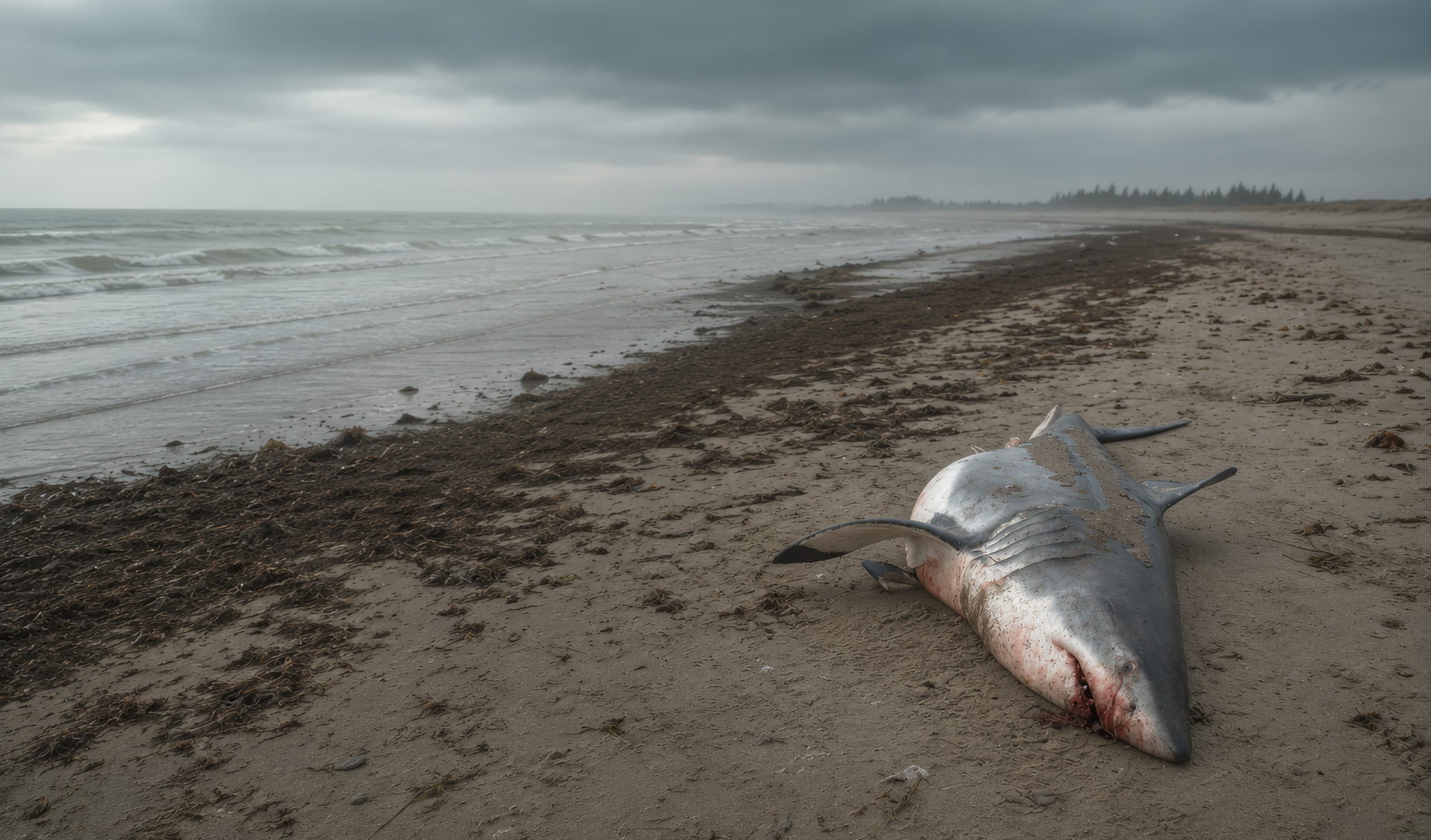
Stranded white shark near Kouchibouguac National Park, New Brunswick
AI-assisted © ORS |. All Rights Reserved
“Fear and apathy bite deeper
than any shark.”
Help protect the sharks
of the St. Lawrence.
— Jeffrey Hay Gallant, ORS
The St. Lawrence Shark Observatory is a registered charity:
Canada Revenue Agency #834462913RR0001
Stranded white shark near Kouchibouguac National Park, New Brunswick
AI-assisted © ORS |. All Rights Reserved
“Fear and apathy
bite deeper
than any shark.”
Help protect the sharks
of the St. Lawrence.
— Jeffrey Hay Gallant, ORS
The St. Lawrence Shark Observatory is a registered charity:
Canada Revenue Agency #834462913RR0001

CSAR
OSF
PUBLICATIONS

© 2026 St. Lawrence Shark Observatory. All Rights Reserved.
CSAR
OSF
PUBLICATIONS
© 2026 St. Lawrence Shark Observatory
All Rights Reserved