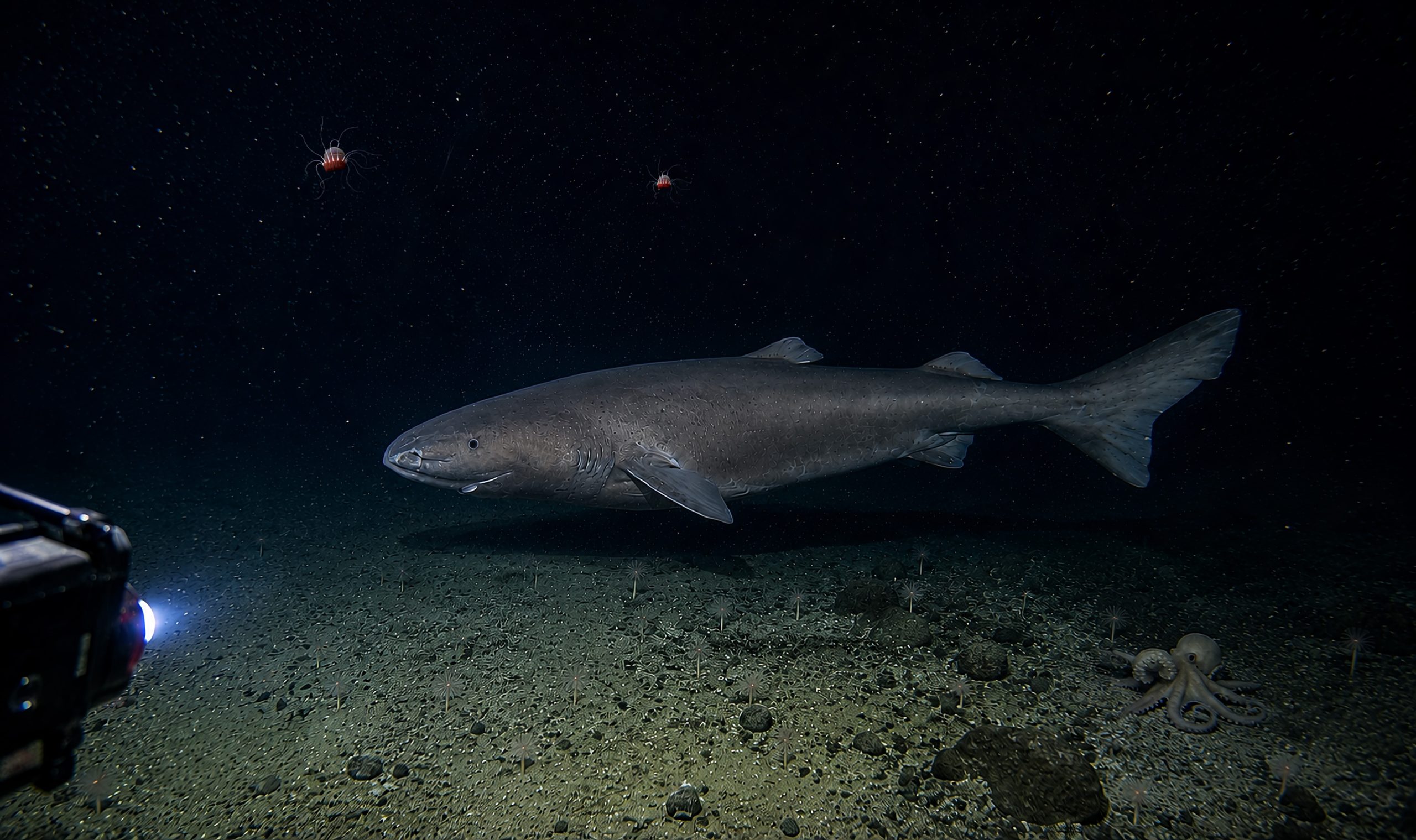
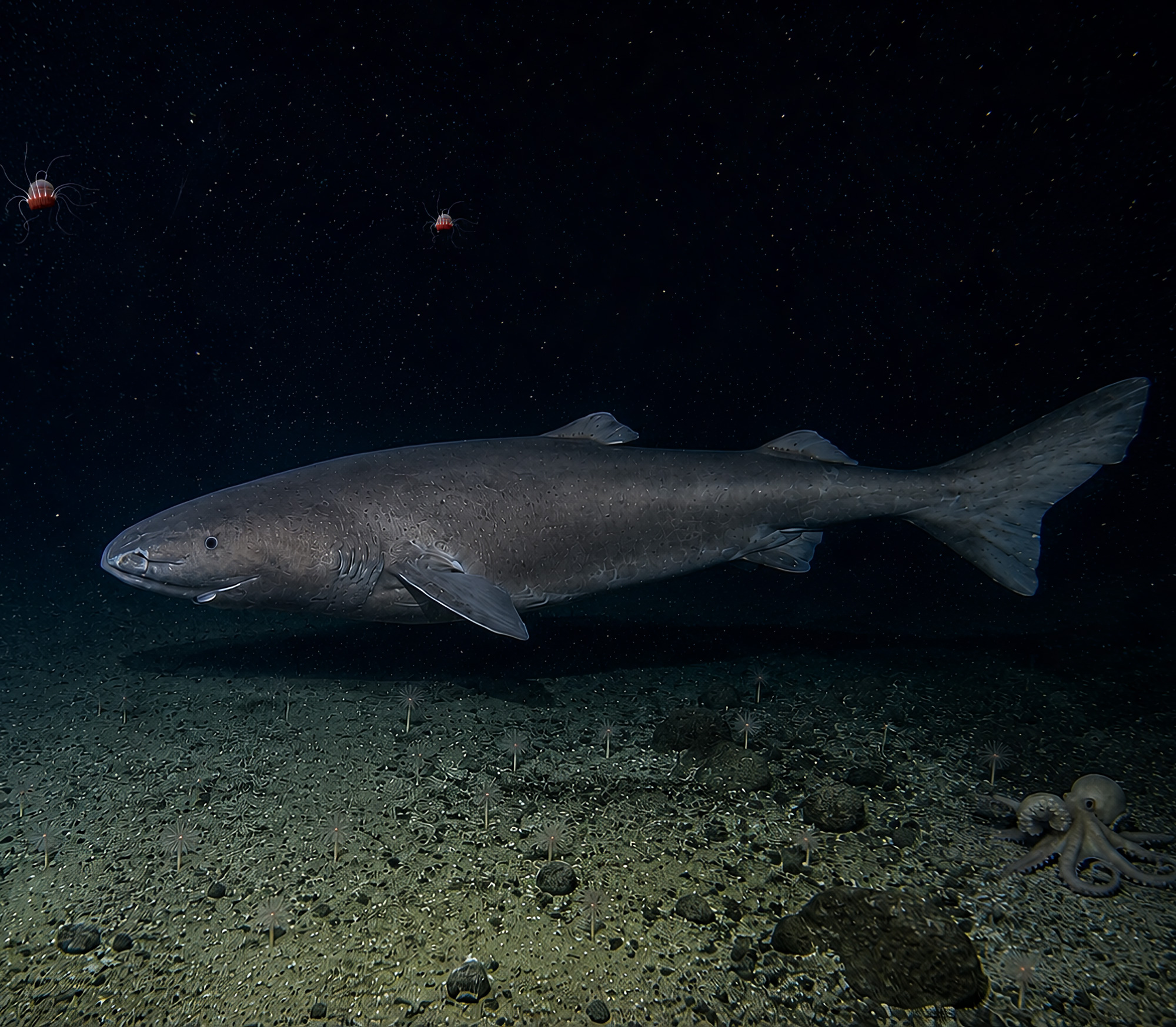
Antarctic sleeper shark, jellyfish and octopus
AI-assisted © ORS | All Rights Reserved
OPINION

Filming during 2023 Magdalens white shark expedition.
Photo © ORS | Jeffrey Hay Gallant
All Rights Reserved
A sleeper shark was filmed in Antarctica.
That was enough.
Revisiting sensationalism, shifting baselines, and the growing tendency to frame every unusual wildlife observation through the lens of climate change.
By
, M. Sc.
7 min read
February 20, 2026
Updated May 20, 2026
Jeffrey Hay Gallant
EDITORIAL

A sleeper shark was filmed in Antarctica. That was enough.
Revisiting sensationalism, shifting baselines, and the growing tendency to frame every unusual wildlife observation through the lens of climate change.
By
, M. Sc.
7 min read
Posted on Feb. 20, 2026
Updated May 20, 2026
Jeffrey Hay Gallant
EDITORIAL
Inspired by media coverage surrounding rare footage of a sleeper shark in Antarctic waters, this editorial explores how modern wildlife reporting can sometimes blur the line between scientific observation, interpretation, and speculation.
When documentation becomes speculation
When news outlets recently announced that a sleeper shark had been filmed in Antarctic waters for the first time, the footage itself was genuinely remarkable. Deep-sea observations of large sleeper sharks remain exceptionally rare, especially in the Southern Ocean, and the imagery deserved attention on its own scientific and visual merit.
What quickly became more frustrating, however, was the increasingly familiar tendency to transform an interesting observation into a broader speculative narrative, in this case, suggestions that the shark may somehow have been “driven” into colder Antarctic waters by climate change.
At that point, the story stopped being about documentation and quietly became something else entirely.
Regardless of whether the animal in question is ultimately classified as the southern sleeper shark (Somniosus antarcticus) or grouped with the Pacific sleeper shark (Somniosus pacificus), sleeper sharks have long been associated with deep, cold Southern Ocean ecosystems, including Antarctic waters. Like their Arctic relative, the Greenland shark (Somniosus microcephalus), they are cold-adapted deep-water sharks associated with near-freezing environments.
So while the footage may indeed represent the first confirmed filming of such a shark in that precise location, the broader implication that scientists were somehow surprised to find a sleeper shark in Antarctic waters feels difficult to justify.
Modern wildlife reporting increasingly rewards surprise, novelty, and dramatic narratives. In that environment, rare observations are transformed into simplified explanations before enough evidence exists to support them.
“First filmed here” is the story. The “it must have moved there because of warming water” add-on is speculation dressed up as explanation.
That distinction matters.
Missing context
Recent molecular research has further complicated the story. A 2023 genomic study[1] published in the Journal of Heredity found little evidence supporting a clear genetic distinction between the so-called southern sleeper shark (Somniosus antarcticus) and the Pacific sleeper shark (Somniosus pacificus), with the authors suggesting the two may ultimately represent the same species.
Ironically, the same paper also references sleeper sharks occurring “from the Arctic Circle to Antarctica,” underscoring how long-established ecological context can quietly disappear once a simplified media narrative takes hold.
The footage was already extraordinary on its own. Yet while headlines helped perpetuate the “southern sleeper shark” narrative, recent genomic research suggests the species itself may not even exist as currently described.
This important context, including the longstanding scientific association between sleeper sharks and Antarctic ecosystems, was absent from the public-facing coverage surrounding the footage.
The problem with new
Superlatives and expressions such as first ever, unprecedented, never before seen, and scientists stunned increasingly dominate wildlife reporting because they generate attention, clicks, and rapid social media amplification. Unfortunately, they can also unintentionally distort public understanding by divorcing observations from their broader ecological and historical context.
Once a simplified narrative enters the media ecosystem, nuance tends to disappear rapidly. Within hours, speculation becomes repetition, repetition becomes familiarity, and familiarity eventually hardens into perceived fact. The sleeper shark story illustrates this perfectly.
Sleeper sharks were already known from polar ecosystems, including the Antarctic. Even so, the footage itself was extraordinary enough to justify international attention. Yet rather than simply celebrating a rare deep-sea observation, some reporting appeared eager to attach a broader climate-driven explanation despite limited supporting evidence.
This is by no means an argument against climate change itself. Climate change is real, measurable, and profoundly affecting marine ecosystems worldwide. But not every unusual observation automatically requires a climate attribution narrative. Scientific credibility depends not only on communicating real environmental change, but also on resisting the temptation to over-interpret isolated observations simply because they fit contemporary expectations.
Sleeper sharks and temperature
The assumption that sleeper sharks necessarily retreat toward colder waters under relatively small temperature shifts also deserves caution. In the St. Lawrence system alone, ORS has documented hundreds of Greenland shark encounters across temperatures ranging from approximately −1.6°C to nearly 16°C[2]. These observations occurred over many years and under a wide variety of environmental conditions.
Like many deep-water sharks, sleeper sharks appear capable of tolerating broader thermal ranges than simplified public narratives sometimes imply. This does not mean climate change is irrelevant to sleeper shark ecology. It simply means that ecological interpretation should be proportional to available evidence. A rare observation does not automatically reveal a large-scale climate-driven redistribution event.
Sometimes a shark filmed in Antarctica is simply a shark filmed in Antarctica.
Shifting baselines
Part of the problem may also reflect what scientists call shifting baselines. People tend to unconsciously redefine what feels “normal” according to what they have personally experienced, what has been recently documented, or what has received the most media attention. As older observations disappear from public awareness, long-established ecological realities can suddenly begin to feel new.
We have witnessed the same phenomenon repeatedly in Canada with the white shark (Carcharodon carcharias) in the Gulf of St. Lawrence. Outside scientific and fishing circles, the species suddenly became perceived as a “new arrival” once sightings began circulating widely through mainstream media and social networks. Yet historical evidence, fisheries records, photographs, newspaper archives, Indigenous knowledge, and oral histories demonstrate that white sharks have been a natural seasonal component of the Gulf ecosystem for centuries, albeit usually in low numbers.
Public awareness has changed far more dramatically than the sharks themselves.
The cost of overstatement
The deeper concern is not merely scientific imprecision. It is the cumulative effect such framing may have on public confidence in science communication more broadly. When climate change gradually becomes the default explanation attached to every unusual ecological observation, even those involving species already associated with the environments in question, the public may eventually struggle to distinguish between carefully supported evidence and speculative narrative-building.
When every ecological surprise is presented as a climate emergency, the public may gradually lose its ability to distinguish between well-supported warnings and speculative interpretation, and desensitisation becomes a real risk.
That risk is especially serious in an era already shaped by misinformation, political polarisation, and growing skepticism toward expertise. Poorly contextualised stories may unintentionally contribute to public desensitisation, making it easier for genuine climate-change impacts, the ones supported by extensive long-term evidence, to be dismissed by skeptics as just another exaggerated headline.
Ironically, overstating weak evidence may ultimately undermine stronger evidence.
Why ORS increasingly prefers written communication
Stories like this also reinforce why ORS increasingly relies on written statements and carefully prepared releases rather than spontaneous interviews immediately following apparently “new” discoveries or other potentially newsworthy events. In the early hours after an extraordinary observation emerges, context is often incomplete and speculation spreads rapidly. Once simplified narratives take hold publicly, nuance becomes extremely difficult to recover.
Written communication slows that process down. It creates space for verification, historical context, precision, and careful wording, all things that are increasingly difficult to preserve within fast-moving modern media cycles.
None of this diminishes the scientific value of the Antarctic footage itself, nor the impressive work of the research team involved.
The footage was already extraordinary.
That was enough.
REFERENCES
(1) Timm, L. E., Tribuzio, C., Walter, R. P., Larson, W. A., Murray, B. W., Hussey, N. E., & Wildes, S. (2023). Molecular ecology of the sleeper shark subgenus Somniosus (Somniosus) reveals genetic homogeneity within species and lack of support for S. antarcticus. Journal of Heredity, 114(2), 152–164.
(2) Gallant, Jeffrey J., Marco A. Rodríguez, Michael J. W. Stokesbury, and Chris Harvey-Clark. (2016). Influence of environmental variables on the diel movements of the Greenland Shark (Somniosus microcephalus) in the St. Lawrence Estuary. Canadian Field-Naturalist 130(1): 1-14.

Founder and scientific director of the St. Lawrence Shark Observatory (ORS) and the Canadian Shark Attack Registry; doctoral researcher at UQAM. First encountered a shark at Peggy’s Cove, Nova Scotia, in 1975. Co-led Canada’s first cage dives in 2000, filmed the world’s first natural footage of a Greenland shark in 2003, and received the Université du Québec à Trois-Rivières (UQTR) Pythagore Prize in Science and Engineering in 2025.
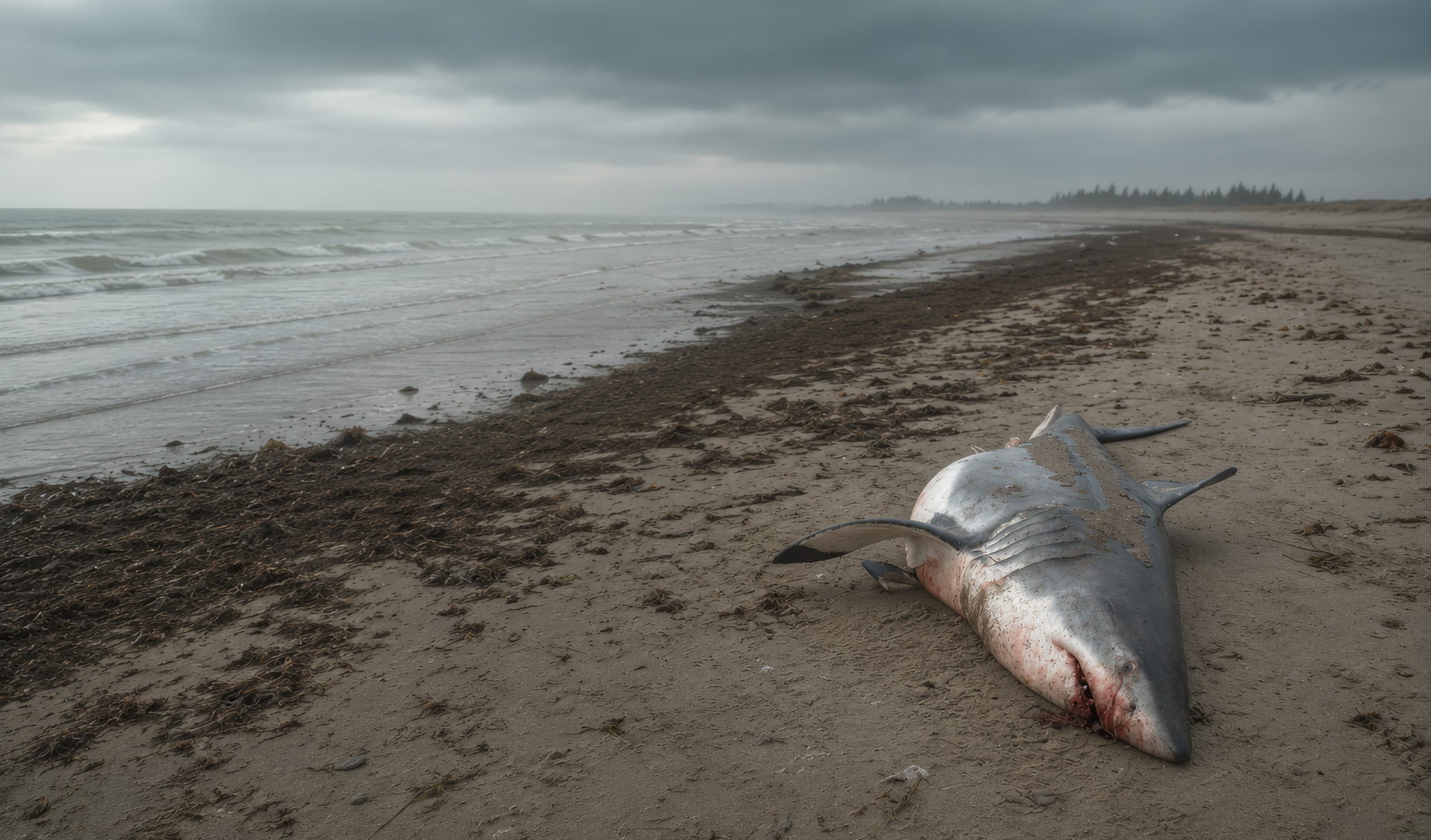
Stranded white shark near Kouchibouguac National Park, New Brunswick
AI-assisted © ORS |. All Rights Reserved
“Fear and apathy bite deeper
than any shark.”
Help protect the sharks
of the St. Lawrence.
— Jeffrey Hay Gallant, ORS
The St. Lawrence Shark Observatory is a registered charity:
Canada Revenue Agency #834462913RR0001
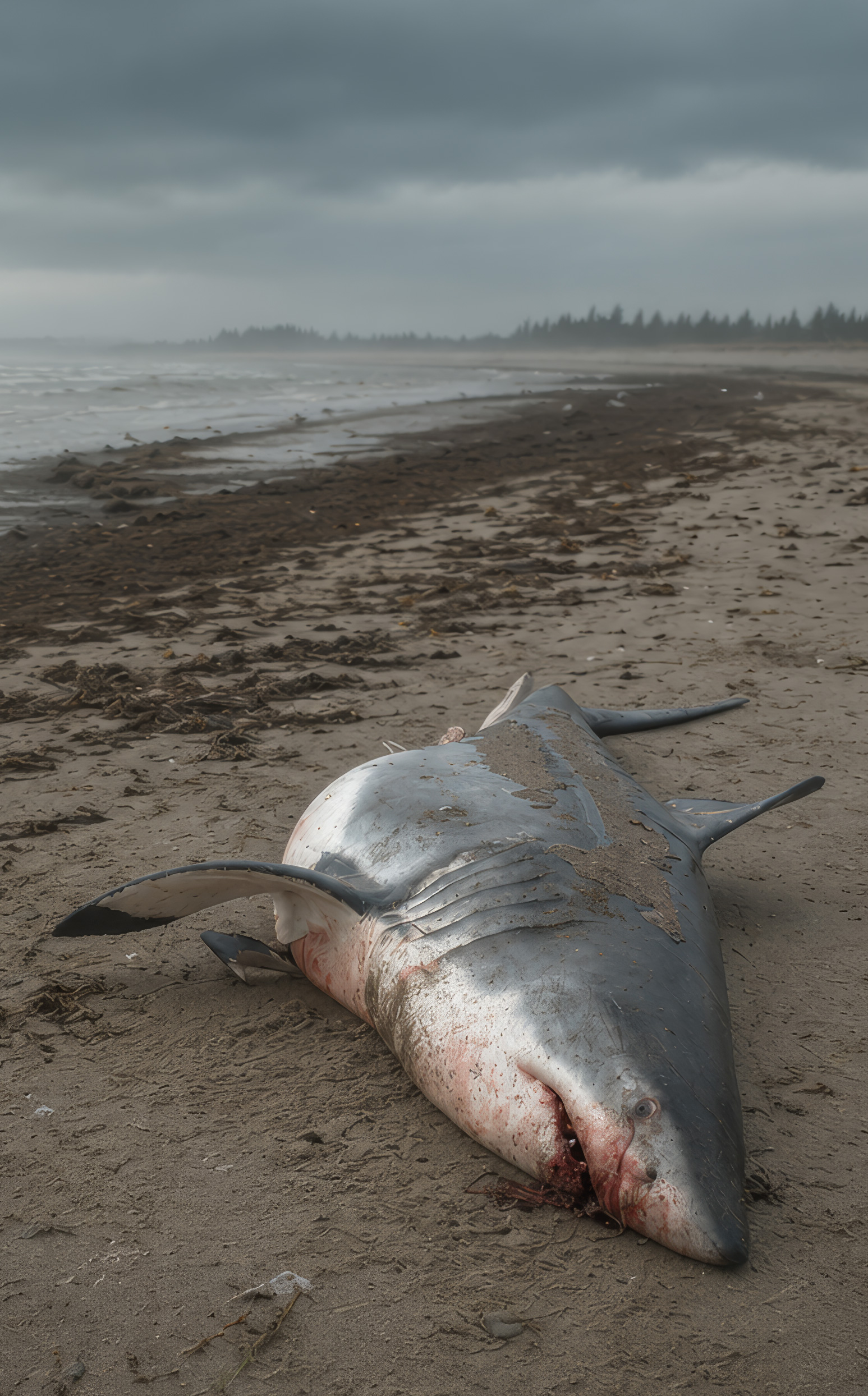
Stranded white shark near Kouchibouguac National Park, New Brunswick
AI-assisted © ORS |. All Rights Reserved
“Fear and apathy
bite deeper
than any shark.”
Help protect the sharks
of the St. Lawrence.
— Jeffrey Hay Gallant, ORS
The St. Lawrence Shark Observatory is a registered charity:
Canada Revenue Agency #834462913RR0001


CSAR
OSF
PUBLICATIONS

© 2026 St. Lawrence Shark Observatory. All Rights Reserved.
CSAR
OSF
PUBLICATIONS
© 2026 St. Lawrence Shark Observatory
All Rights Reserved