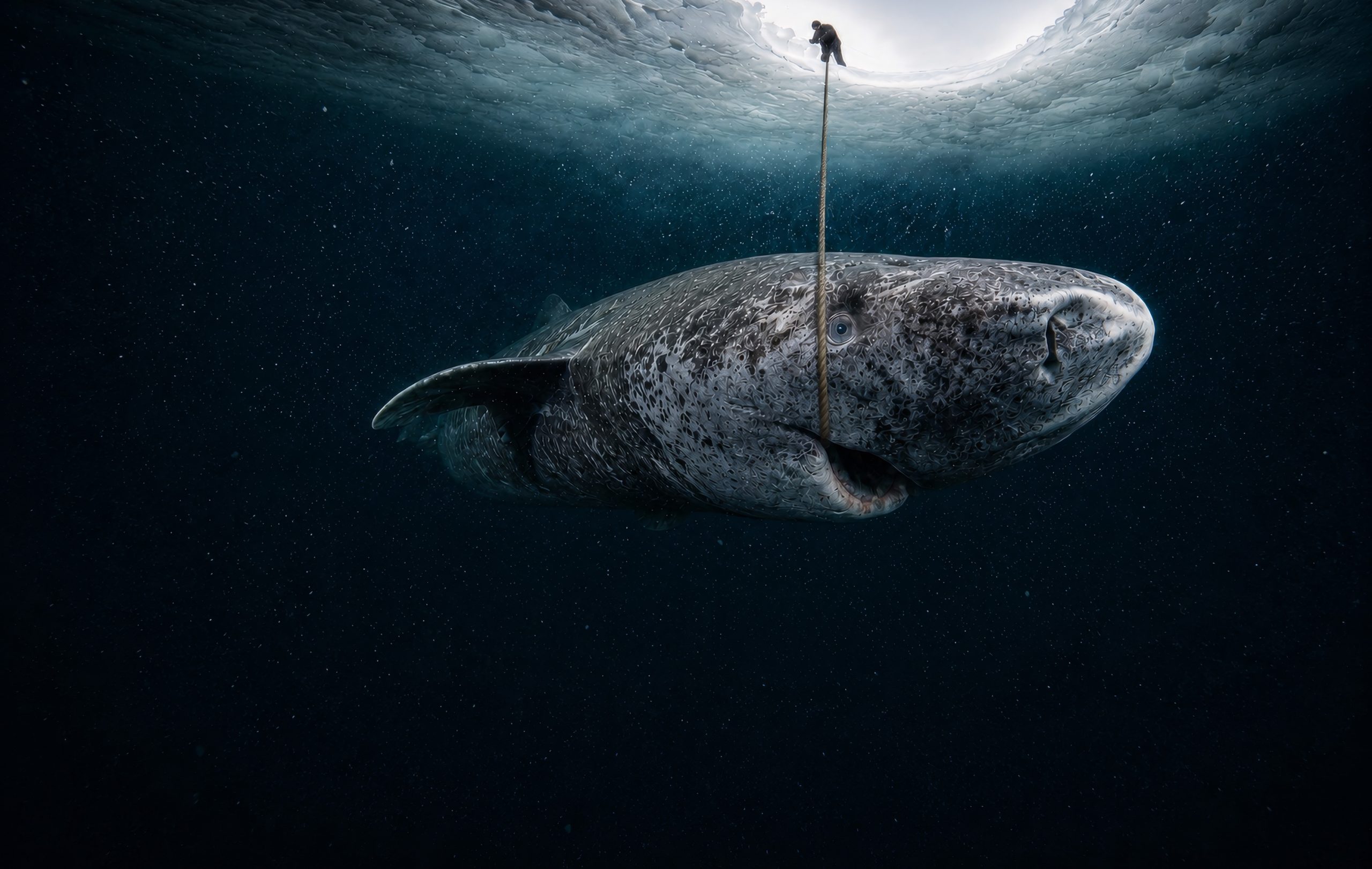
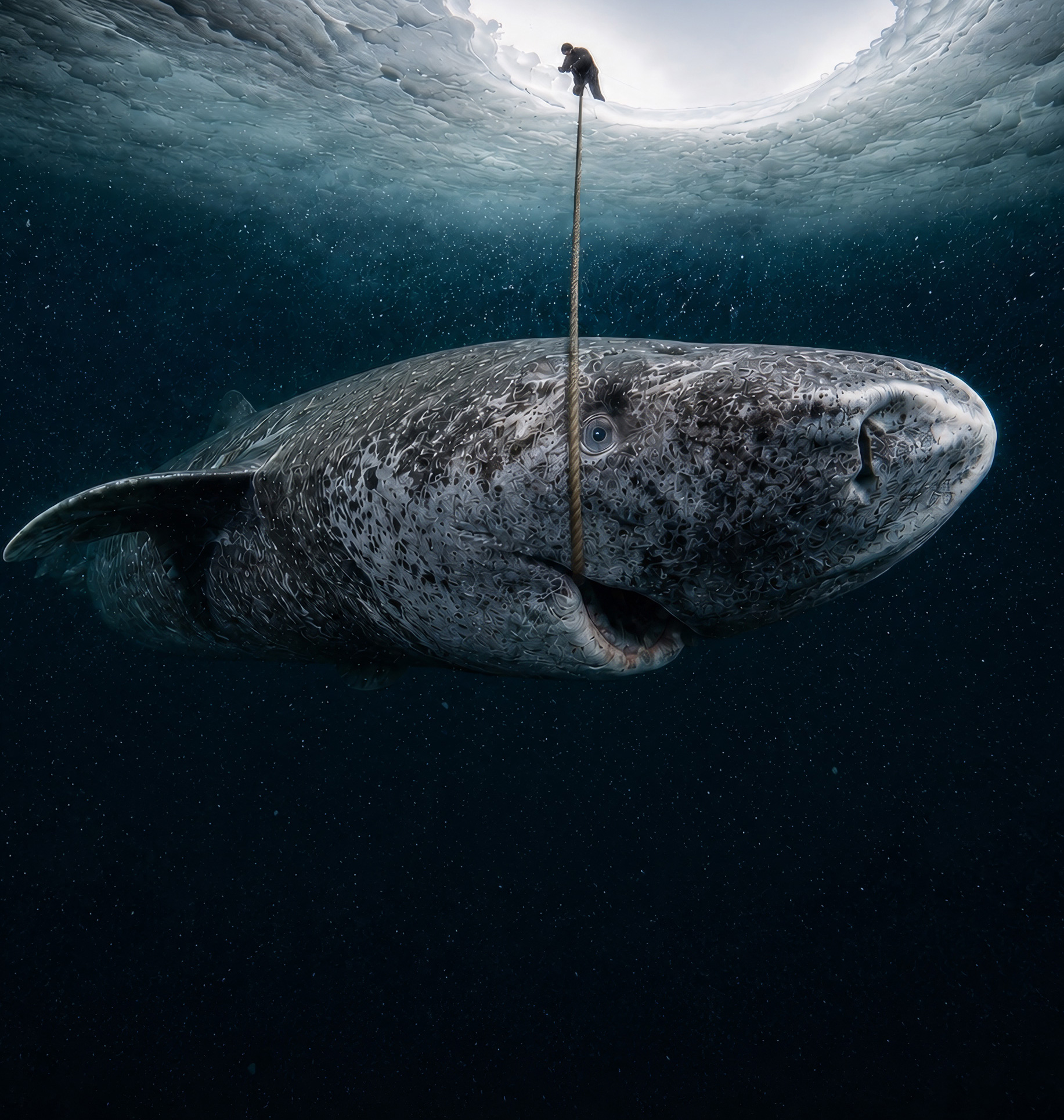
A Greenland shark during a staged under-ice photographic encounter.
AI-assisted © ORS | All Rights Reserved
OPINION

Sharks at a fish market in Yemen.
Photo by Rod Waddington (CC BY-SA 2.0)
Hooked on conservation
Before the photograph, there is a story viewers rarely see, and sometimes the illusion is more carefully crafted than the truth.
By
, M. Sc.
8 min read
Posted on Dec. 8, 2012
Updated May 7, 2026
Jeffrey Hay Gallant
EDITORIAL

Hooked on conservation
Before the photograph, there is a story viewers rarely see, and sometimes the illusion is more carefully crafted than the truth.
By
, M. Sc.
8 min read
Posted on Dec. 8, 2012
Updated May 7, 2026
Jeffrey Hay Gallant
EDITORIAL
The following editorial was originally written in 2012 in response to the growing popularity of staged under-ice encounters with Greenland shark in the Canadian Arctic. At the time, relatively little scientific literature existed regarding the physiological effects of deep-water capture and rapid ascent on Greenland sharks, and most concerns expressed here were based primarily on direct field observations accumulated over many years of working with the species. Since then, additional scientific research has documented physiological stress responses associated with Greenland shark capture and handling, including disturbances in blood chemistry and metabolic stress following deep-water retrieval. Those studies are referenced in the 2017 update appended to this editorial. This text is republished here as both a historical document and a reflection on the ethical responsibilities associated with wildlife photography, tourism, and shark conservation.
The first underwater photos of a live Greenland shark were taken in the Canadian Arctic during a scientific expedition in 1995. As Arctic travel became more popular and accessible roughly a decade later, several photographers and expedition operators eventually followed in those footsteps. Today, when one Googles Greenland shark images from the Arctic, most of the photos show the world’s most northerly shark seemingly hovering just beneath the ice cover, where the depths below reach far beyond the range of scuba divers. The images are breathtaking, but they are mostly taken at the expense of the shark’s health. Telemetry studies over the last decade, including our own, have demonstrated that the diel vertical movements of the Greenland shark rarely take it all the way to the surface, and that its shallowest transits mostly occur at night under the cover of darkness. Most sharks photographed beneath the ice are caught on hook and line before being hauled to the surface to serve as models for paying travellers and photographers. The sharks are typically snagged at depths of hundreds of metres in total darkness and then subjected to rapid ascent and intense light levels.
Having ourselves made hundreds of observations of Greenland sharks swimming freely without the use of bait or fishing apparatus, we are uniquely qualified to state that the appearance and behaviour of most sharks shown in Arctic photos and video sequences are anything but natural. Many of the sharks, some swimming disoriented or completely vertical with jaws agape, are clearly in distress. A great many photos show the ice pack at an angle or even beneath the shark, obvious clues that the images were rotated to create the illusion that the shark is swimming horizontally.
In some images, the shark is upside down with its ocular parasite pointing away from the ice, a conspicuous sign that the shark has no forward movement and is either dead or will die long before the image is edited and posted on social media. Other photos show visible signs that the shark is or was tethered to the surface with a rope. The caudal peduncle, the narrow area at the base of the tail, either does not appear in the image or shows signs of abrasion where the noose damaged the skin.
Injury notwithstanding, these are the lucky ones, since some sharks do not even make it to the surface in one piece. As they struggle on the seafloor to break loose from the hook lodged in their gullet, they alert other sharks to their vulnerability and are promptly cannibalised. Others die from the trauma associated with rapid ascent from hundreds of metres, followed by human manipulation, frozen tissues, and slow asphyxiation as their internal organs are crushed beneath the shark’s own weight on the ice surface.
The opening Greenland shark shown in this trailer is quite obviously dead or dying. The sharks appearing later in the footage were also likely caught on hook and line before being restrained beneath the ice hole for underwater photographers. Their abnormal posture, limited movement, and orientation bear little resemblance to the natural behaviour of free-swimming Greenland sharks observed in the wild.
Equally troubling is the continued promotion of the outdated myth that Greenland sharks are blind. While ocular parasites are common in some Arctic populations, blindness is neither universal nor absolute. Our own observations of non-parasitised Greenland sharks in the St. Lawrence demonstrated visually mediated behaviour and responses to divers, findings published in Harvey-Clark et al. (2005), Vision and its Relationship to Novel Behaviour in St. Lawrence River Greenland Sharks [1]. More recent research has further confirmed that Greenland sharks possess a functional visual system adapted to extremely low-light environments [2].
The parting shot also clearly shows a shark that had been tied by the tail, with visible rope abrasion around the caudal peduncle. If this trailer is intended to promote shark conservation, it instead exploits the spectacle of captured, restrained, and likely dying animals to manufacture a dramatic conservation narrative.
In the South Pacific, this practice would be akin to capturing chambered nautilus at depths exceeding 300 m (1,000 ft) and subjecting them to the same rapid ascent to bring them within reach of waiting underwater photographers. Likewise, dragging a Greenland shark to the surface for the sole purpose of taking photographs is no more ethically acceptable than injecting bleach into a nocturnal octopus den to force the animal into daylight where it is exposed to blinding strobes and hungry pinnipeds. To do so for the sake of a potential cover shot, or even worse, under the guise of promoting conservation and environmental awareness, is highly detrimental to the very animal that the well-meaning, or occasionally self-serving, photographer claims to protect.
The ever-controversial practice of wildlife photo staging is tolerated with the Greenland shark because it is, after all, “just a shark.” On the other hand, a tremendous uproar would instantly resonate throughout the blogosphere if the same treatment were inflicted upon far less threatening animals such as dolphins or seals.
The ever-controversial practice of wildlife photo staging is tolerated with the Greenland shark because it is, after all, “just a shark.” On the other hand, a tremendous uproar would instantly resonate throughout the blogosphere if the same treatment were inflicted upon far less threatening animals such as dolphins or seals.
I often wonder how many photographers actually consider the plight of the Greenland shark as they watch it through their viewfinders, showing visible signs of severe physiological stress and respiratory distress after lying exposed on the ice while divers suited up and prepared their cameras. I would like to see the actual circumstances of these staged photo sessions detailed in the captions accompanying such images. People normally bewildered by the photographer’s prowess and technical skill would likely express concern for the shark, not admiration for the diver, if they were aware of the truth behind the image.
Wildlife photography, no matter how well-intentioned, should never serve as a pretext to cause harm to any animal, including the Greenland shark.
2017 Update
Since this editorial was originally published in 2012, scientific research has further reinforced the concern raised here regarding the capture and handling of Greenland shark for photography and tourism activities. Barkley (2017) [3] documented pronounced physiological stress responses in Greenland sharks following deep-water capture, including elevated blood lactate levels consistent with exhaustive exertion, metabolic disruption, and significant acid–base imbalance. These findings support the concern that rapidly hauling Greenland sharks from depths of several hundred metres imposes substantial physiological trauma beyond what may be immediately visible externally.
That same year, Herbert et al. (2017) [4] demonstrated that Greenland shark blood oxygen transport is highly sensitive to changes in pH and carbon dioxide concentration. This research highlights the vulnerability of the species’ blood chemistry to physiological disturbance during capture, rapid ascent, handling, and prolonged surface exposure. Together, these studies strengthen the concern raised in this editorial by providing scientific evidence that the capture and manipulation of Greenland sharks for staged photographic encounters can subject the animals to extreme stress and potentially life-threatening physiological consequences.
REFERENCES
(1) Harvey-Clark, C. J., Gallant, J. J., & Batt, J. H. (2005). Vision and its Relationship to Novel Behaviour in St. Lawrence River Greenland Sharks, Somniosus microcephalus. The Canadian Field-Naturalist, 119(3), 355.
(2) Fogg, L. G., Tom, E., Policarpo, M., Cho, W., Gao, F., Hii, D., Fawcett, A. E., Boileau, N., Bech-Poulsen, A., Steffensen, K. F., Ng, C. J., Bushnell, P. G., Steffensen, J. F., Brill, R., Salzburger, W., & Skowronska-Krawczyk, D. (2026). The visual system of the longest-living vertebrate, the Greenland shark. Nature Communications, 17(1), 39.
(3) Barkley, A., Fisk, A., Hussey, N., Cooke, S., & Hedges, K. (2017). Capture-induced stress in deep-water Arctic fish species. Polar Biology, 40(1), 213–220.
(4) Herbert, N., Skov, P., Tirsgaard, B., Bushnell, P., Brill, R., Harvey Clark, C., & Steffensen, J. (2017). Blood O affinity of a large polar elasmobranch, the Greenland shark Somniosus microcephalus. Polar Biology, 40(11), 2297–2305.

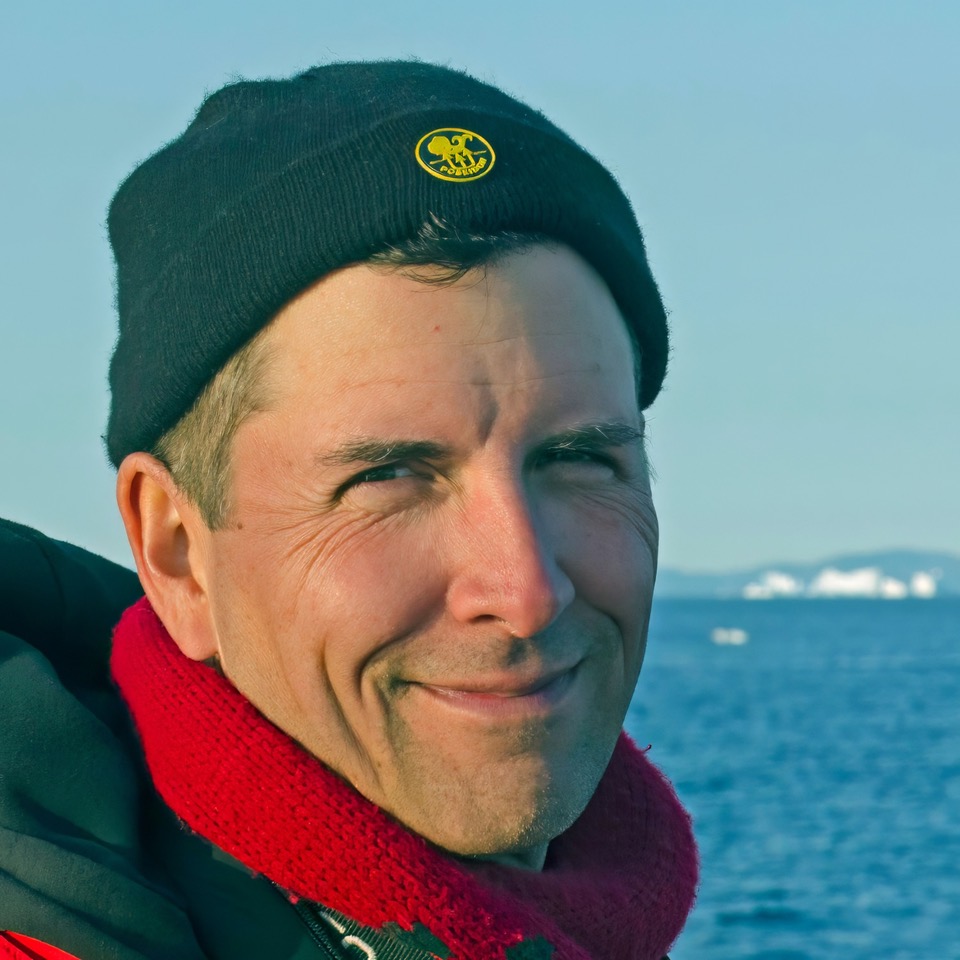
Founder and scientific director of the St. Lawrence Shark Observatory (ORS) and the Canadian Shark Attack Registry; doctoral researcher at UQAM. First encountered a shark at Peggy’s Cove, Nova Scotia, in 1975. Co-led Canada’s first cage dives in 2000, filmed the world’s first natural footage of a Greenland shark in 2003, and received the Université du Québec à Trois-Rivières (UQTR) Pythagore Prize in Science and Engineering in 2025.
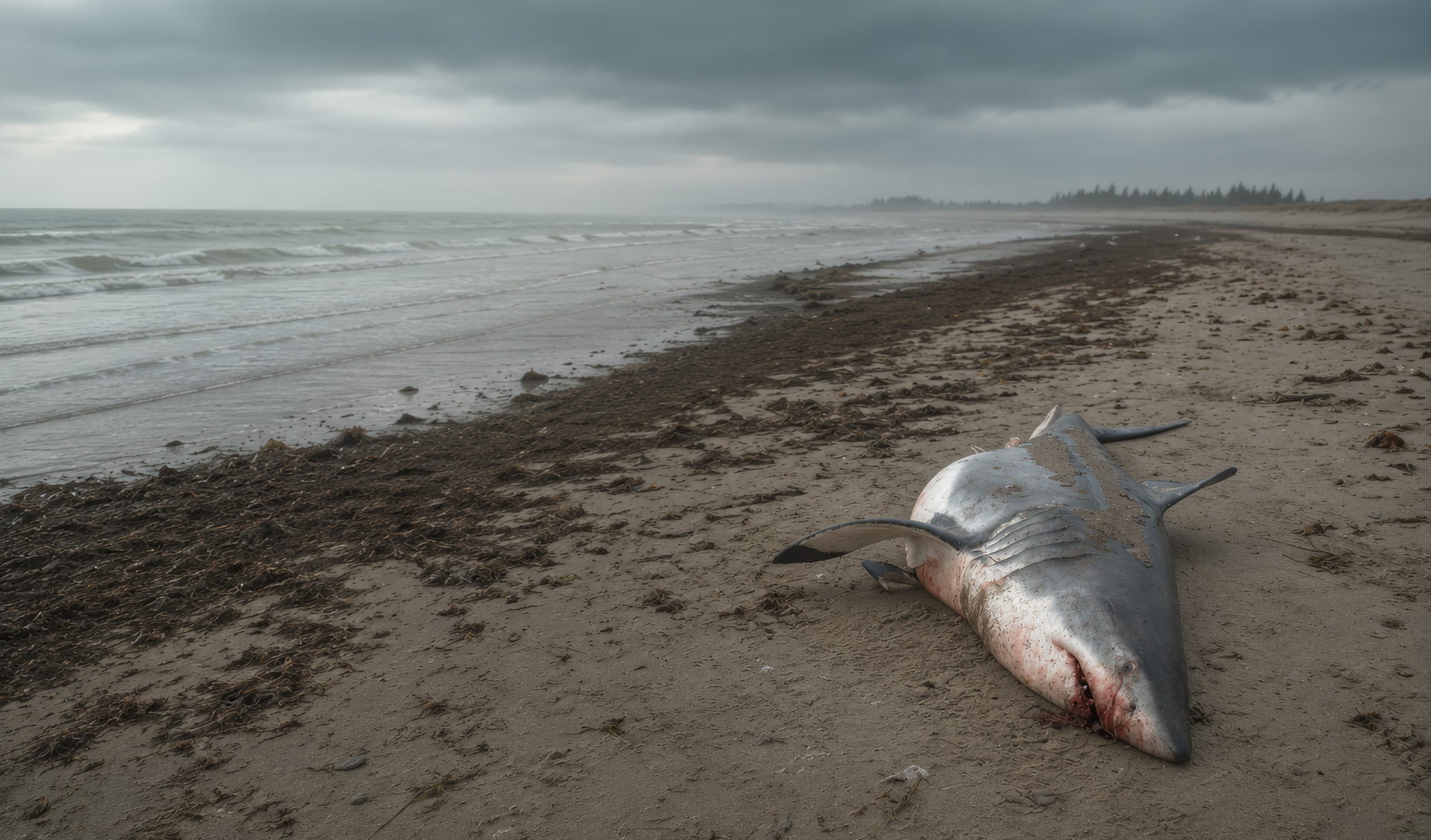
Stranded white shark near Kouchibouguac National Park, New Brunswick
AI-assisted © ORS |. All Rights Reserved
“Fear and apathy bite deeper
than any shark.”
Help protect the sharks
of the St. Lawrence.
— Jeffrey Hay Gallant, ORS
The St. Lawrence Shark Observatory is a registered charity:
Canada Revenue Agency #834462913RR0001
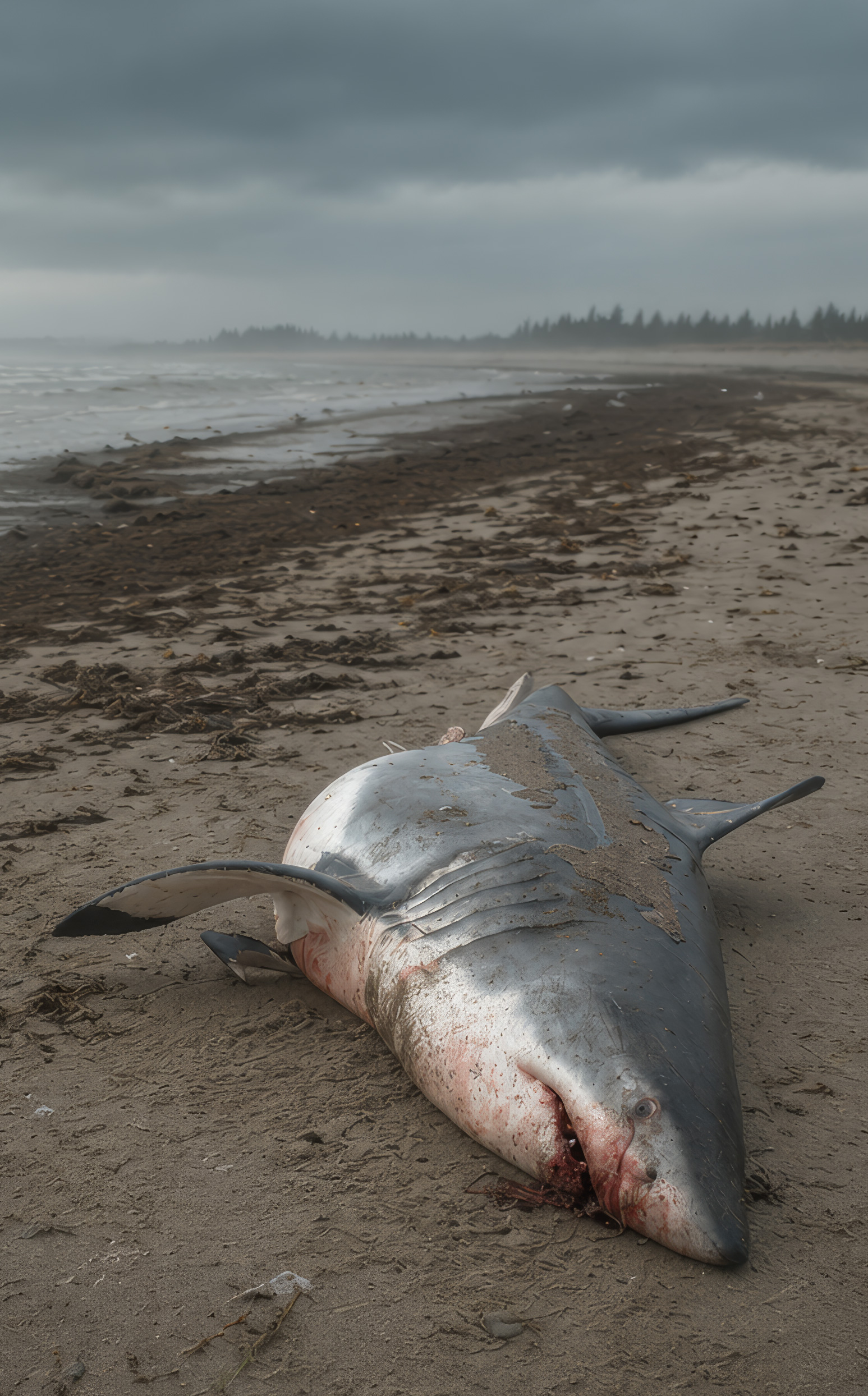
Stranded white shark near Kouchibouguac National Park, New Brunswick
AI-assisted © ORS |. All Rights Reserved
“Fear and apathy
bite deeper
than any shark.”
Help protect the sharks
of the St. Lawrence.
— Jeffrey Hay Gallant, ORS
The St. Lawrence Shark Observatory is a registered charity:
Canada Revenue Agency #834462913RR0001


CSAR
OSF
PUBLICATIONS

© 2026 St. Lawrence Shark Observatory. All Rights Reserved.
CSAR
OSF
PUBLICATIONS
© 2026 St. Lawrence Shark Observatory
All Rights Reserved