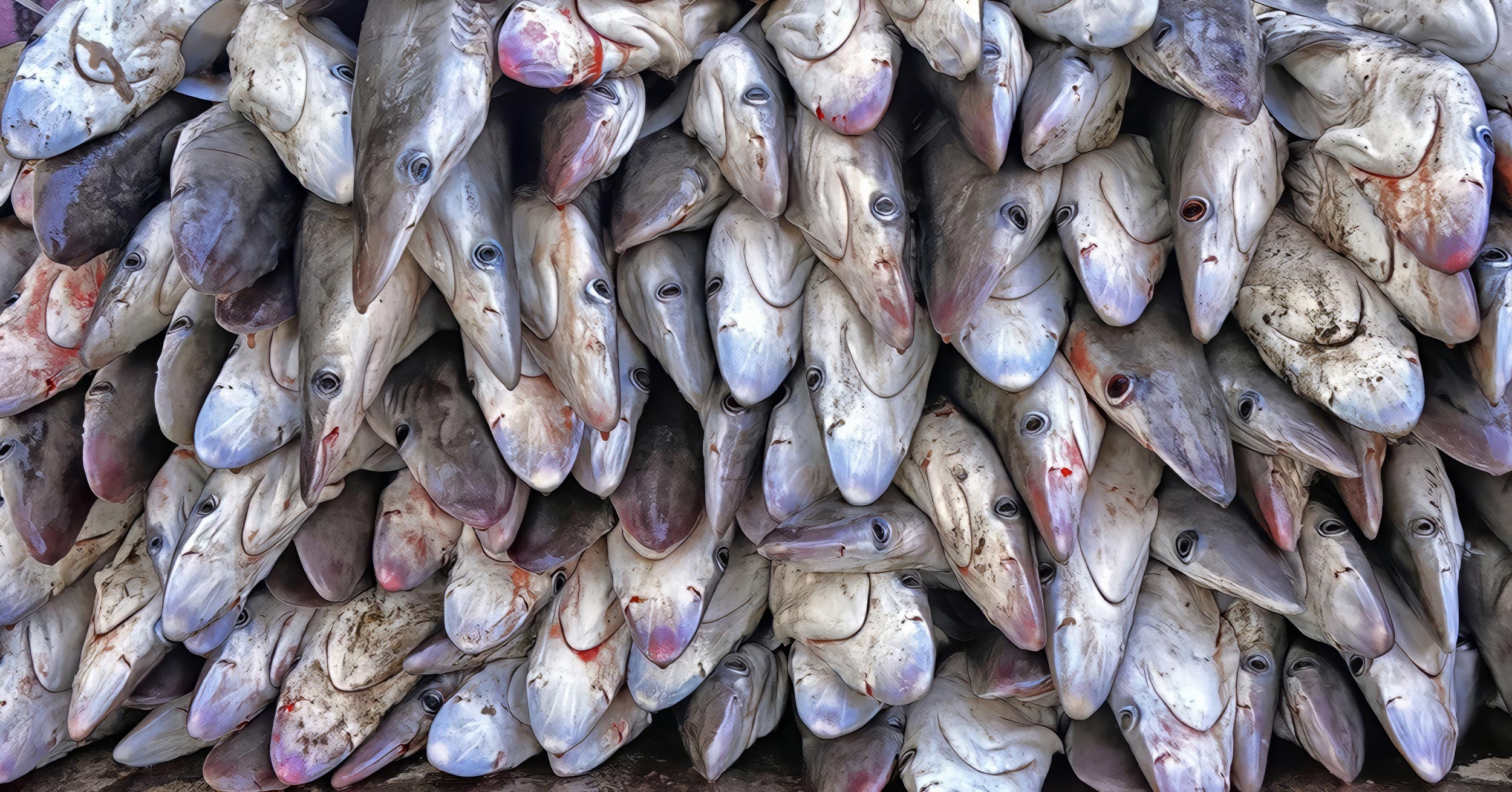
Sharks at a fish market in Yemen.
Photo by Rod Waddington (CC BY-SA 2.0)
OPINION


Sharks at a fish market in Yemen.
Photo by Rod Waddington (CC BY-SA 2.0)
Shark fins banned in Canada?
Not really.
Revisiting Canada’s shark fin trade ban, legal loopholes, and the illusion of meaningful reform.
By
, M. Sc.
8 min read
Posted on June 28, 2019
Updated May 15, 2026
Jeffrey Hay Gallant
EDITORIAL


Shark fins banned in Canada?
Not really.
Revisiting Canada’s shark fin trade ban, legal loopholes, and the illusion of meaningful reform.
By
, M. Sc.
8 min read
Posted on June 28, 2019
Updated May 15, 2026
Jeffrey Hay Gallant
EDITORIAL
Originally published following the adoption of Bill C-68, this editorial has been revised for clarity and updated context while preserving the substance and intent of the original text. Additional commentary and references reflecting subsequent legal and policy developments have also been included.
2023 UPDATE
Nearly four years after the St. Lawrence Shark Observatory (ORS) publicly emerged as the first and only dissenting scientific voice against certain provisions of Canada’s then-new shark fin trade ban, the McGill Journal of Sustainable Development Law (McGill University Faculty of Law) cited this editorial and ORS scientific director Jeffrey Gallant in support of its own legal critique of the amendment.
The article[1] argued that Canada’s revised Fisheries Act still failed to comply fully with General Agreement on Tariffs and Trade (GATT) obligations concerning sharks because the law continued to permit the importation and trade of derivative shark products under certain conditions. In essence, the legislation banned detached fins while still allowing the importation of entire shark carcasses with fins attached, a loophole that ORS had highlighted publicly from the outset.
The McGill paper concluded that stronger protections extending to derivative products would better support both shark conservation and Canada’s international trade obligations.
(1) Wang, A. (2023). Canada’s shark fin trade ban and the GATT non-discrimination obligation. McGill Journal of Sustainable Development Law, 18(2), 113–139.
The devil in the details
Recent headlines triumphantly announced that Canada had banned shark fins. At first glance, the news sounded almost too good to be true. Unfortunately, as is often the case with wildlife policy and political messaging, the devil was hidden in the details.
Although I applauded the Canadian government’s willingness to take visible action on behalf of sharks, an effort largely driven by years of relentless advocacy from animal welfare organisations, conservationists, and concerned citizens across the country, I nevertheless struggled to see how Bill C-68[2] could meaningfully reduce the long-term availability of shark fins in Canada.
Certainly, the amendment represented an important symbolic step and a legislative milestone worth celebrating. Yet despite the triumphant headlines, the law still appeared to contain a major loophole hidden in plain sight.
Just semantics?
“Canada becomes the first G20 country to ban shark fin trade.”
— BBC
“Canada announces shark-fin ban in honour of Sharkwater filmmaker.”
— Global News
“Canada becomes first country to pass comprehensive ban on shark-fin imports and exports.”
— Financial Post
Some journalists apparently overlooked the remarkably concise clause concerning sharks or they would have quickly realised that only fins not naturally attached to a shark carcass had been prohibited. There was, and still is, no blanket prohibition on importing or exporting most shark species with fins attached.
In practical terms, shark fins could therefore continue entering the Canadian market legally, provided the sharks crossed the border intact before processing. The distinction may appear semantic at first glance, but its implications are substantial.
Canada had already prohibited the domestic practice of shark finning since 1994. The amendment to Bill C-68 was intended primarily to address the importation of fins into Canada.
However, under the revised legislation, fins could still legally enter the country attached to a shark carcass. Once imported, little appeared to prevent the fins from being separated, distributed, and sold through essentially the same commercial supply chains already in place.
This immediately raised several practical questions:
- Once an intact shark carcass is legally imported into Canada, what prevents distributors from selling the fins separately?
- How can wholesalers, retailers, or consumers verify that severed fins offered for sale originated from legally imported whole sharks rather than the illegal trade?
- How can inspectors realistically determine the origin of detached fins once they appear in restaurants, markets, or distribution chains?
- What mechanisms exist to distinguish imported fins from fins obtained through domestic fisheries or recreational shark derbies where finning itself remains illegal but shark capture may still occur?[3]
Despite triumphant media coverage, the legislation appeared to rely heavily on assumptions of good faith and traceability within an international wildlife trade historically plagued by opacity, mislabelling, and weak enforcement.
A symbolic victory?
Much of the public narrative surrounding the amendment framed it as a transformative conservation victory.
And symbolically, it was important.
But symbolically important legislation is not necessarily biologically effective legislation.
Even after the amendment, sharks continued to be killed globally by the tens of millions every year. Under the revised framework, fins destined for the Canadian market could still legally arrive attached to carcasses before being removed domestically.
Certainly, importing entire sharks rather than detached fins increases transport costs and logistical complexity. Yet the remaining carcasses can still be processed into meat, fertiliser, pet food, fishmeal, or other commercial byproducts, potentially offsetting part of the additional expense.
In practice, the law risked functioning more as a regulatory modification than a meaningful reduction in market demand.
Requiem for the spiny dogfish?
Ironically, legislation intended to help protect sharks may also unintentionally increase pressure on smaller-bodied species.
When ORS surveyed Montreal food markets years ago, shark fins sold for extraordinary prices by weight. From a commercial perspective, a kilogram of fins remains a kilogram of fins regardless of whether it originated from a large oceanic shark or numerous smaller individuals.
Species such as the spiny dogfish (Squalus acanthias), abundant-looking but biologically vulnerable because of their slow reproduction and late maturity[4], may therefore remain economically attractive for exploitation.
In theory, Bill C-68 could reduce incentives to fin very large sharks whose intact carcasses are cumbersome and expensive to transport. But in practice, unscrupulous fisheries may simply compensate by retaining larger numbers of smaller or immature sharks that are easier and cheaper to export whole before their fins are removed domestically.
For slow-growing shark populations, such shifts may still carry serious long-term ecological consequences.
One genuine positive
One potentially important benefit of the amended legislation is that it may improve enforcement involving shark species protected under CITES[5].
Identifying shark species from detached fins alone is notoriously difficult. Whole carcasses are substantially easier to identify morphologically and genetically, which may help authorities detect illegal trade involving threatened or endangered sharks.
That improvement should not be dismissed.
Nevertheless, important questions still remain regarding traceability and sourcing.
Did the imported shark originate from a genuinely sustainable fishery?
Was it harvested legally?
Was it caught within a protected area or marine reserve?
Was it landed under meaningful oversight?
The legislation offered limited reassurance on these broader conservation concerns.
Eco-certification: A missed opportunity
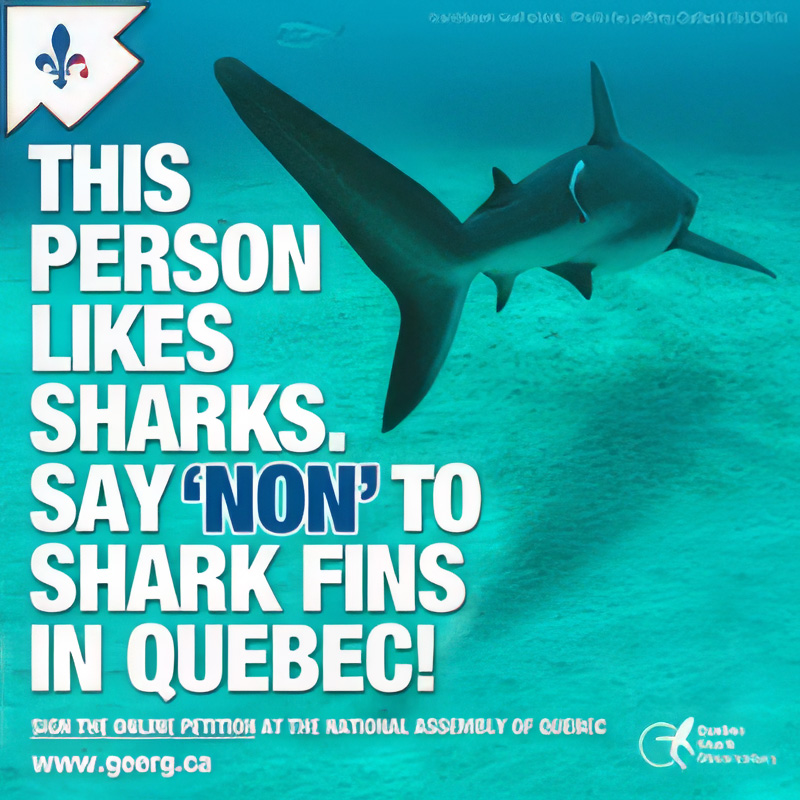
Years before Bill C-68, ORS proposed an alternative approach while petitioning the National Assembly of Québec to strengthen shark conservation measures.
Recognising that outright bans can be politically and legally difficult, we suggested the creation of a strict eco-certification system for shark products sold within Québec. Under such a system, only fins obtained from demonstrably sustainable and traceable fisheries would receive certification.
Products lacking documentation would remain legal but would no longer benefit from consumer uncertainty.
In other words, transparency itself would become the regulatory tool.
The proposal was rejected under the argument that shark products fell entirely under federal jurisdiction, an interpretation that remains legally debatable given Québec’s authority over food labelling and consumer protection standards.
Slowly, but not necessarily surely
Public awareness surrounding shark conservation has unquestionably improved over the past two decades. Influential documentaries, advocacy campaigns, and conservation initiatives helped expose the brutality of shark finning and shifted public perception worldwide.
Yet shark fins remain a lucrative commodity.
As admirable as the intentions behind Bill C-68 may have been, laws that depend heavily on voluntary compliance, traceability assumptions, or economic goodwill within highly profitable international wildlife trades often struggle to achieve their intended ecological outcomes.
Unless governments implement robust accountability mechanisms, transparent sourcing systems, meaningful enforcement, or truly comprehensive trade restrictions, sharks will likely continue to disappear at unsustainable rates long before legal loopholes catch up with conservation rhetoric.
“If the sole condition for legally purchasing ivory were to import the entire walrus or elephant, someone would still do it, find a profitable way to dispose of the carcass, and make a fortune. And so may be the fate of sharks and their prized fins destined for the Canadian market.”
— Jeffrey Hay Gallant, ORS
Today, years after the original debate, the broader lesson may extend beyond shark conservation itself. In an era increasingly shaped by performative environmental politics and media-friendly announcements, symbolic victories are often celebrated long before their real-world effectiveness is critically examined. For sharks, among the slowest reproducing and most heavily exploited vertebrates on Earth, symbolism alone may not be enough.
REFERENCES
(2) Government of Canada. (2019). Bill C-68: An Act to amend the Fisheries Act and other Acts in consequence. 1st Session, 42nd Parliament. Royal Assent: June 21, 2019.
(3) Fisheries and Oceans Canada. (2019). Groundfish Pacific Region 2019 Integrated Fisheries Management Plan Summary. Accessed June 26, 2019.
(4) Fordham, S., Fowler, S. L., Coelho, R., Goldman, K. J., & Francis, M. (2006). Squalus acanthias Northeast Atlantic subpopulation. The IUCN Red List of Threatened Species 2006: e.T44168A10866677.
(5) Convention on International Trade in Endangered Species of Wild Fauna and Flora (CITES). (2019). Sharks and manta rays.

Founder and scientific director of the St. Lawrence Shark Observatory (ORS) and the Canadian Shark Attack Registry; doctoral researcher at UQAM. First encountered a shark at Peggy’s Cove, Nova Scotia, in 1975. Co-led Canada’s first cage dives in 2000, filmed the world’s first natural footage of a Greenland shark in 2003, and received the Université du Québec à Trois-Rivières (UQTR) Pythagore Prize in Science and Engineering in 2025.

Stranded white shark near Kouchibouguac National Park, New Brunswick
AI-assisted © ORS |. All Rights Reserved
“Fear and apathy bite deeper
than any shark.”
Help protect the sharks
of the St. Lawrence.
— Jeffrey Hay Gallant, ORS
The St. Lawrence Shark Observatory is a registered charity:
Canada Revenue Agency #834462913RR0001

Stranded white shark near Kouchibouguac National Park, New Brunswick
AI-assisted © ORS |. All Rights Reserved
“Fear and apathy
bite deeper
than any shark.”
Help protect the sharks
of the St. Lawrence.
— Jeffrey Hay Gallant, ORS
The St. Lawrence Shark Observatory is a registered charity:
Canada Revenue Agency #834462913RR0001


CSAR
OSF
PUBLICATIONS

© 2026 St. Lawrence Shark Observatory. All Rights Reserved.
CSAR
OSF
PUBLICATIONS
© 2026 St. Lawrence Shark Observatory
All Rights Reserved