
MEDIA
FOR IMMEDIATE RELEASE


© ORS
PRESS RELEASE
SEPTEMBER 26, 2026 | FOR IMMEDIATE RELEASE
White shark attack on scuba diver at Percé highlights a changing reality in the Gulf of St. Lawrence
CSAR assessment emphasises informed risk management as white sharks become increasingly present in Québec and Atlantic Canadian waters
Drummondville, QC, September 26, 2026
The 16 September white shark attack that injured a scuba diver at Bonaventure Island, near Percé, represents the first confirmed white shark attack on a scuba diver in Canadian waters. The St. Lawrence Shark Observatory has now completed its assessment of the incident through the Canadian Shark Attack Registry (CSAR-0032), providing a more complete reconstruction of the event, its ecological context and two earlier white shark encounters around Bonaventure Island during the 2026 season.
According to Plongée Percé, the incident occurred near the end of a 33-minute recreational dive while three divers were completing a standard safety stop at approximately five metres. An instructor heard a noise, turned around and observed a white shark near the third diver during the physical interaction. The shark disappeared within seconds. The injured diver remained conscious, received immediate first aid and was transported to hospital.
The Observatory wishes him a full recovery and recognises the rapid response of the divers, dive operator and emergency personnel involved. The Observatory also thanks the manager of Plongée Percé for his cooperation with the Canadian Shark Attack Registry and for providing information concerning the incident and the preceding white shark encounters around Bonaventure Island. His willingness to share this information openly has helped CSAR establish a more complete and accurate chronology of events.
CSAR has classified the event as a confirmed injurious white shark–diver interaction. Photographs of the diver’s equipment examined by the Registry provide physical evidence of substantial tooth-inflicted damage. While the available evidence confirms the involvement of a white shark, it remains insufficient to determine conclusively why the shark interacted with the diver.
Note on terminology: CSAR uses the term “attack” deliberately when an injurious physical interaction is initiated by a shark. In this case, substituting terms such as “incident” or “negative encounter” would unnecessarily obscure the fact that a diver was bitten and seriously injured. The term describes the event and does not attribute intent or motivation to the shark. A full explanation of CSAR terminology and classification is available in Understanding Shark Interactions in Canada.
Two earlier encounters at Bonaventure Island
The CSAR assessment also documents two earlier white shark encounters around Bonaventure Island during the 2026 season.
On 21 August, a white shark made physical contact with a scuba diver’s fins. On 13 September, three days before the injurious incident, another white shark was observed by divers in the area. There is presently no evidence that the same individual shark was involved in any of the three encounters.
These preceding events are important because they establish repeated white shark presence around Bonaventure Island before the 16 September incident, including one encounter involving physical contact with a diver. They therefore form relevant information in assessing the local risk context.
At the same time, the available evidence does not establish that the 16 September incident was inevitable or that the three events represented an escalating behavioural sequence. Their significance must be assessed without either minimising them or interpreting them retrospectively as a certain warning that an attack would occur.
“These earlier encounters are important pieces of the chronology and should not be minimised,” said Jeffrey Hay Gallant, Scientific Director of the St. Lawrence Shark Observatory, and Curator of CSAR. “At the same time, knowing after the fact that an injury occurred can change the way earlier events appear to us. Our responsibility is to document what was known, evaluate its significance objectively and distinguish reasonable precaution from conclusions based on hindsight.”
The complete CSAR assessment (CSAR-0032) provides further details concerning these encounters, the evidence available to the Registry and their significance in evaluating the local risk context.
A changing context in the Gulf of St. Lawrence
White sharks are not newcomers to the Gulf of St. Lawrence. Archaeological evidence, Indigenous knowledge, historical records and modern scientific observations demonstrate their longstanding presence in Atlantic Canadian waters.[1]
After a substantial decline in the Northwest Atlantic during the latter twentieth century, available evidence indicates that the population began recovering following conservation measures introduced during the 1990s.[2] More recent research has documented an increasing seasonal presence in Atlantic Canadian waters, including a marked increase in the probability of tagged white sharks migrating into the region beginning around 2019–2021.[3]
For people who have spent decades in these waters, this represents a significant change in practical context.
“Divers are passionate people. The attraction of the water is irresistible to many of us,” said Gallant. “I frequently dived around Bonaventure Island myself during the 1990s, including at Le Bilbo, the site of the recent incident. At the time, an encounter with a white shark during one of those dives would have been considered extraordinarily unlikely. A little more than twenty-five years later, we have to approach diving in those same waters with a different level of awareness. That does not mean people should stop diving there. It means that an important native predator is progressively reoccupying its historical range, and that its presence now needs to be taken into account.”
Bonaventure Island presents a particularly relevant ecological setting because of its substantial seal concentration. The Observatory has also documented evidence of white shark predation on seals around the island in recent years. Taken together with the three 2026 diver encounters, the evidence indicates that white shark presence around Bonaventure Island should no longer be regarded as unexpected.
The risk context at Bonaventure Island has changed. The combination of repeated white shark encounters, a substantial seal concentration, documented evidence of predation and the 16 September injurious incident means that the possibility of encountering a white shark while diving there can no longer be treated as merely theoretical.
The Observatory is neither advising divers to avoid Bonaventure Island nor declaring the site safe. Individual divers may reasonably reach different decisions about whether to dive there. Those decisions should be made with an understanding that white sharks are now seasonally present in the region and that an injurious interaction has occurred.
The long history of sharks in the Gulf also provides a broader perspective. Indigenous peoples lived alongside large sharks in these waters for centuries and millennia before the modern decline and subsequent recovery of white sharks.
“If Indigenous peoples were able to coexist with an imposing predator such as the white shark, we must learn to do so as well,” said Gallant. “We have to understand that the white shark is in its place in the Gulf, respect it as a predator, and accept that sharing its habitat cannot be completely without risk.”
Learning from Nova Scotia and Australia
Experiences elsewhere provide useful perspective on what coexistence with white sharks can mean in practice.
Closer to home, the first confirmed chance encounter between scuba divers and a white shark in Canadian waters was documented near Halifax, Nova Scotia, in November 2021 (CSAR-0026). Since then, more than a dozen encounters between recreational divers and white sharks have been reported to or documented by the Observatory in the Halifax area without documented physical contact or injury. Divers continue to use these waters.
The Nova Scotia experience demonstrates that repeated white shark presence does not inevitably lead to an injurious interaction. It does not, however, establish that all dive sites where white sharks occur present the same risk. Bonaventure Island differs in important respects, notably its substantial seal concentration and documented evidence of white shark predation. Risk must therefore be evaluated in its local ecological context.
Australia provides a longer-term perspective on coexistence with large sharks. Despite decades of shark research, monitoring, public education and risk-management measures, serious incidents still occur every year. Over the past decade, Australia has averaged approximately 27 shark incidents involving injury and 2.7 fatalities annually.[4] During the same week as the Percé incident, a surfer was seriously injured near Geraldton, Western Australia, on 14 September, the Percé incident occurred on 16 September, and a swimmer was killed near Perth on 18 September.[5,6]
Conditions in Australia, Nova Scotia and Québec differ substantially, and their incident rates should not be directly compared. Together, however, these experiences illustrate two important principles: the presence of white sharks does not mean that an injurious interaction is likely, but even well-established risk-management practices cannot eliminate risk completely.
“There is no reason to expect Australian levels of shark incidents in Atlantic Canada,” said Gallant. “Australia has far greater year-round exposure to coastal recreation and a different diversity and abundance of potentially dangerous sharks. But neither is it business as usual here. White sharks are increasingly present in areas where encounters were considered extremely unusual only a generation ago. We have to adapt without exaggerating the risk or pretending that nothing has changed.”
Neither monsters nor harmless animals
For much of the twentieth century, white sharks were routinely portrayed as indiscriminate killers and “man-eaters.” Today, an opposite but equally simplistic narrative can sometimes be encountered, often promoted with the best conservation intentions: that the risks associated with sharks should be downplayed in order to counter decades of fear and misunderstanding.
Neither extreme accurately reflects the scientific evidence.
“For decades we demonised sharks as killing machines. Today, out of genuine concern for their well-being, we sometimes hear the opposite: that they are simply misunderstood and essentially harmless,” Gallant said. “Neither extreme accurately reflects the scientific evidence, and the truth is to be found somewhere in between. A white shark is a powerful wild predator. It is not a monster, but neither is it a teddy bear. Respecting an animal also means respecting what that animal is capable of doing.”
Informed decisions rather than fear
The Observatory does not recommend abandoning recreational diving or other normal marine activities because of this incident. Nor does it consider reassuring statistics, by themselves, an adequate basis for evaluating personal safety.
Instead, the CSAR assessment emphasises informed risk management.
At dive sites where white sharks occur seasonally, operators should inform customers and students about known recent shark activity, including sightings, encounters with divers and evidence of recent predation. Divers should likewise ask for this information when it is not included in the pre-dive briefing.
The objective is not to determine whether a dive should proceed, but to provide the information necessary for each diver to make an informed personal decision.
The same principle applies specifically to previous encounters. Recent shark sightings, close approaches or physical interactions with divers should be communicated to subsequent dive groups. Such information does not necessarily mean that diving should cease, but divers cannot incorporate a known hazard into their personal risk assessment if they have not been informed of it.
Divers should remain attentive throughout the dive, including during descent, ascent and safety stops, and continue their vigilance until completely out of the water. When practical, buddy teams can position themselves to monitor different directions, while also frequently checking below them.
Divers should also avoid approaching a recently killed seal or other large marine animal. This situation has already been documented at Bonaventure Island: in September 2024, divers encountered a freshly killed adult grey seal on the seafloor with extensive recent injuries consistent with white shark predation. The discovery of a fresh carcass, particularly one that is still bleeding or bears substantial fresh injuries, should be regarded as a reason to move calmly away and seriously consider ending the dive. The predator may still be nearby, while blood, bodily fluids and other material released by the carcass may also attract other sharks.
The complete recommendations and their scientific rationale are provided in the CSAR assessment (CSAR-0032).
Full CSAR assessment now available
The complete Canadian Shark Attack Registry assessment of the 16 September 2026 Percé incident is now available through the St. Lawrence Shark Observatory.
The assessment includes the detailed incident reconstruction, evaluation of the available physical and testimonial evidence, the two preceding 2026 white shark encounters, the ecological context surrounding Bonaventure Island, discussion of the limitations of predicting shark behaviour, comparisons with other diver encounters, and detailed recommendations for divers and dive operators.
CSAR’s role is not to assign blame or determine whether dive sites, beaches or other marine recreation areas should remain open or closed. Its purpose is to document shark-human interactions as accurately as possible and provide evidence-based information that allows water users, operators and responsible authorities to make informed decisions.
Learn more
Readers wishing to better understand sharks and their interactions with humans are encouraged to consult the Canadian Shark Attack Registry and its companion publication, Understanding shark interactions in Canada. Together, these resources provide scientific context, evidence-based incident assessments, behavioural interpretation, risk evaluation, and practical safety guidance for Canadian waters.
By promoting knowledge, respect, and coexistence rather than fear or denial, these resources support both informed public safety and shark conservation.
The Observatory has also published several recent scientific media releases concerning the seasonal presence and increasing observations of white sharks in the Gulf of St. Lawrence.
Media enquiries
The Observatory provided several interviews to media organisations on the days following the incident. It will henceforth respond to enquiries concerning this case in writing only. This allows questions to be answered completely and with the appropriate scientific context as additional information becomes available. Journalists are welcome to submit questions in writing.
About the Observatory
The St. Lawrence Shark Observatory (ORS), officially founded in 2003 under the name Greenland Shark and Elasmobranch Education and Research Group (GEERG), is Canada’s first independent shark research organisation and registered charity. Entirely volunteer-run, the ORS is dedicated to the scientific study, conservation, and public understanding of sharks inhabiting the Gulf and Estuary of the St. Lawrence.
In 2025, the organisation commemorated the 25th anniversary of its first field expedition, marking a quarter century of commitment to shark research and conservation in the St. Lawrence and Atlantic Canada. Throughout its history, ORS has achieved numerous Canadian and international firsts in shark research, particularly through its pioneering work on the Greenland shark. In 2022, the ORS also founded the Canadian Shark Attack Registry, Canada’s first scientific initiative dedicated to documenting and assessing shark-human interactions in Canadian waters.
Through innovative, non-invasive research integrating field science, historical archives, archaeology, Indigenous knowledge, and modern molecular techniques, the ORS seeks to advance understanding of sharks, both past and present, while promoting rigorous, evidence-based information free from sensationalism and misinformation. In addition to its research and conservation activities, the organisation is actively involved in public education and outreach, particularly among young people, whom it considers the future custodians of sharks and the oceans.
For more information about the history, mission, research, publications, and team of the St. Lawrence Shark Observatory (ORS), please visit the organisation’s About page.
REFERENCES
(1) Betts, M. W., Blair, S. E., & Black, D. W. (2017). Perspectivism, mortuary symbolism, and human-shark relationships on the Maritime Peninsula. American Antiquity, 77(4), 621–645.
(2) Curtis, T. H., McCandless, C. T., Carlson, J. K., Skomal, G. B., Kohler, N. E., Natanson, L. J., Burgess, G. H., Hoey, J. J., & Pratt, H. L. Jr. (2014). Seasonal distribution and historic trends in abundance of white sharks, Carcharodon carcharias, in the western North Atlantic Ocean. PLoS ONE, 9(6), e99240.
(3) Allegue, H., Bordeleau, X., Winton, M. V., Skomal, G. B., Joyce, W., Barajas, V. L., Trudel, M., & Bowlby, H. D. (2025). Systematic assessment of the increasing presence of white sharks in Atlantic Canadian waters. Marine Ecology Progress Series, 761, 145–161.
(4) Australian Shark Incident Database. Taronga Conservation Society Australia.
(5) Western Australia Department of Primary Industries and Regional Development. (2026). Shark incident at Glenfield Beach, Geraldton. 14 September 2026.
(6) AFP. (2026). Shark kills swimmer off beach in Western Australia: police. 18 September 2026.
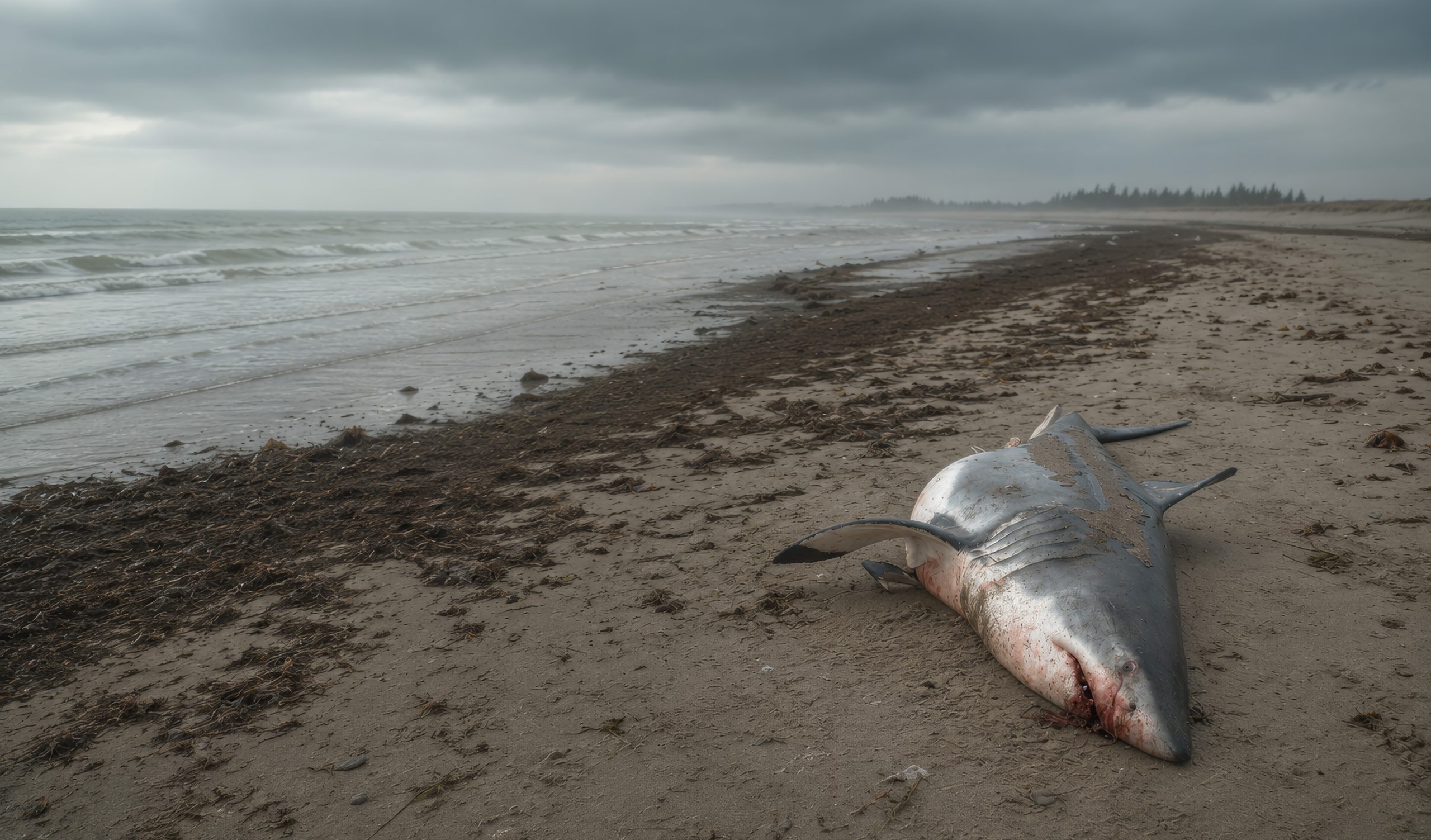
Stranded white shark near Kouchibouguac National Park, New Brunswick
AI-assisted © ORS |. All Rights Reserved
“Fear and apathy bite deeper
than any shark.”
Help protect the sharks
of the St. Lawrence.
— Jeffrey Hay Gallant, ORS
The St. Lawrence Shark Observatory is a registered charity:
Canada Revenue Agency #834462913RR0001
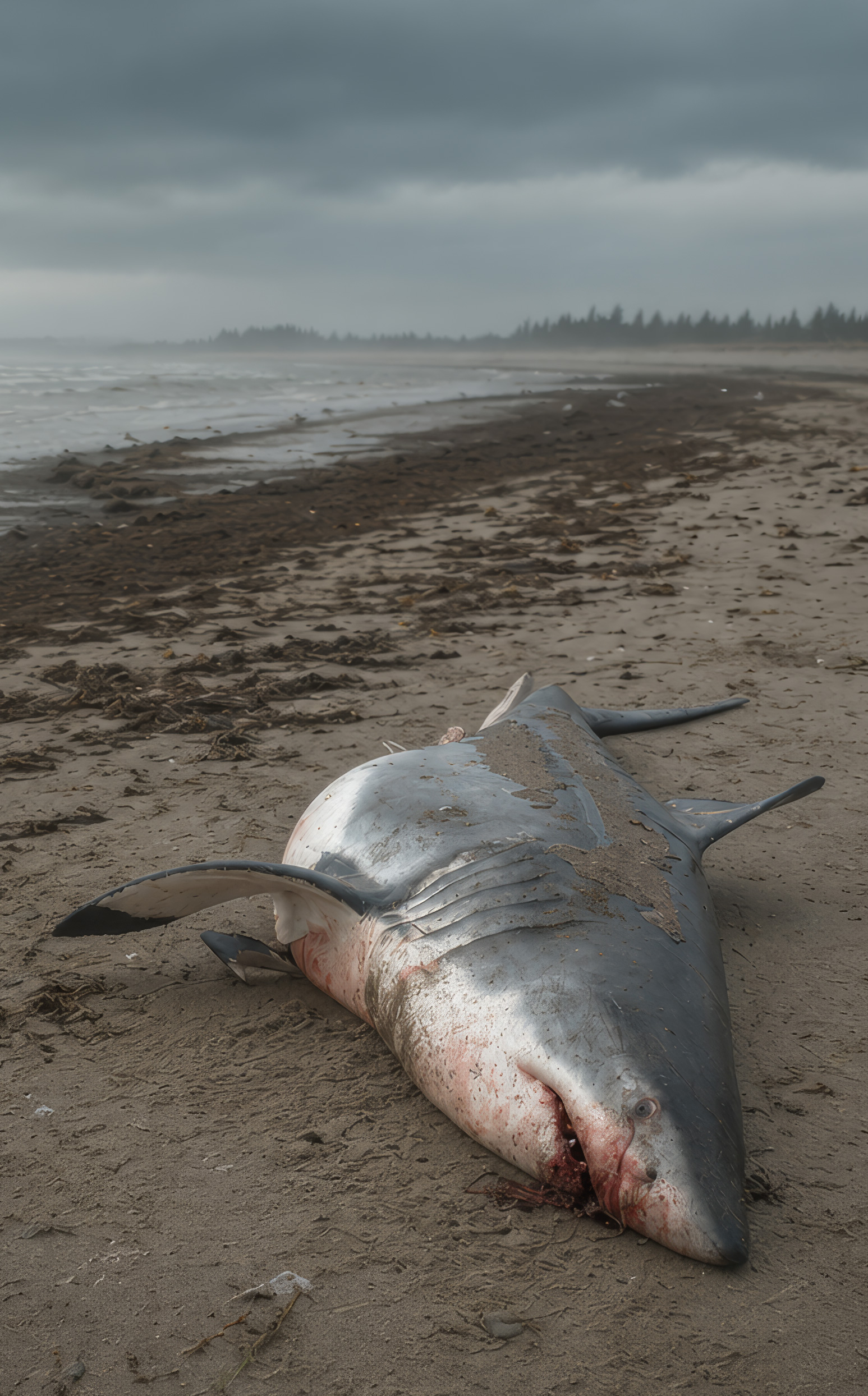
Stranded white shark near Kouchibouguac National Park, New Brunswick
AI-assisted © ORS |. All Rights Reserved
“Fear and apathy
bite deeper
than any shark.”
Help protect the sharks
of the St. Lawrence.
— Jeffrey Hay Gallant, ORS
The St. Lawrence Shark Observatory is a registered charity:
Canada Revenue Agency #834462913RR0001


© 2026 St. Lawrence Shark Observatory. All Rights Reserved.