
© ORS
FAQ

© ORS
The ORS Frequently Asked Questions (FAQ) is a growing reference designed to answer the questions we receive most often from journalists, educators, students, fishers, divers and the general public.
Rather than publishing a large encyclopedia all at once, we are releasing individual answers as they are completed. Each article is based on the best available scientific evidence and is reviewed and updated as new information becomes available.
 COPYRIGHT NOTICE: The text, analyses, and interpretations presented in this FAQ are the intellectual property of the St. Lawrence Shark Observatory (ORS). Many of these articles contain original syntheses and interpretations developed specifically by ORS and are not available elsewhere. Reproduction or republication, in whole or in part, is therefore not permitted without prior written permission. © 2026 St. Lawrence Shark Observatory. All Rights Reserved.
FAQ — WHITE SHARK
FAQ — WHITE SHARK
Why are white sharks becoming more common in the Gulf of St. Lawrence?
LAST UPDATED: 10.08.2026
One of the most frequently asked questions concerns the apparent increase in white shark sightings throughout the Gulf of St. Lawrence and Atlantic Canada. Although no single factor fully explains this trend, the available scientific evidence suggests that several ecological and technological factors are acting together.
Before considering the possible causes, it is important to distinguish between two different phenomena: an increase in the number of sharks that are actually present, and an increase in the number of sharks that are observed and reported. These processes are related but not synonymous.
Modern technology has undoubtedly made white sharks easier to detect than in previous decades. However, improved detection alone is unlikely to explain the magnitude and geographic extent of the recent increase in sightings.
Recovery of the Northwest Atlantic population
The current working hypothesis of the St. Lawrence Shark Observatory (ORS) is that the principal driver of the recent increase in white shark observations is the gradual recovery of the Northwest Atlantic population following decades of legal protection in both Canada and the United States.
According to this hypothesis, as the population recovers, increasing numbers of juvenile and subadult sharks disperse into peripheral parts of the species’ historical range, reducing competition with larger adults while exploiting abundant prey resources. The Gulf of St. Lawrence, where marine mammal populations have recovered substantially in recent decades, appears to provide favourable seasonal foraging habitat.
Although this hypothesis remains to be tested directly, it is consistent with similar range expansions observed in recovering populations of other large marine predators and provides a coherent explanation for the increasing seasonal presence of white sharks in the Gulf of St. Lawrence.
Recovery of marine mammal populations
As white sharks mature, their diet shifts from primarily fish to marine mammals, with grey seals representing one of their principal prey species in Atlantic Canada. Consequently, the recovery of grey seal populations in the Gulf of St. Lawrence has greatly increased the availability of one of the species’ principal prey sources. Harbour seals and harp seals may also contribute to the region’s seasonal prey base.
An abundant and predictable food supply is likely one of the main reasons why increasing numbers of white sharks now use the Gulf during the warmer months.
Environmental change
Changing environmental conditions may also be contributing to the increase in observations. Rather than bringing white sharks into the Gulf for the first time, warming waters may simply be extending the period during which conditions remain suitable.
Whereas white sharks were once reported during a relatively short seasonal window, they are now detected regularly from June through November, and some researchers suspect they may remain in the region even longer. This longer seasonal residency naturally increases the likelihood of encounters and documented observations.
Better detection
Today’s researchers, fishers and recreational boaters possess tools that simply did not exist a generation ago. Satellite-tagging programmes, acoustic telemetry networks, drones, smartphones, social media and citizen science initiatives all contribute to documenting sharks that might previously have gone unnoticed. These technologies have dramatically improved our ability to detect, verify and report white shark occurrences throughout Atlantic Canada and Québec.
A returning predator, not a new arrival
Perhaps the most important point is that the white shark is not a newcomer to the Gulf of St. Lawrence.
Mi’kmaq oral traditions, archaeological discoveries, including ancient white shark teeth, historical fisheries records, explorer and missionary accounts, museum collections, and modern scientific observations all indicate that white sharks have inhabited these waters for centuries, and likely millennia.
The recent increase in sightings therefore reflects the recovery of a native predator, together with our improved ability to document its presence, rather than the arrival of an entirely new species.
Conclusion
Current evidence indicates that the increase in white shark observations is best explained by several interacting factors:
• the recovery of the Northwest Atlantic white shark population;
• the recovery of marine mammal populations, particularly grey seals;
• environmental changes that may extend the period of seasonal occupancy; and
• greatly improved detection and reporting technologies.
No single factor, considered in isolation, adequately explains the phenomenon. Instead, the available evidence points to a combination of ecological recovery and improved observation, resulting in the increasing presence, and increasing visibility, of one of the Gulf of St. Lawrence’s long-standing native predators.
REFERENCES
Peer-reviewed literature
• Allegue, H., Bordeleau, X., Winton, M. V., Skomal, G. B., Joyce, W., Barajas, V. L., Trudel, M., & Bowlby, H. D. (2025). Systematic assessment of the increasing presence of white sharks in Atlantic Canadian waters. Marine Ecology Progress Series, 761, 145–161.
• Curtis, T. H., McCandless, C. T., Carlson, J. K., Skomal, G. B., Kohler, N. E., Natanson, L. J., McElroy, W. D., McCandless, C. T., & Pratt, H. L., Jr. (2014). Seasonal distribution and historic trends in abundance of white sharks (Carcharodon carcharias) in the western North Atlantic Ocean. PLoS ONE, 9(6), e99240.
• Fisheries and Oceans Canada. (2025). Recovery strategy for the white shark (Carcharodon carcharias) in Atlantic Canadian waters. Species at Risk Act Recovery Strategy Series. Fisheries and Oceans Canada.
• Fisheries and Oceans Canada. (2021). COSEWIC assessment and status report on the white shark (Carcharodon carcharias) in Canada. Committee on the Status of Endangered Wildlife in Canada.
• Natanson, L. J., & Skomal, G. B. (2015). Age and growth of the white shark (Carcharodon carcharias) in the western North Atlantic Ocean. Marine and Freshwater Research, 66(5), 387–398.
• Skomal, G. B., Braun, C. D., Chisholm, J. H., & Thorrold, S. R. (2017). Movements of the white shark (Carcharodon carcharias) in the western North Atlantic Ocean. Marine Ecology Progress Series, 580, 231–243.
ORS resources
• St. Lawrence Shark Observatory (ORS). Is climate change responsible for the increase in white sharks? (FAQ)
• St. Lawrence Shark Observatory (ORS). Multiple white sharks pinging in the Gulf: What does it mean? (Media release, 2026)
• St. Lawrence Shark Observatory (ORS). White sharks and the perils of misinformation (Editorial)
• St. Lawrence Shark Observatory (ORS). White shark (Species profile)
The ORS FAQ is being expanded progressively as new articles are completed.
In the meantime, you may find the following resources helpful:

Founder and scientific director of the St. Lawrence Shark Observatory (ORS) and curator of the Canadian Shark Attack Registry. His first encounter with a shark was at Peggy’s Cove, Nova Scotia, in 1975. He co-led Canada’s first shark cage dives in 2000, captured the world’s first footage of a Greenland shark in its natural habitat in 2003, and received the Université du Québec à Trois-Rivières (UQTR) Pythagore Prize in Science and Engineering in 2025.
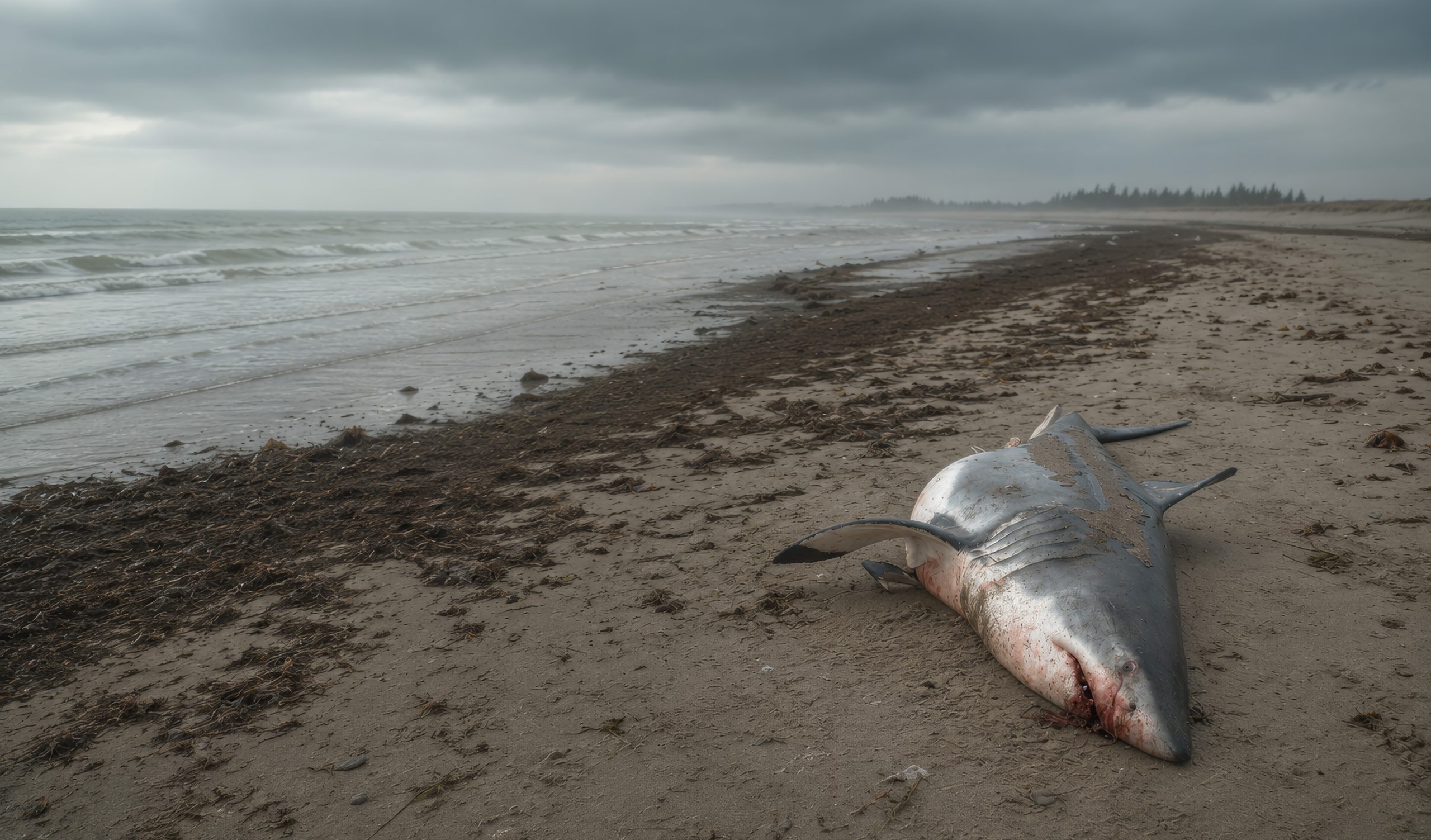
Stranded white shark near Kouchibouguac National Park, New Brunswick
AI-assisted © ORS |. All Rights Reserved
“Fear and apathy bite deeper
than any shark.”
Help protect the sharks
of the St. Lawrence.
— Jeffrey Hay Gallant, ORS
The St. Lawrence Shark Observatory is a registered charity:
Canada Revenue Agency #834462913RR0001
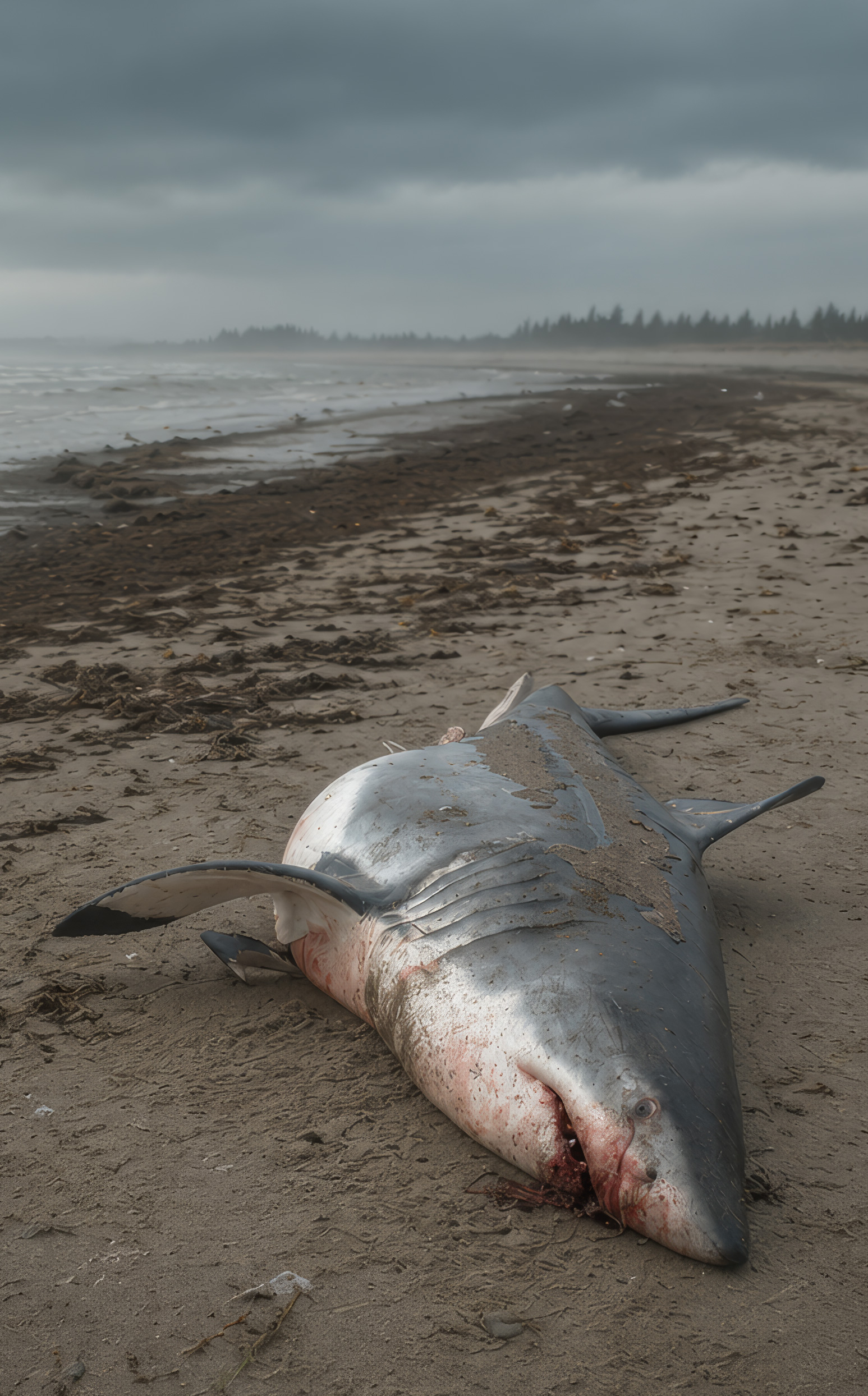
Stranded white shark near Kouchibouguac National Park, New Brunswick
AI-assisted © ORS |. All Rights Reserved
“Fear and apathy
bite deeper
than any shark.”
Help protect the sharks
of the St. Lawrence.
— Jeffrey Hay Gallant, ORS
The St. Lawrence Shark Observatory is a registered charity:
Canada Revenue Agency #834462913RR0001


© 2026 St. Lawrence Shark Observatory. All Rights Reserved.