
© ORS
FAQ

© ORS
The ORS Frequently Asked Questions (FAQ) is a growing reference designed to answer the questions we receive most often from journalists, educators, students, fishers, divers and the general public.
Rather than publishing a large encyclopedia all at once, we are releasing individual answers as they are completed. Each article is based on the best available scientific evidence and is reviewed and updated as new information becomes available.
 COPYRIGHT NOTICE: The text, analyses, and interpretations presented in this FAQ are the intellectual property of the St. Lawrence Shark Observatory (ORS). Many of these articles contain original syntheses and interpretations developed specifically by ORS and are not available elsewhere. Reproduction or republication, in whole or in part, is therefore not permitted without prior written permission. © 2026 St. Lawrence Shark Observatory. All Rights Reserved.
FAQ — WHITE SHARK
FAQ — WHITE SHARK
Is climate change responsible for the increase in white sharks?
Climate change may be influencing the distribution and seasonal movements of white sharks, but there is currently no evidence that it is the primary cause of their increasing presence in the Gulf of St. Lawrence.
LAST UPDATED: 13.08.2026
White sharks are not new to the Gulf of St. Lawrence
White sharks are not a new arrival in Atlantic Canada or Québec. Historical records, archaeological evidence and Indigenous oral histories indicate that the species has been present in the region for centuries, and likely much longer. Because white sharks occurred in Canadian waters long before the recent period of rapid climate warming, climate change cannot by itself explain their presence. Instead, it may influence how frequently sharks are observed, where they occur, and how long they remain each season.
Climate influences movement, not necessarily abundance
White sharks are not a warm-water species expanding into Canada simply because the ocean is getting warmer. They are regionally endothermic predators capable of maintaining parts of their bodies above ambient water temperature and regularly occupy a broad range of thermal conditions.
Tracking studies show that Northwest Atlantic white sharks routinely migrate between subtropical waters and the considerably colder waters of Atlantic Canada. Temperature nevertheless influences their movements and the timing of their seasonal migrations, so changing ocean conditions could affect when sharks arrive, how long they remain, and which areas they use.
The ORS working hypothesis
Although no single factor can fully explain the increase in white shark observations, ORS considers population recovery to be the most likely primary driver. In the ORS working hypothesis, the gradual recovery of the Northwest Atlantic population has allowed increasing numbers of white sharks to reoccupy suitable seasonal habitat within their historical range. As the population expands, increasing competition for food and space may encourage juvenile and subadult sharks to disperse into peripheral but suitable habitats, where abundant prey can be exploited with reduced competition from larger conspecifics. Other factors, including prey availability, climate change, oceanographic variability, and improved reporting, may also influence when and where sharks are observed.
The Gulf of St. Lawrence supports large populations of seals, particularly grey seals, providing a high-energy prey resource for maturing white sharks as they undergo their ontogenetic dietary shift from predominantly fish-based diets to increasing consumption of marine mammals. Consequently, the growing use of Canadian waters is likely to reflect a combination of recovering shark numbers, abundant prey, suitable habitat, and normal seasonal migration rather than a response to temperature alone.
The role of climate change
Climate change could nevertheless modify this pattern. Warming waters can alter marine food webs, prey distributions, oceanographic conditions, and the timing of seasonal migrations. It is therefore reasonable to expect climate-driven changes to further influence the distribution, timing and duration of white shark occupancy in the Gulf. The extent to which these processes contribute to the recent increase in white shark observations in Atlantic Canada, however, remains uncertain and is an active area of scientific research.
Conclusion
For these reasons, ORS considers climate change a potential contributing factor, particularly in determining when and where white sharks occur, but not a sufficient explanation for the long-term increase in white shark observations in Atlantic Canada. The available evidence currently supports the ORS working hypothesis that the gradual recovery of the Northwest Atlantic white shark population, together with abundant prey, suitable seasonal habitat, and natural dispersal, is the principal explanation for this trend.
REFERENCES
Peer-reviewed literature
• Allegue, H., Bordeleau, X., Winton, M. V., Skomal, G. B., Joyce, W., Barajas, V. L., Trudel, M., & Bowlby, H. D. (2025). Systematic assessment of the increasing presence of white sharks in Atlantic Canadian waters. Marine Ecology Progress Series, 761, 145–161.
• Curtis, T. H., McCandless, C. T., Carlson, J. K., et al. (2014). Seasonal distribution and historic trends in abundance of white sharks (Carcharodon carcharias) in the Western North Atlantic Ocean. PLoS ONE, 9(6): e99240.
• COSEWIC. (2021). COSEWIC Assessment and Status Report on the White Shark (Carcharodon carcharias) in Canada.
• Skomal, G. B., Braun, C. D., Chisholm, J. H., & Thorrold, S. R. (2017). Movements of the white shark in the western North Atlantic. Marine Ecology Progress Series, 580, 231–243.
ORS resources
• St. Lawrence Shark Observatory (ORS). Why are white sharks becoming more common in the Gulf of St. Lawrence? (FAQ)
• St. Lawrence Shark Observatory (ORS). Multiple white sharks pinging in the Gulf: what does it mean? (Media release, 2026)
• St. Lawrence Shark Observatory (ORS). White sharks and the perils of misinformation (Editorial)
• St. Lawrence Shark Observatory (ORS). Canadian Shark Attack Registry (CSAR)
• St. Lawrence Shark Observatory (ORS). White shark (Species profile)
The ORS FAQ is being expanded progressively as new articles are completed.
In the meantime, you may find the following resources helpful:

Founder and scientific director of the St. Lawrence Shark Observatory (ORS) and curator of the Canadian Shark Attack Registry. His first encounter with a shark was at Peggy’s Cove, Nova Scotia, in 1975. He co-led Canada’s first shark cage dives in 2000, captured the world’s first footage of a Greenland shark in its natural habitat in 2003, and received the Université du Québec à Trois-Rivières (UQTR) Pythagore Prize in Science and Engineering in 2025.
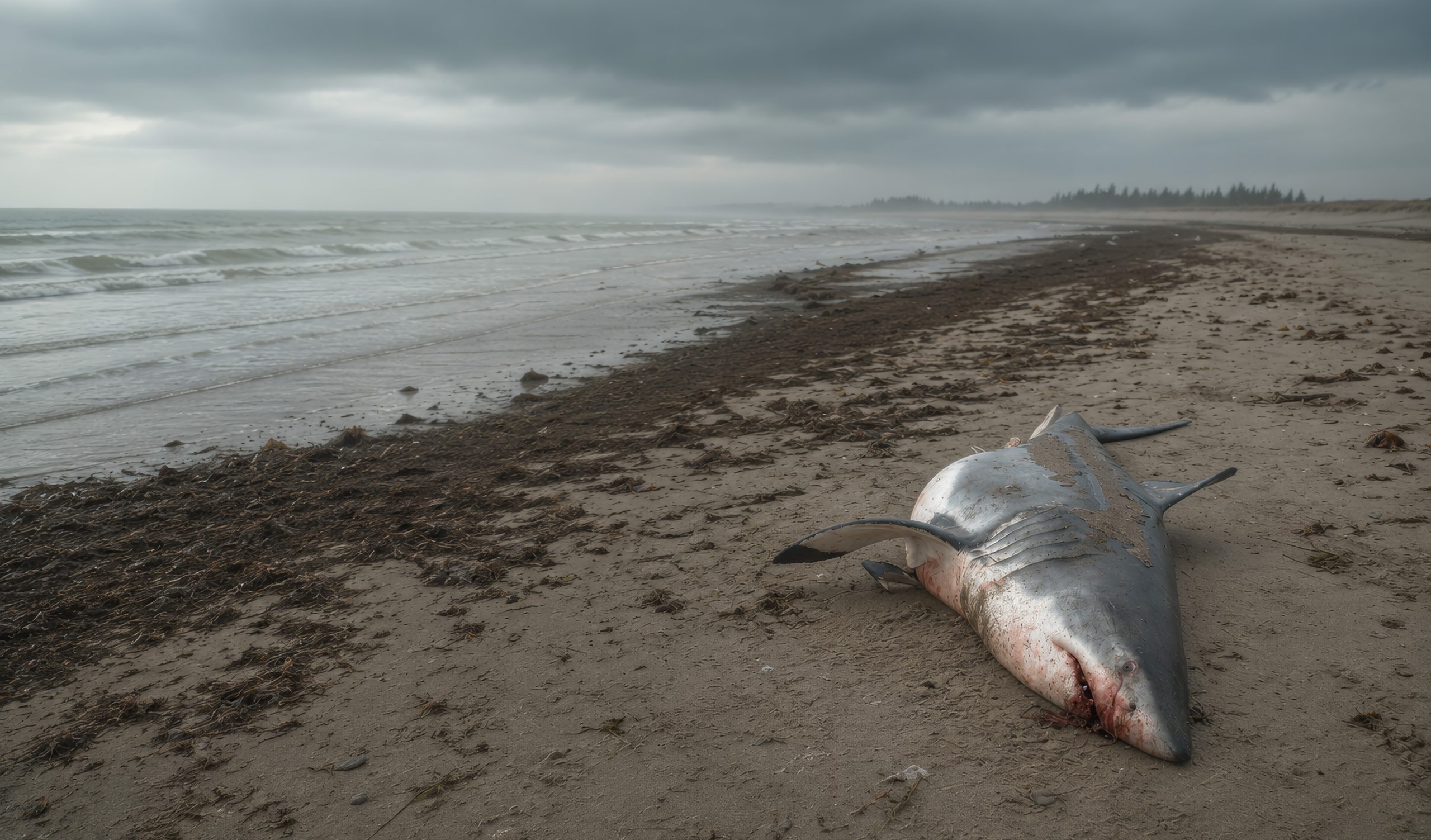
Stranded white shark near Kouchibouguac National Park, New Brunswick
AI-assisted © ORS |. All Rights Reserved
“Fear and apathy bite deeper
than any shark.”
Help protect the sharks
of the St. Lawrence.
— Jeffrey Hay Gallant, ORS
The St. Lawrence Shark Observatory is a registered charity:
Canada Revenue Agency #834462913RR0001
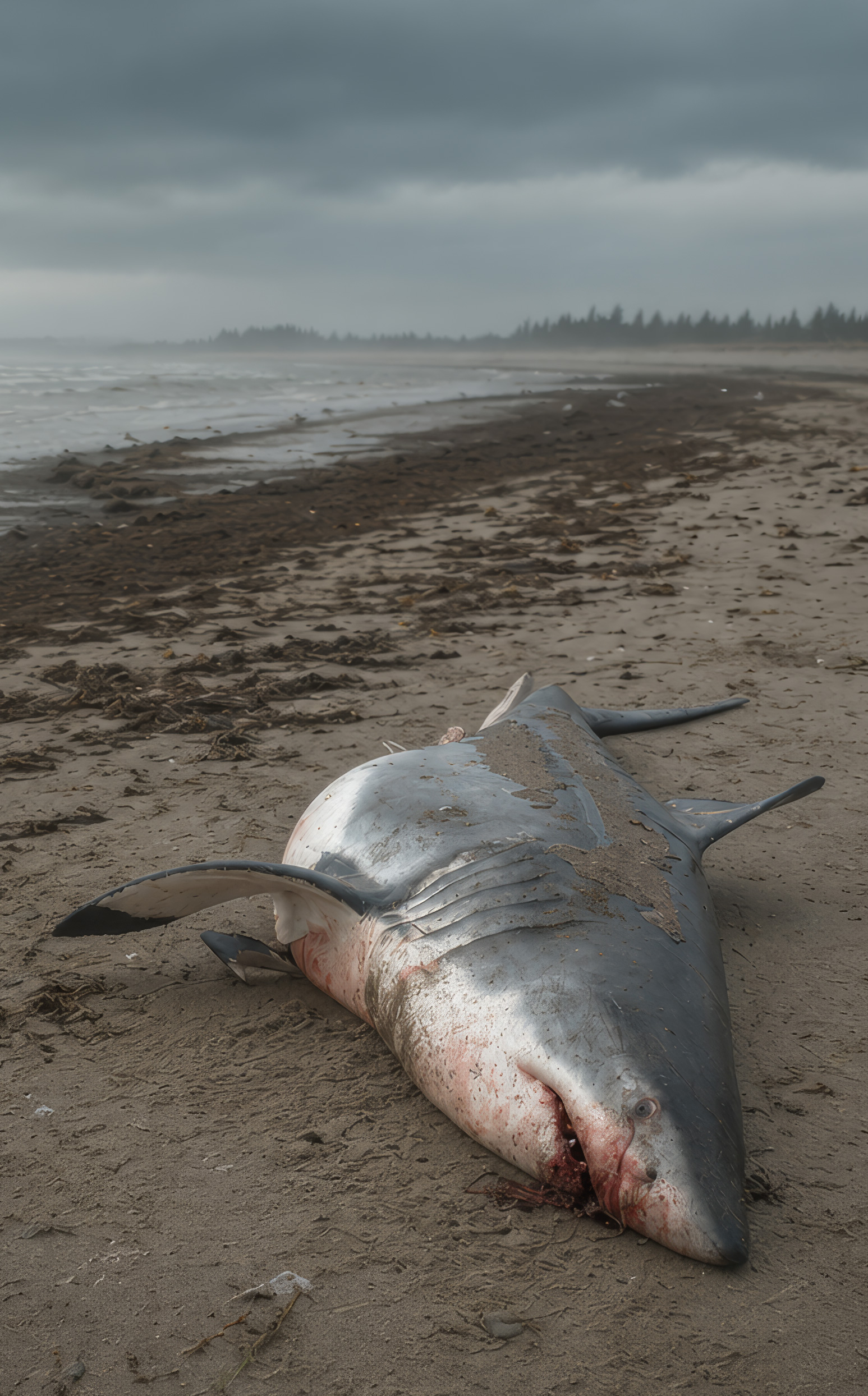
Stranded white shark near Kouchibouguac National Park, New Brunswick
AI-assisted © ORS |. All Rights Reserved
“Fear and apathy
bite deeper
than any shark.”
Help protect the sharks
of the St. Lawrence.
— Jeffrey Hay Gallant, ORS
The St. Lawrence Shark Observatory is a registered charity:
Canada Revenue Agency #834462913RR0001



© 2026 St. Lawrence Shark Observatory. All Rights Reserved.